. . .
After a while Linus becomes worried. He becomes concerned for his brother. He sends out his black dog. The black dog disappears. The black dog reappears. The black dog pants.
The black dog takes Linus’ sleeve in its grutty teeth.
It pulls him down paths that, if you are not the antichrist, you should not walk. You would get your shoes all muddy. You would get dog-slobber on your sleeve. You should not walk them. Those paths are bad.
The dog and Linus arrive by Tom.
Linus sits down next to Tom. Tom is in an empty office building hallway. He has fallen, then pulled himself painfully upright against a wall. He is sweating hard and his eyes have a thousand-yard stare. There aren’t actually a thousand yards between Linus and Tom, so this is awful unsettling for both boys.
“What happened?” says Linus. “What happened? Who did this?”
Tom looks at him.
“It was the cleaning man,” Tom mumbles.
“What?”
“It. Was. The. Cleaning. Man.”
Linus bites his lip. “Damn it, Tom,” he says. “I told you the undertones of your science adventuring were too classist!”
Tom laughs. He can’t help it. It wracks him. “That was my error.”
“Still,” says Linus.
“He swiffed me,” says Tom, swiffedly. “He had a swiffer. He swiffed — oh, God, Linus. He swiffed the parasitic ophidian DNA right out of my genetic code. I’m not inhuman any more! I can’t blink! I can’t smell anything! I keep trying and all that happens is my eyelids close!”
“Calm down, Tom.”
“What am I?” Tom says. He makes a whining noise, deep in his throat. “Oh, God, if I were a girl I would be bearing live young right now.”
“Not right now,” says Linus, hopefully.
“Look at this blood!” says Tom. He shakes his pinkish arm at Linus. “I’m not Tom. What is with this hot blood, Linus? What am I?”
“You’re my brother,” Linus says.
“Ha,” laughs Tom. “Ha ha. Your brother. The antichrist’s brother.”
He lets the tears flow from his eyes.
“I’m human, Linus. Look at me. I can’t even science.”
“You know you’re going to destroy the human plague and warm the earth and bring about a revived civilization of serpent-people,” says Linus, in distress. “Come on now.”
“That future was erased,” says Tom. “Swiffed right out of me. There’s just a hole —”
He laughs again. Then he gives Linus this aching smile.
“Guess I’m off the team, huh?” he says.
And more tears flow.
. . .
“I mean, that’s good, isn’t it?” Tom says, now that he’s human. “Humanity can be my most . . . fabulous . . . adventure . . .”
Linus, who isn’t, straightens. Then he looks around.
Tom clutches at his sleeve.
“You can’t fight him, Linus,” Tom says. “He’ll devour you. He’ll destroy you. You don’t understand. You’re not good enou — evil enou — you’re not good enough. He’d win.”
Linus sets his jaw.
Then an uneasy memory fills him. He looks at the walls around him. He looks at the floor. He remembers a childhood fear.
He rests his hand for a moment on a pristine wall.
“I know you, monster,” he says. He is distracted. He is ignoring Tom. He is walking on an ethereal, exalted mental plane that only an antichrist, thinking about the cleaning man, can walk. (You shouldn’t walk on this plane, by the way. It’s poorly balanced. You might fall off!)
“I know you,” he repeats. “I remember.”
He looks around. His eyes burn.
“You don’t get to do this to him and just walk away, Mr. — Mr. —”
Linus has no idea what his enemy’s name is.
He spits out: “Mr. Clean.”
. . .
“Yes,” says Tom. “Yes, he does. You can’t, Linus. You can’t. I will never forgive you if you go after him and get the Devil cleaned out of you. You can’t. It’s wrong. Don’t you get it? It’s wrong. You can’t let him. You are supposed to be exactly who you are.”
At this the antichrist hesitates.
He picks Tom up. He cradles the human in his arms.
The black dog pants. The black dog whuffles. The black dog leaves its muddy footprints all over the just-cleaned floor.
“Let’s get you home,” says the future Mr. Enemy.
“I won’t be trapped this way forever, will I?” says Tom.
“Of course not,” the antichrist says.
He walks forbidden paths with Tom, whose tears sizzle in the heat.
“Of course not,” agrees Tom, crying Friedman. “I’ll get out of this trap. Six months tops. You’ll see!”
– 5 –
Tom is sick for most of a year. Then he gets better. He finds himself on an uncharted island with his guardian Bertram, who has half a golden face.
“I think I liked writhing in fever and agony better,” says Tom.
“That’s the spirit,” says Bertram bluffly.

. . .
Tom is weak, but he recovers.
“I’d thought I’d cut off half your face,” Bertram says, “and put it over mine. But it turns out I’m almost as bad at being awful as I am at being good.”
“That’s amazing, sir,” says Tom. “You must’ve shot all snake-eyes in the great craps game that is life.”
“Ha,” says Bertram. He shrugs it off. He goes out to stare at the endless surf.
The NHS does not cover hospital bills for recuperation facilities on private islands, even for complications arising from having ophidian DNA unexpectedly swiffed off of one’s genome or having half of a golden face. Eventually the debts become staggering and a coalition of savory health care interests and unsavory criminal bank-lords confiscate Bertram’s island with a mercenary fleet.
“You’re welcome to stay, Tom,” says chief doctor Miriam Clepper, but he shakes his head.
“You’d just run endless experiments on me to better understand the nature of humanity’s ophidian successors,” sighs Tom.
“That’s so,” admits Dr. Clepper. “But we’ve got cake!”
. . .
So Tom and Bertram move to London and become milliners instead. Bertram sniffs wistfully at the mercury and loads Tom’s arms up with various hats.
Tom gives him a hatful glare.
“I do still loathe you,” Tom says, “You know.”
“That’s fine, boy,” Bertram Gulley says.
“I’ll kill you when I’ve got a good chance!”
But he doesn’t.
. . .
It’s not Tom that kills Bertram Gulley. It’s not even complications arising from his golden face. It’s Lucy Souvante, space princess assassin, aka the evil prophet of space.
– 6 –
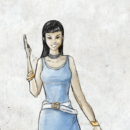
Bertram opens the door. He sees Lucy standing there. He gapes.
“You’re on record,” says Lucy softly, “as being one of my sister’s previous targets. I don’t suppose you know what exactly happened with her death?”
“I don’t know what —”
. . .
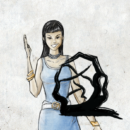
Lucy’s eyes hold a prophecy of damnation. Bertram staggers. He throws his arm in front of his face.
He babbles, “She gave me a slim chance for survival! I took it! We were playing a game!”
He falls down. She advances.
“We too will play a game,” says Lucy Souvante, “then. Rock-paper-scissors. For your life.”
“I —”
She is counting. One, two, three. He throws rock. She throws paper. He looks up from her hand to her face.
“Best two,” he says, “out of three?”
This rules revision does not take place.
. . .
She rips his throat out. He falls, gushing, to the floor.
She looks around his apartment.
She sifts through it.
. . .
Tom opens the door. He comes home. He looks from Bertram to Lucy and he frowns.
“Oh?” she asks. She turns.
He is displaying an extraordinary variety of expressions. Finally he goes and he kneels beside Bertram Gulley’s corpse.
“Ignore that,” she says. “Boy. Let’s play rock-paper-scissors.”
But he shakes his head.
“It’s a fair game,” she says.
Tom is staring into Bertram’s eyes. He is frowning. She walks over. She slaps him. He catches her hand. He flings her over. He lands kneeling on her stomach with one hand on her throat. “I know you,” he says. “We met in the future.”
She pulsates. She diffuses into a black cloud of malice. She blasts him back against the wall.
She holds him there.
She recoalesces. She flips up her umbrella one-handed. She levels its tip at him.
“You were saying?” she says.
Tom’s eyes blaze. For a moment, he is almost a science adventurer again. He sees how to do it. Knee her in the stomach. Take the umbrella. Thumb it to anti-aerated weaponry. Stop her from throwing any rock-paper-scissors moves —
Sponsors
Today's
STRANGE ENCOUNTER ...

Navvy_Rock_noBG
