. . .
Too much of the time it is the latter.
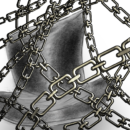
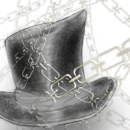
Too much of the time he is as a boy who is drowning, too much of the time the hat is swallowing him, sending him back to the darkness of suffocation, making him weep in fear and his body hunger to cast off the hat, but it is helping him.
Now and then, from time to time, a fire will light in him; Tom will align with Tom; he will align with himself, and the hat will acknowledge it, and in the darkness of one who wears an ill-fitting graveyard hat that slips down occasionally over one’s eyes, there is a momentary flame.
– 9 –
If you feed food then it won’t go bad.
It balances the entropy out!
If you put dead hats on a milliner’s boy — well, that is and it isn’t the same.
– 10 –
There are days when it seems like it is all an illusion.
After a while, Tom takes off the hat. It has not really changed him. The next few attempts do even less.
It is not until he slips while walking in the hat cemetery — plunges suddenly under the surface, falls into a hypersaturated morass and almost drowns there, choking and retching as he flounders until his hand comes up against a sturdy shelf of fedora and hardhat that allows him to scramble back up onto galea firma — that the dream-wroth takes him a second time.
. . .
Back then he needs that.
Back then he requires that moment of absolute fear, that humming airlessness in his limbs and lungs, to awaken him to his purpose. Back then it is only when the ego of Tom Friedman has slipped from him and there is only a fire clinging to its desire to live and, maybe, a bit of a future hat in him longing to be born —
It is only then that he can see it, truly see it, truly understand.
There is a difference, however.
. . .
This second vision is stronger. It is more potent. It is a full fire in him and the hat he makes is better than any hat he had even imagined theretofore. He takes armfuls of . . . pieces . . . home with him and he works to an inspired and sharp-edged design.
It is as if he is cutting the topmost layer from reality as he works, revealing something stranger that lies beneath. The hat that he finishes does not seem quite made of the stuff he built it from; it is more lustrous, warmer, both more splendid and further wrong.
. . .
Mr. Gulley sends a woman by to clean Tom’s house biweekly. The first time she sees the hat she leaves the room; he can hear her in the bathroom.
She is vomiting.
Later, she speaks to him in low, quiet tones; concerned; distressed; unwilling to work for him if such a hat is being worn. He smiles and frowns at her discomfort; he honors her concerns and will lock away the corpse-hat when she comes by for cleaning; but he pays no real attention to her words.
. . .
His guidance counselor, Mr. Loggins, is jovial and condescending. Tom does not even pretend to care.
. . .
It could still be Tom’s imagination even then. It could still be that he has done nothing more than take the stuff of dead hats, cut and fold it into new shapes, and stick it on his head.
Everything else could be the vapors of the hat cemetery and the mercury in his home.
It is ambiguous.
The world equivocates.
Did he pour magic from a bearskin hat into his naked hand, or just rip up some old bits of cloth?
Does he refine himself towards perfection, towards being one thing, towards being a pure thing? Does he tease up the fire of himself, wind it through the magic of a hat, make it a lens for the fire of himself, to straighten and purify his thoughts? Or is he merely full of the hatter-wroth, full of the sickness and the arrogance of those who spend too much time in the company of hats?
. . .
The dream-light in him is the littlest of magic flames. It is no power worth the harnessing. He is no Hans. He is no Eldri. He is not worthy to make a hat to lens the sacred fire. He is only Thomas Friedman. He isn’t even a serpent-boy.
All that was in him, all the magic and destiny and sacrifice that was in him, was barely enough to make that first lump of hat for a lonely mortal, to give him an ugly bit of trash and ruination to wear on his head and share a tiny, elliptical glimpse of the direction of his fate.
Only —
The better the hat he makes, the better the hat he can make.
It is an accelerating phenomenon. It is a self-reinforcing phenomenon. He is as a snake that folds itself into being in the ocean’s deeps. He is like a wolf pulling itself out of a stone. He is like a storm that sees itself and folds itself down into being nithrid or a mannequin articulating into the shape of a living boy.
He is caught up by the future of him. He sees the one path that is his future. In showing itself to him, it hooks him; it drags him down along that path.
. . .
The third time he brings the dream-wroth upon himself.
He starves himself. He thirsts himself. He spends four days, which is at least three and a half days too much, roaming the cemetery of the hats. At the end of it he is delirious; chanting songs that make no sense and giggling at shadows, he tumbles suddenly through into a crisp clarity of vision, works in a fury, and when he has done he has not the faintest idea of what it is that he has done, but it has changed him.
After that he does not need such measures any longer.
After that he does not need to suffocate, or drown, or starve himself. He need only wear the hat to produce that pitch of desperate attention, now woven together with rather than actively preceding the joy and the insight it attends.
And now and again he fears he has doomed himself; that the process of refinement he has chosen will reveal itself to be an endless turning-inwards rather than a looking-out. That he is sealing himself with his particular evolution into the world of his own conceptions rather than opening himself to the great vistas that spread beyond — as if the price of perfecting his vision were that he must wear a blindfold; of perfecting his hearing, that he must fill his ears with a dread black jam; as if the price of unfolding his dreams, to better look upon them, would be to bind them all down and deaden them under the weight of his lifeless hat.
Such concepts, he decides, are futile; he does his best to scrub them out.
. . .
He cannot stop.
Tom cannot stop.
The better the hats he has made, the better the hats he can make. The better the hats he can make, the better the hats he must.
Soon he is something more than human.
Now the dream is always with him, it is always possessing him, it is running through him like the storm.
The seventeenth hat is visibly magic.
It is still a corpse-hat. It is still cold and still and pieces of the dead — but there is more to it than that. There is something in it that would attract the notice of Hans, were Hans alive. There is something that makes crowds part when the orphan Tom walks by.
It is not just the stench.
It is the power.
. . .
“Thomas,” says Mr. Loggins, “you must stop.”
He is a dull and lumpy man. He is not ready for this. He is a school counselor, but he has earned his diploma in school counseling from a scenic diploma mill in the Stropshire Hills.
It has not prepared him for Thomas Friedman and his hats.
Sponsors
Today's
STRANGE ENCOUNTER ...

Icon_Linus_NoBG