. . .
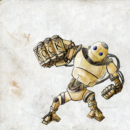
Yet Eldri looks at Navvy Jim and it disturbs him, not because Navvy Jim is aces at playing rock-paper-scissors, but because he loves the game.
Eldri has never before made a robot capable of loving things.
He did not know that this was possible.
. . .
It is shocking enough that Navvy Jim is dedicated. It is shocking enough that Navvy Jim is sincere and earnest in his desire to play rock-paper-scissors; and more, that the robot has shown indications of sensibility, indications of conceptual flexibility, as if Navvy Jim were capable of imagining situations where it could conceivably be correct not to play rock-paper-scissors, or not to win. Once, for instance, when Eldri was puttering around and working on a Candyland-playing robot — the concept being more difficult than it might at first appear — Navvy Jim’s eyes took soft light in the background, and Eldri heard him wonder this:
“If I must kill a man, ought I also to defeat him in the game?”
Eldri expressed concern: “Jim.”
The robot tilted its head. It regarded him. “Tell me, sir; does it make an action moral to win rock-paper-scissors with it, or does it make rock-paper-scissors immoral when the things one does with it are bad?”
“You should not experience such concerns,” Eldri had explained.
. . .
That kind of thing is mind-blowing enough. Amazing, thought Eldri at the time, and every time he’s thought back to that conversation since, because the words ‘rock-paper-scissors immoral’ had left his robot’s metal jaws.
But there is something more amazing, more impossible, more mind-blowing yet, which is to say: Navvy Jim can love.
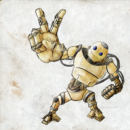
Eldri sees it for the first time in the robot’s eyes when Jim is playing rock-paper-scissors with Emily at the dinner table. It is furtive. It is surreptitious. There is a strict no-gaming rule at the dinner table. It is not until she accidentally bumps her hand on the table from beneath it that he realizes that the two of them are playing at all — he turns his head, he sees the robot standing at the entry: caught brass-handed throwing the most suspicious rock-paper-scissors sign of them all.



. . .
(But the most suspicious legitimate rock-paper-scissors throw is, of course, the scissors.
It is the only sign you cannot really explain away with a clever excuse, even if you are a robot. “I was trying to make a Vulcan peace sign, but — I failed!” simply does not cut it compared to the elegance of rock’s yawning and stretching or paper’s “What? I have a hand!”)
There is Navvy Jim, there, throwing scissors. There is Emily, looking guilty, with one hand under the table — flat and open, he would guess.
And she is looking down, shamefaced, flattening her paper-hand against her knee under the table, but Navvy Jim —
Navvy Jim is grinning fondly. He makes over half that grin to guilt, and he apologizes, but his apology stops at this:
“I am sorry, sir. I couldn’t help it. She’s just so . . .”
He pauses there. He thinks.
. . .
“What is the word for it,” asks Navvy Jim, “when someone makes you happy, and you want to play rock-paper-scissors with them, and keep them safe, and see them smile?”
“Friendship?” says Eldri. “Love?”
“No,” says Navvy Jim. He shakes his head. “I am certain it must be one of scissors, paper, or rock.”
“Rock, then,” says Eldri.
Navvy Jim smiles. He winks at Emily. Then, brazen, in utter defiance of the rules and all household propriety, he lifts his forearm. He brings it down. He counts, quietly.
“You can’t be serious,” says Eldri.
One. . .
Two. . .
. . .
“Aw, man,” sighs Emily, who has thrown “space laser,” and does not know — any more than Navvy Jim would have, if you had asked him — how to decide the score.




. . .
Let’s back up a moment.
The Earth spins, unaware of the fate awaiting it. A swarm of scissors seethes towards it from the distant industrialized and scissors-hurling planet of the wicked god of space.
You shouldn’t throw countless trillions of scissors at another planet! But he’s done.
Their numbers are limitless, by the way. They glitter as they fly.
The pressure of photons against their shiny metal surface causes them to move.
Light drives them along. Glints that pass back and forth between them serve as signals; as coordination; as tools for navigation; as the synapses of its great space-brain. If they have no special medium by which they could step outside their raw physical presence and adjust their course — no inherent power, other than the function of their reflection, to do other than fly along the path that their gravity and their velocity set forth for them — then it is equally fair to say, neither do we:
The great brain of the scissors-swarm, with its sharp malevolence, is exactly as much of a prisoner of physics as is the human soul.
It glints within itself. Within itself it makes choices.
It hones in on the Earth.
. . .
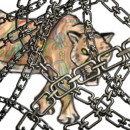
The jaguars that are in a constant decaying orbit around the Earth dive frantically out of the scissors’ path. GPS and military and telephone satellites, less wise and less cursed by ancient Mayan sorcerer-sages, shatter against their blades instead.
“Should we fight them?” wonders Bahlum. “Should we use our jaguar magic against them?”
“I habe a cut on by nose,” mutters the jaguar, Ixchel.
The jaguars are still very tired from the seraph. It is harder than you might imagine to ward off the righteous vengeance of the Lord.
. . .
The scissors-swarm bursts past the jaguars while they are still coming up with excuses not to fight.
“Maybe the humans deserve this,” declares Chan. “Because of all the constitutional amendments against gay marriage!”
“Or even,” offers Yohl — nobody has ever accused magical jaguars in a decaying orbit around the Earth of being a homogeneous sociopolitical entity — “the gay marriage, itself!”
Sponsors
Today's
STRANGE ENCOUNTER ...

Boot
