
– 8 –
“You could die, you know,” cautions a silver snake.
Its paper tongue flicks, and the lightning moves.
“They’ll fall on you,” it says, “and the Earth will shake, and you’ll probably be buried alive.”
It’s a good warning, I think. It’s an important truth. But Emily, she doesn’t mind. She doesn’t heed.
She doesn’t . . . actually . . . know . . . how to understand the words of snakes.
So she just picks it up, and she kisses it, instead, and she gets a paper cut on her upper lip; and she puts it down, and she pats its head.
And she goes off to summon down the sky.

– 9 –
I don’t know why I’m wasting time on that stuff. I mean, I told you. This story isn’t about Emily. This story is about Mr. Enemy.
I just . . .
It’s just, I would like to imagine
that somehow Emily will endure.

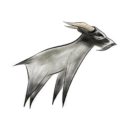
Lamb
“Goats are very dull creatures,” says Jane, in a worldly fashion. “I have entirely outgrown my one-time goat infatuation and now concern myself entirely with more sophisticated animals like lambs.”
She outfits a lamb in a three-piece and a monocle on a golden chain.
Then she runs away!
The lamb traipses through their maisonette like it’s skipping through the flowers. It knocks over a lamp. Then a bowl. Then Martin’s box that holds anything. Martin’s pile of white gold coins spills out.
“I can explain that,” says Martin.
The lamb eyes him snootily through the monocle.
“It’s just money,” Martin says. “Please. Jane doesn’t know. I didn’t hurt anybody.”
Pretty soon Martin is babbling confessions to crimes he didn’t even commit!
“I’m a mob boss!” Martin says. “I had sex with an omelette!”
The lamb has him sweating.
“No, wait! I’m a really sharp goat!”
The lamb traipses off on an adventure to the catacombs under Rome. It becomes involved with hard people, cold people, strange people.
It does not show up in our story again.
“I killed Jimmy Hoffa!” Martin says, in full-on desperation; but he doesn’t even know who that was.

– 1 –
Edmund wakes up. Edmund yawns. Edmund stretches. Edmund wanders off to eat Sid, because he’s hungry.
So Sid shoots him with a death ray.
Go Sid!
– 2 –
Let’s go back a little.
Sid is thinking about the bad milk. It’s expired. He shouldn’t drink it.
. . . or should he?
“Maybe,” says Sid, “I will just drink a little.”
He pours himself a little. Just a little. Then he tastes it. He makes a face. It is quite bad.
“I bet,” he says, “that if I drink it all, the world will be better.”
This won’t make the world better.
“Or at least,” he says, “it’ll fix someone’s life.”
It won’t fix anyone’s life. Unless you . . . I mean, unless you, I mean, right now, unless what you need right now, to have hope for the world, is for Sid to drink a bunch of bad milk. I don’t know why you’d need that. But maybe if you wanted to need that, I mean, so you could?
He’d drink it for you.
He’s drinking it now.
He gets half of it down. Then he’s choking. He’s spluttering. It’s come out his nose. He can’t drink any more for a while.
Then he thinks.
“Maybe,” he says, reasoning with himself, “it’ll have gotten better. It’ll have aged. Like fine wine, or a cheese.”
It hasn’t aged.
Well, that’s technically inaccurate.
“Tonight,” he says, resting his head on the table, “I really, really, really have to win.”
– 3 –
A fly has landed on Sid’s pale finger. He lifts it, gentle and calm, up to his right eye’s eyelashes.
It is going to crawl down onto his eye.
His left side is shuddering continuously but his right side has it under control. His eye has gone full clear, all quivering and awful jelly; he is wroth with the power of his (Torment’s) House.
It is perfect.
At last it is perfect.
It will crawl onto his eye. Maybe it will lay eggs there. And the world will be saved.
It will — if he can just do this.
If he can just get through this part, this last hard part, everything is sure to be fine. Everything will be OK forever. Just let it . . . just . . .
There’s a knock at his door.
He twitches; it flies away; he howls. He beats his head against the table. He freaks out. He can’t stop.
Then he stands up. He walks to the door. He opens it.
“Oh, hi, Emily,” he says. “What bad timing! I was just —”
He waves his hand vaguely.
He waits for her gold eyes to throw him into confusion. He waits to forget what he was doing. But she isn’t goldening him. She isn’t bespelling him, not this time. She isn’t keeping him from exerting the power of his House.
She’s just holding out a basket. She isn’t speaking. The basket’s got a cloth and some cookies inside.
Sid sighs.
He raises an eyebrow at her.
After a while, she reluctantly turns on her speech amplifier. It’s svart-elf technology. It lets her talk without straining. “They’re cookies,” she says.
“I see that,” says Sid.
“They’ll rot your teeth,” she says. “I mean, if you eat enough of them.”
He makes a face at her. She blushes. She looks away.
It’s kind of creepy having her there, but there’s only one of her. You can stand in a creepy point near somebody but it doesn’t give the whole effect of the Keepers’ House.
“I don’t know why you’d think I’d eat your cookies for that reason,” says Sid. “Dental hygiene is extremely important. I am a good person, Emily.”
She just shrugs, forcibly hands him the basket, and she goes away.
He closes the door. He drops the basket by the door and he starts shuddering. He doesn’t want those cookies.
Maybe later, when they’re stale, and more crumbly, and less sweet.

– 4 –
BOOM
Edmund’s form dissolves. He is howling. His form pales, rips itself away from reality, gelatinizes for a moment, crisp edge around a translucent core —
But Death is small and the wolf is large.
Death may not have Fenris’ Edmund Gulley.
Edmund’s form stabilizes and it resumes its strength. He bats the gun away, he drags Sid to the floor against the edge of Sid’s bed, he is howling; he gapes his maw, he opens it to devour the boy in a single bite, and confusion surges over him in a wave.
He stares at Sid. He cannot figure out how to fit the whole Sid in his mouth at once. Sid appears to be larger than his mouth. He cannot even figure out how to bite a little piece off.
Edmund works his mouth. He rubs puzzledly at his forehead. He tries to remember theorems of geometry.
Edmund can’t remember theorems of geometry!
This is a particular weakness of wolves.
His back crawls. For a moment he thinks it’s a spider and he almost drops Sid to flutter it frantically away, but then he realizes.
“You,” he says.
Them.
There’s the whispering of clothing behind him. Edmund puts Sid down carefully. He turns. He looks at them.
Them, in their yellow hats.
“What are you doing?” he says. “Why would you stop me? Why? Look at him!”
He’s almost crying.
“Look at him.”
Sid pulls himself up to his feet. He shoots a glance at them. At Fred. At Emily. At Paul. Emily can’t meet his eyes.
“Thanks,” says Sid. “That was a close one! I almost got eaten by that white-eyed boy.”
His voice is amazingly even.
“Come on,” says Edmund.
“You’re not supposed to be in my room,” says Sid.
Edmund hits him. The sound is horrible in the silence.
Then Sid shrugs. He goes over to the closet. He gets his outing coat. He slips past the boys and girls in their yellow hats. His feet crunching, he goes out.
“You can’t do this,” says Edmund. “Why would you save him?”
They don’t have answers.
“He is hurting,” Edmund says. “He is in such awful chains. He is hurting. Let me free him. You can’t pin me down like this. I’m Edmund Gulley. I’ll have you all expelled.”
He can almost hear them talking. Almost. It’s like watching birds through a camera and knowing that they’re twittering amongst themselves.
“I can make this stop,” Edmund pleads.
“Hell with this,” says Emily.
The others’ attention turns from him with a snap. It’s like being pressed to the ground under a giant, heavy metal plate that someone has suddenly removed, or like having a bunch of people standing in a creepy semicircle staring at you suddenly turn away and stare at one of their own instead.
Which is, in fact, what they’ve just done.
“What?” Emily says. She makes faces at them. “What? Hell with this. Hell with everything! I can’t do this any more. Better he did eat him. What are we fighting for? What are we fighting for, life bought with this?”
She is still making faces at them. They are utterly quiet.
“Don’t look at me like that.”
Edmund moves.
She squeaks as he comes at her. She focuses on him. Her eyes flash with fear, regret, remorse, and gold. But she is just a moment too late.
The others are turning on him again. But they are just a moment too late as well.
He shatters her with his eyes.
He knocks her down. He leaps past her out the door. He turns. He glares.
They try to hold, but they do not hold. Before his glare, they scatter; they dissipate; they dissolve into the hallways of the Lethal Magnet School for Wayward Youth like gusts of wind. They leave Emily there, on the floor, clawing feebly for her hat, and they do not stop Edmund as he chases after Sid.
Sid turns at the end of a hallway. He sees Edmund coming up from behind him.
He punches through a glass case on the wall beside him.
He takes out a fire axe.
Edmund is a blur.
Sid looks at the axe for a moment. He seems mildly confused. He swallows. He leans his tongue out towards the blade.
You shouldn’t do this, by the way. The first thing to do is to take the glass bits out of your hand. Then, without licking the fire axe, use it to defend yourself from the attacking Edmund-beast!
I mean, obviously, it’s possible that if you just lick the axe in circumstances like that you will get a pony; or everything will end in a beautiful, happy ending; or you will become a magical, inescapable Prince.
But this probably isn’t what would actually happen.
Sid doesn’t quite manage to lick the axe, either way. It is knocked from his hand and he is knocked back and his eyes follow it and there is an overpowering sense of loss in them; and then —
White.
It surges. It fills his field of view.
Edmund’s hunger drowns out Sid’s vision. His heart catches in his throat. His mouth and his nose go dry. He is still moving, he thinks, he may even still be fighting, but he cannot see.
He cannot hear.
He cannot taste.
He wonders if he is dead now. He wonders if Edmund has killed him; if this is what it means to be eaten by the House of Hunger, that one falls forever in the great hungry white.
He wonders if the world still exists, without him.
He wonders what it would actually mean, to be alive.
And in that nothingness he reaches for himself and he cannot find himself. He is suddenly dual, the Sid that is and the Sid that is seen. He reaches for the self that accepted the burden of Torment; the self willing to be like that, live like that, that something beautiful, something amazing could be born.
That the world could live just more day, even.
It is gone.
Edmund has ripped it out of him. He’s devoured it.
Sid remembers his name. It’s Sid Sidwell. He is crying and covered in wounds. Wounds, and ripped clothes, and two unhappy spiders.
The burden of Torment is gone.
It has left him alone.
It is as if a clear full-body cast has been stripped from him, and now his body is free to bend, to curl, to reject the world, to become small.
And he still thinks, —
It occurs to him after a while that he still thinks what he was doing was for the best. He could still do it. He could still —
He looks at the axe. He licks his lips. He could still be the sacrifice the world requires —
Only, he can’t.
He’s not strong enough. He doesn’t even —
He admits this to himself. He is ashamed of it, but he doesn’t even want to be strong enough again. He doesn’t want to go back to that.
Oh, God.
What he wants is for the pain to stop.
He can feel the world beginning to crack.
His head is pounding. He can barely breathe. So he scrawls out a pentagram in his blood on the floor. He marks the edges of it with runes. With a will that has become so much as iron that the dizziness barely touches him, he summons up half a thing to clean him and to tend his wounds and brush away the spiders, and to carry him off to the infirmary where he can rest.
As for the other half, he doesn’t know.
– 5 –
I don’t know why Sid survived, by the way. Edmund never explained that to anyone.
Maybe it was a sign that Edmund was getting better. Stronger. More in control of it. That he was made more a god of freedom and less of a ravening beast.
Maybe it was a weird, perverse self-denial. Like, he wanted to eat Sid, and therefore did not.
Or maybe he just ate the worst part first, and when he was finished, he found that he couldn’t stomach eating anything more.
– 1 –
Protestors pin a complaint to Martin’s door. It alleges that he is an excessively sharp goat.
“You yell one wild self-accusation,” Martin mutters.
But he can’t keep a little smile from his face.
To think it! Him! Martin! A goat!
He crumbles the protest note. He tosses it in the garbage. Unfortunately Jane frequently reads and/or eats things found in the garbage. A dispute arises.
“I am no longer even sure what a goat and what isn’t is,” Jane says.
“They’re like,” Martin says, and he gestures vaguely. “They’re like goat impersonators, only less so.”
“Bah!” says Jane, dismissively.
“You use a stone,” Martin says. “Right?”
He holds a stone to his forehead. He impersonates a duck.
(It’s a stone of impersonating farmyard animals.)
“And that’s a goat,” Jane says.
“That’s a duck!” Martin says, reverting. “But a comparatively goat-like one.”
“I am going to go empty the contents of a troll’s stomach,” says Jane. “Unless that’s not even a real troll.”
“They’re a real troll!”
“I bet this isn’t even Ipswich,” says Jane, sulkily, and storms out.
After a while Martin puts the stone on his forehead again. He impersonates an excessively sharp goat. He wanders around the apartment, bleating and cutting things.
It isn’t addictive. Not really.
He can stop it any time that he’d like!
– 2 –
Edmund stops by Linus’ room. Linus is rocking back and forth on his bed, staring at a mural of a fireplace — with a burnt-down fire — scrawled at the other end.
Edmund looks him up and down. He sighs.
“Come on,” Edmund says. “Let’s get a drink.”
Linus looks up.
He smiles at Edmund. Then his smile fades. Then he smiles again. He stands up, creakily. He hasn’t left his room in a little while. He rubs his nose. He washes his hair with a puff of antichrist magic. It doesn’t make him smell better, but it does make him smell less unwashed.
Then he gets his coat.
Neither of them bother mentioning that the other looks practically the worst they’ve ever seen them. It’s not because they’re awkward talking about stuff like that, although they are. It’s just —
They don’t want to face the idea that other people are hurting as badly as themselves, and they don’t want to deny it either, not in dear friends.
So they just walk, in their pale hats.
After a while they start stealthing, instead, moving like shadows in the night. They reach the bar. They stand hidden, lurking, opposite the doorway of the Lethal Magnet School for Wayward Youth school bar.
“How do you want to play this?” Linus asks.
“I don’t want to be carded,” says Edmund. “I don’t want to go to any trouble. I just want to sit with you and have a drink.”
“Right,” says Linus.
His white dog appears. It flows off around the corner. They follow it. They walk forbidden paths. They are cold paths. They lead through icy lands. The two of them emerge at a table where two drinks and a bottle are already set.
The white dog pants.
The glasses clink, and it is gone.
“To enemies,” says Linus.
Edmund looks at him. He shakes his head. “To friends.”
“Aw,” says Linus.
They sit there for a while. They drink. Edmund finally says, “I ate a guy. And . . . some other guys. And some corpses.”
“Ha,” says Linus.
“Ha?”
“I hear you,” Linus says.
He looks at his reflection in his booze. I don’t know what kind it is. I’m not really very good with alcohol. It’s some kind of amber-colored Lethal Magnet booze that they should absolutely under no circumstances ever sell to the children, but are nevertheless obligated to stock.
“Have you —”
Have you ever slipped up, Linus? And killed and eaten someone?
Linus shakes his head.
“Really?”
“I always see Tom,” he says. “Like, he’s grabbing me, and he’s shaking me, and he’s saying, ‘You never. You don’t ever, you little snot.’”
“Oh,” says Edmund.
“So I don’t eat them. Because I don’t have to. Only,” says Linus, who will become Mr. Enemy, “eventually, I suppose I will. Or the Devil’ll get me. Or I’ll do my own bad things. That has to happen, you know, because we’re living in a world.”
“Yeah,” says Edmund.
“I shouldn’t have left,” Linus says.
“What?”
“I shouldn’t have left. I should have found him. I should have fought him then.”
“. . . the cleaning man?”
“Yeah.”
“Tom was dying, man.”
“I should have stayed, and found him, and we could have fought.”
“Tom was dying.”
“I could have —”
“He’d swiffed the ophidian DNA off of Tom’s genome, Linus,” Edmund says. “He was dying.”
“I get it!” Linus says.
They’re quiet for a bit.
“You’re not strong enough,” says Edmund, “anyway. You’re just Linus. You need to, you know, grow up and stuff.”
“I got a B- in Hand Weapons,” says Linus. “That’s passing.”
“Well,” says Edmund. “You weren’t strong enough, anyway. You’d have just wound up in some kind of institution for antichrists.”
“I know,” says Linus.
They’re quiet for a while. Edmund gives him an apologetic look. Linus swirls his drink.
“That place is fucking lonely,” he says.
“I heard that Ce—” Edmund starts, about to refer to the rumor about antichrist Cecilia, but;
“You heard wrong,” says Linus. “She’s not the antichrist. She’s just rich and kind of spoiled. They had to let her go.”
“Oh.”
“Heh,” says Linus. “And you?”
“I’m going to break Fenris out,” says Edmund. “I’m going to break him out. And then, I’m going to throw myself down in front of him. And he’s going to eat me. And he’ll eat me, and it’ll all be just and fair and good.”
Linus closes his eyes.
He inhales. He exhales.
“Is that how it works?” he says.
“It’s what’s going to happen,” says Edmund.
He swallows.
Then he looks at Linus. “What would you do,” he says, softly, “if I could free you?”
“From?”
“The House of Hunger,” says Edmund. “The white hat. If you could just be Linus again. If I could eat the hat out of you. If I could eat the pale white and leave you as you were before.”
“What?”
“I’m learning how,” says Edmund. “I can do it. I can rip it out of you. I can free you. From me. I don’t want you hatted into my story, Linus. You don’t have to be part of this. You can just be . . . Linus.”
“Until the Devil rips out my heart and soul and lives in my body,” Linus points out.
“That might not ever happen,” says Edmund. “I mean, what if it never actually happens? Or what if it’s not for a while?”
Linus’ dog appears. It pants.
It drops a grenade into Linus’ hand. Linus pulls the pin. Linus swallows the hand grenade.
A waitress blinks and the dog disappears.
“You can live your life,” says Edmund, who is not paying that much attention. “An ordinary life, you know? Until it happens. A real life, until it happens. I want that. I want — I don’t want to take you down with me into the pale dark.”
Linus considers.
“What would I do,” he asks, “if you could do that? You asked?”
“Yeah.”
“I’d fill a grenade with holy water,” Linus says. “And then I’d swallow it.”
“What?”
Edmund retroactively parses recent visual information. Linus’ hand is blistered. Oh God, thinks Edmund, the bomb —
“I figure,” says Linus, “if I lose the wolf-hunger; the wolf-throat and the wolf-gut — then it’ll go off. And it’ll kill me. Makes sense, right? If you unwind me from you, rip off my hat, and exile me from the House of Hunger.”
“That’s —”
“And then I can be free of you,” Linus says, “And cut out from your story, and also, dead.”
Edmund stares at him.
“You can kick out Bernard,” says Linus casually. “You can kick out Lucy. You can kick out all of them, Edmund. But not me.”
“But you — but we —”
Edmund stares at Linus.
“What am I feeling?” he asks Linus, helplessly. “I can’t tell. My heart is wrapped in stone.”
“Heh,” says Linus.
He leans back. He stares at the ceiling.
“From the moment I put the hat on,” Linus says, “I knew you’d been right. From the beginning, that you’d been right. They shouldn’t have pent up that wolf like that. That was bad. What the svart-elves did to that wolf of yours, they’re bad.”
“He’s a world-eating wolf,” Edmund says, reflexively taking the role of Devil’s advocate.
“I dunno,” Linus agrees.
He shrugs.
“I’ve been a lot of things,” Linus says. “You know? But I’m really only one thing now. I am just your friend.”
“Are you?”
“And the cleaning man’s enemy,” concedes Linus. “I’m your friend and I’m his enemy.”
“His enemy.”
“And Tom’s brother,” says Linus, who will be Mr. Enemy someday. “And maybe the antichrist. I think I might still be the antichrist. I’m trying to still be the antichrist. It’s so goddamn hard.”
“That’s four things,” says Edmund.
“And Jane’s friend,” says Linus. “Whatever happened to her?”
“Five things,” says Edmund.
“Five hypostases,” concedes Linus, “but only one genus of ousia.”
“I have no idea what you just said,” says Edmund.
“Get drunker,” the antichrist suggests.
– 3 –
Lucy stares down a goat.
She shakes her fist at it, one, two, three.
This goat is better than the other goats she has played rock-paper-scissors against. It has dissipated itself into a cloud of roses and mist.
This goat has known better than to stand there and face the evil prophet of space’s rock-paper-scissors game head-on.
It has not trained for nine hundred years in the martial arts, becoming gradually more human and more powerful, for nothing.
Lucy throws paper. There is nothing there.
There is no goat. There is no goat, rock, scissors, or rival paper. She looks around.
An evil feeling!
It is behind her. It is charging her.
She skates away from it, even though there’s no ice on the ground to skate on. She hurls out her palm. An aegis of evil prophecy crawls along her hand. It stuns the goat. It paralyzes its thought processes. The goat hurtles past her and crashes into a nearby bridge.
She shakes her fist. One, two, —
The bridge troll has ravened upwards. It has seized the goat in its awful maw. It is biting down on the goat with an terrible crunching. It snaps the goat’s spine in two.
Lucy’s face falls.
She is stricken.
The troll gulps down the goat. It looks around for human witnesses. Then — as all trolls do, when at last they have defeated their enemies — it begins to shift and shimmer down into the shape of a goat itself.
Lucy brushes back her hair. She twitches her mouth in horror.
Then she says, with venom in her voice, “That was my opponent.”
Three, paper, she counts, which is totally cheating.
There is a searing moment of space-wroth. There is a hollow, despairing roil of chaos and the void. The ex-troll, the new-goat, is drawn inwards by a void that ripples into being in its center. Its skin flutters with it. It stares at her for a moment in utmost dismay. Then the polarity of the rippling reverses; it gasps, bleats a desperate warning to all goat-kind, which shall go —
I strongly suspect —
Unheeded, and it explodes into a rain of meat and blood and goat-bits that tumbles down over a good deal of Essex and of Kent.
Sponsors
Today's
STRANGE ENCOUNTER ...

Boot
