– 14 –
Edmund and Andrea dance.
They dance — that time, and others; they dance until Edmund is utterly exhausted, after the patterns of a nithrid’s ways.
“What are you?” he asks.
The quad goes dark when they are at practice. The clouds roll in and deepest night occupies even what would have been the brightest day. In that thick darkness are veins of darting color, purple, yellow, and white, as the eye tracks the lightning that is the nithrid’s dance.
Edmund tries.
He really does.
It is already the fourth session, now, and he is still half-choking with exhaustion, his own saliva, and chunks of heavy air by the fifteenth minute of the dance. He can’t even hold out long enough to get a good cardiovascular workout out of the experience. He’s too lost. Too staggering. Too inept.
He spins to a halt, tripping over an old stone fountain that he’d forgotten was there, and the nithrid slams into him. She isn’t sure why. Some combination of “to remind him that there is nithrid also moving on this track,” “humor,” and “because she does not decide not to slam into him before the fait is accompli.”
“Gah,” he says.
He sprawls there in the fading dark, bloody, with a nithrid on his back. She doesn’t bother getting all the way back up. She just sits.
“This is like wrestling with the wolf,” he says, and laughs.
She stands. She walks away a little bit. “The problem you are having,” she says, “is that you are not hacking the fundamental laws of the universe with your footsteps.”
“I’m not very good at that,” Edmund admits.
He rolls over and sits up.
“I could try eating the light or something,” he says, “but I didn’t want to get all cute in the first month.”
“Eating the light.”
She stares at him, then shrugs.
“No,” she says. “Don’t do that.”
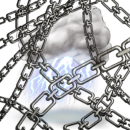
She floats a few feet to the right. Her foot comes down. Where it touches the earth smokes; dark gathers; a numinous pall clouds the air. She sights a metal pole; she arcs to it: she leaves a trail of violet behind.
She catches her breath around a spear of pain all through her chest, swallows it down long enough to say: “Like thus.” before she must rest instead of speaking.
“Please remember,” he says, “that I am not actually a nithrid.”
“I know,” she says. “But —”
She ponders.
“You look at yourself,” explains the nithrid. “And you see yourself. You see the magic in yourself. And it wasn’t magic before, of course. It was only a thing before. Before you looked at it, it was only that which had happened: marvelous and physical but not magical or intrinsically affecting at all. Only, then you look. You look, and your own sight of it weaves it into magic. You become able to do what before you only inspired to do. Thus: nithrid. Does that make sense?”
She twists, a single writhing, convoluted motion that takes her four feet into the air; makes her form appear to dissolve into caryatids intertwining, bowing towards the center, incandescent, before the frog eggs and the whisked duck and the rainbow glimmers that enchain her snap her back.
“Like so,” she says.
“I cannot see myself doing that,” Edmund admits.
He squints at her.
“Nobody sees me doing that,” he says. “You don’t even see me doing that.”
“Is that so?” she wonders, distractedly. “Hm. That may be a thing.”
She arcs to the water of the fountain. She sits beside him. She is beginning to bleed from the edges of her mouth and eyes.
“It hadn’t occurred to me,” she says, “but I suppose I don’t see you people as storms. That’s so. I’d thought that that might just be because I’m outside you? But you are rough, gross and physical by nature, and all bound up to wolf and gold.”
“I am that,” Edmund agrees.
“It would be easier,” she says, “if you were naturally electric. If you were the Easter bunny, or something like.”
“Energizer,” says Edmund, with surprising insight.
“The energizer bunny,” she corrects herself. “But — you are not hopeless. It is not that bad. There is a potential in you to be a breaker of chains. A killer. A devourer. A wielder of the lightning. It is a dim and distant potential. It is drowning in your gross mortal fleshiness and the constriction of your pet wolf’s fetters but in you I see something golden, conductive. It is buried but it is there. So see it yourself, Edmund Junior. See it harder. Empower it with your eyes.”
“I can’t see it,” he says softly. “It’s your perception.”
She hesitates.
Then she waves a hand dismissively. “Just look harder,” she says. “It’s there.”
“Maybe,” says Edmund, “I wasn’t meant to — I mean, maybe I’m supposed to look at the magic that’s actually in me, and not . . . like, your nithrid-style stuff.”
She looks at him blankly.
“I mean,” he says. “Maybe I’m not supposed to be hacking the world with my feet. Wolves are supposed to pad quietly and not with great crescendos of thunder. We’re not like, you know, cats or —”
Edmund remembers that most cats do not clank.
“I mean, like kettles, or the like.”
“I am not your father,” she says, “or your faculty advisor. Please feel free to try this, if you like.”
“Right, then,” he says.
He concentrates. People walking by think about bothering him, but don’t. He looks inwards. He faces himself, as in a mirror. He tries to recognize the magic in him: the wolf; the storm. After a while he shrugs.
“I have nothing.”
“It is all right,” she says. “Two human eyes are clouded.”
“No. I mean, inside me,” says Edmund. He holds out his hand. He closes it on air, twists it, snaps it open and closed a few times as if grasping at something that he cannot feel. “Inside me, there is a yawning white nothing. I think it is the wolf. I think it is the thing that calls the wolf, the thing that frees the wolf, the white hunger that is in the wolf. It is a devour-some emptiness. It eats the eyes of the mind I use to look at it with.”
“Huh,” she says.
“You’re bleeding,” he says. He tilts his head. He looks at her.
“Please,” she says, waving it off, “finish your discussion. I have now become interested in this nothing.”
“But you’re bleeding.”
“I pushed too hard,” she says.
He squints.
“The cage of my bones is lined with knives,” she says. She touches her cheekbones. She touches her breastbone, then runs her hand down in front of her chest to indicate the ribs. “If I am too vast, too fierce, too quick, then they will cut me when I breathe.”
His face twitches.
“It is of no account,” she says. “I am a nithrid, that has been caught by Hans. I would rather focus my attention on whether you have actually seen something worth seeing, and therefore worth stirring into a storm with your inner eyes.”
He isn’t listening.
She waves a hand in front of his face. He isn’t looking.
She says something. He does not hear it. She says other things. He does not hear them. She shakes his shoulder. She pushes him. She becomes angry. She pushes harder but he does not feel it. He does not react.
He pours it all down, down, down, into the box around his heart instead, until the world is humming, empty, barely present around him; and even still he must fight back the pain.
It’s not about her. He wishes it were just about her. He doesn’t even really like her.
It’s not about her.
What is hurting him now is the same gnawing emptiness he’d mentioned, only seen from the other side. It is the same knowledge that gripped Linus Evans, once, when he felt Hans’ death and knew the cleaning man would rise; the same that gripped poor Betty’s mother when she saw the turtle-people come.
He is hurting because he has acquired a fuzzy, awful awareness of the sea of hurt and wrongness that is suffusing the mortal world.
Finally he lets himself hear her.
He says, “I’m sorry. I can’t help you. I can’t help anybody.”
“. . . I was not asking for your assistance,” she tells him. “I was teaching you. . . .”
She stares at him blankly.
He is distant. He is mahogany, balsa wood, and teak. He will accept it.
“Of course you didn’t,” he says.
He gets up.
He can feel it, behind him. She is breathing. With each breath she is cut. He can feel it, inside him. The wolf is hurting. The fetter cuts into it. And somewhere in the world Linus Evans, who was his friend, is still alone, and suffering, and the antichrist; and Tom, he thinks, must be off in some hospital somewhere recovering from being ophidian; and Jane and Mouser doubtless wandering the streets eating out of the trash bins; and everything is wrong, wrong, wrong, and awful, and there is no brightness in it; it is rising like a storm of pain and horror in him, and he bumps into someone, barely even manages to make himself look up and apologize, o how wayward I have become —
“Linus?” he says.
“Bro!” says Linus.
“Oh my G— my— my— oh my sweet, euphemistical goodness,” says Edmund, dropping the rage and pain from him like a backpack that he’s just shrugged off. “Linus?”
He hugs Linus. He pounds his back. “How the hell have you been?”
– 15 –
Peter stops by Andrea’s room. He knocks. He waits. After a while she comes down the hall.
“I’m not in there,” she tells him.
Gamely, he tries, “Are you certain? We could check.”
“That is —”
She hesitates. She looks at him. “That is attempting to be clever, to one who has known the greatest of dwarf-smiths.”
“Well, yes,” says Peter.
She opens the door. She goes in. She nods sideways and he follows.
“Why,” she says, flatly, looking around and spotting herself, “so I am.”
Technically he could get in trouble for being in her room but the penalties for being wayward at the Lethal Magnet School for Wayward Youth are markedly lax.
She turns her attention from her own presence to his. “Did you need something, Peter?”
“There’s a dance,” he says, bluntly.
“I’m aware,” she says.
He goes a little still. “Are you?”
“It’s my nature,” she says.
“I don’t understand,” he says.
“As a dance student,” she says. “It is my nature to be aware of the fact that there are dances. I see the flyers on the wall; I think: aha! And I file the information in my mind.”
“I thought it might be that other thing,” he says.
She doesn’t bother lying about it, nor does she confess. She just looks at him with her pupils slit like a cat’s.
“I was just thinking,” he says, bluffly, moving on, and rubbing the back of his head, “that since you’re an alien freak and all, that you might not have anybody to dance with.”
“With,” she says.
“Yes,” he says. “Like, I mean, a boy.”
She stares at him in complete bafflement.
“You know.” He puts one hand in the air, and the other hand lower in the air, and mimes turning. He cannot quite manage a quarter-rotation before embarrassment stops him from proceeding further. “Like that.”
She scratches above one ear. “How extraordinary,” she says. “I had assumed that my teacher was merely joking.”
“You’re making fun of me,” Peter says. “I won’t have it. I’m a human, you know, not like . . .”
He trails off, because he can tell from her reaction that she wasn’t making fun of him.
“You really . . .” He laughs a little. “You really . . . no way.”
She blushes. She looks off. “It’s not funny,” she says.
“Dang right it’s not,” he says. “That’s awful, is what it is.”
“What?”
He sprawls on her bed. She almost objects, because he hasn’t taken his shoes off, but then she ignores it. “You freaks are all so lonely,” he says.
“There’s more of us? Of me, I mean? Of . . . I don’t know what grammatical case to use,” she says.
“I knew the Devil when I was a kid,” says Peter. “Had to punch him in the nose to get him to go away. I always felt bad about that, after.”
“What?”
“I thought, maybe he comes around, temptin’ everybody like that, because he doesn’t have any other way to talk to people. But now I’m sure.”
He sits up.
“There’s a wolf-boy,” Peter says, “too. Guy couldn’t be any stiffer if you shoved a triad of trissors up his butt. Er, if you’ll pardon my saying so.”
“Edmund,” says the nithrid. “He is not like me.”
“Could have fooled me,” says Peter.
“He is useless,” says Andrea, bitterly. “I am trying to teach him transcendence, but how can I? There is nothing to transcend.”
Peter swings around. He sits up. He looks at her.
“Him?” he says. “Oh, you shouldn’t.”
“What?”
“He’s too tight-wound already,” says Peter. “You push him and you’ll split him in half.”
“He’s not splitting,” says the nithrid. “He’s just . . . lumping there.”
“Look,” says Peter. “Kid thinks he’s a milksop who ought to grow harder. But he’s not. He’s a born rotter, that one, trying to hang on to the gentle way. You give him too much rope, he’ll just tie it to a tree and hang himself. Stands to reason.”
Her eyes search his face. “You’re joking,” she says.
“No,” he says.
“I need him,” she says. The chains through her hurt her as she breathes. Her ghost-duck glowers. “He will burst my chains. I will go out, alive and free and blasting about the world. I will shatter its cities. I will fill them up with the anima of God. They will look at me, and him, and we shall storm and marvel; we shall fill them with wonder at our glory; we will light the souls of the survivors and make them great.”
“Yeah, yeah,” he says. “Kill, destroy, get admiring looks, oh how marvelous! Whatever. If you just do — whatever — then you won’t be alone, right?”
“What?”
“You all think that,” he says. “If you just — break your chains. Kill people. Tempt people. Eat people. Wolf stuff. Devil stuff. Whatever. If you just do that, then everybody will love you. That’s how the Devil thought, too, you know. That it wasn’t him, or me, that stood between us. That it was God, or mebbe Hans. That it’s all that easy, you just do what you want and everybody will love you and it won’t actually be bad.”
“Stop it,” she says.
“You know,” says Peter. “You people don’t have a right to be on our world. Doing what you like, spreading fear and devastation — you’re just —”
“Stop it.”
He stops.
He looks down at his hands for a while. She paces back and forth. Then he looks up.
“So,” he says, “I was wondering, if you wanted to dance. With me. At the dance. But obviously I was —”
“Fine!” she says.
“Huh?”
“Fine,” she says. “Get out. I’ll dance with you. Go!”
“You don’t have to,” he says, as he backs out of the room. “I’ve just served you two big steaming platefuls of truth, you can —”
“Get out!” she yells, and throws a shoe at his back and it dissolves into lightning as it touches him and he convulses and the back of his uniform smokes and he falls painfully against the wall as she slams the door behind him.
A few other doors are open now. A few girls are peering out and looking at him.
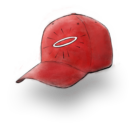
“And then there’s that hat guy,” Peter says vaguely. “I bet that hat’s one of them, too. I bet that the hat needs people.”
He gives the floor monitor an awkward shrug and he walks away.
– 16 –
“I,” Linus explains proudly, “am now a student at the Lethal Magnet Academy for Wayward Youth.”
“You? Wayward?”
“I know,” says Linus. He brushes imaginary crumbs off of his waistcoat. “But the truth is, I need an education.”
“Can’t you just,” and Edmund makes a vaguely magical gesture.
“Watch,” Linus says.
Linus’ black dog appears. It pants. It attempts to instruct them in geometry. It fails.
Edmund blinks and it’s gone again.
“I see,” Edmund says, because he does.
“Ever since Tom,” says Linus. He hesitates. Then he smiles a little. “Well, it struck me. I mean, what if someone cleans the Devil out of me someday? Don’t I need to be ready for an ordinary life? What if I wind up wanting — you know — kids, marriage, a career, all that stuff?”
“Dang,” says Edmund. “Being shuffled through an endless series of foster homes has done you some serious good, man.”
“Ha ha,” laughs Linus.
It should be embarrassed laughter. Edmund clearly thinks that Linus has been doing something normal and proper and civilized, like shuffling through a series of increasingly baroque and terrifying foster homes, when in fact he’s been living in a bloody box —
But it’s not embarrassed laughter. It should be, but it isn’t. Edmund’s here. He’s found Edmund.
The laugh’s just joy.
“Let’s go get a drink,” Edmund says.
“Pardon?”
“There’s a bar!” Edmund says. “They’re not allowed to serve us, but we’re totally allowed to steal drinks. I mean, ‘allowed.’”
“Edmund,” says Linus in a tone of pleased shock.
“Or coffee?”
Edmund spots Peter across the way. He waves vigorously. “Oi! Peter!”
Peter squints at them. He comes over.
He stares rudely at Linus.
“This is my mate Linus,” says Edmund. He beams. “Him and me, we used to hang all the fucking time. Fought Venusians and stuff.”
“Oh,” says Peter, in sudden fury, “so that’s how it is, is it?”
“What?” says Linus.
Linus draws back a bit from Peter’s glare. He blushes.
“Just, spit, spot, off and he’s making some other kid the antichrist? Is that all I was to him?”
“What?”
Linus Evans, it must be admitted, was the Devil’s second choice.
“Listen,” says Peter. He juts his chin. “You can just tell him that I don’t care. I didn’t want the job. That’s why I punched him! I am only in this to smoosh scissors.”
“Tell who?” Linus says, bewildered.
“Oh, yeah,” Edmund remembers. “Peter knows the Devil too.”
“Bloody bastard thinks I care,” says Peter. “Well, I don’t care! He can run around doing his Devil stuff with whomever he wants! I’m a good, church-fearing Christian. Going. Church-going. Dang it. Fudge.”
He snorts, turns his head away from Linus, and he stomps off.
“I guess,” says Linus, scratching his ear, “that he doesn’t care about the Devil.”
“Come on,” Edmund says.
There are ornamental statuary angels scattered through the Lethal Magnet School’s grounds. They are much like ordinary statuary angels but they are branded Lethal and have this look in their eyes like if there were any wolves there, they’d want to kill them.
Peter is kicking one of them, hard, over and over again, in the leg.
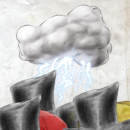
– 17 –
For a while Linus’ presence makes Edmund happy; but that happiness frays from him over time.
Each time Edmund sees the nithrid he is reminded of the blood.
Each time he sees — practically anybody that isn’t Linus — he’s reminded of the fact that eating people is considered contrary to the cornerstone principles of decorum, even at the Lethal Magnet School for Wayward Youth. And yet he’d like to. He really . . . kind of . . . would.
Each time he goes to bed, in his furless bed, in his bed that does not breathe, that is not warm, or, well, not warmer than a normal bed, at any rate, he is reminded that he is alone and far from his wolf, for all that the wolf is in his blood, is in his bones, is something that trickles through him every moment when he breathes.
He can’t take it any longer.
He begins to brood. He begins to listen to Linus’ poetry and it speaks to him. He begins to wander aimlessly through the foggy nights.
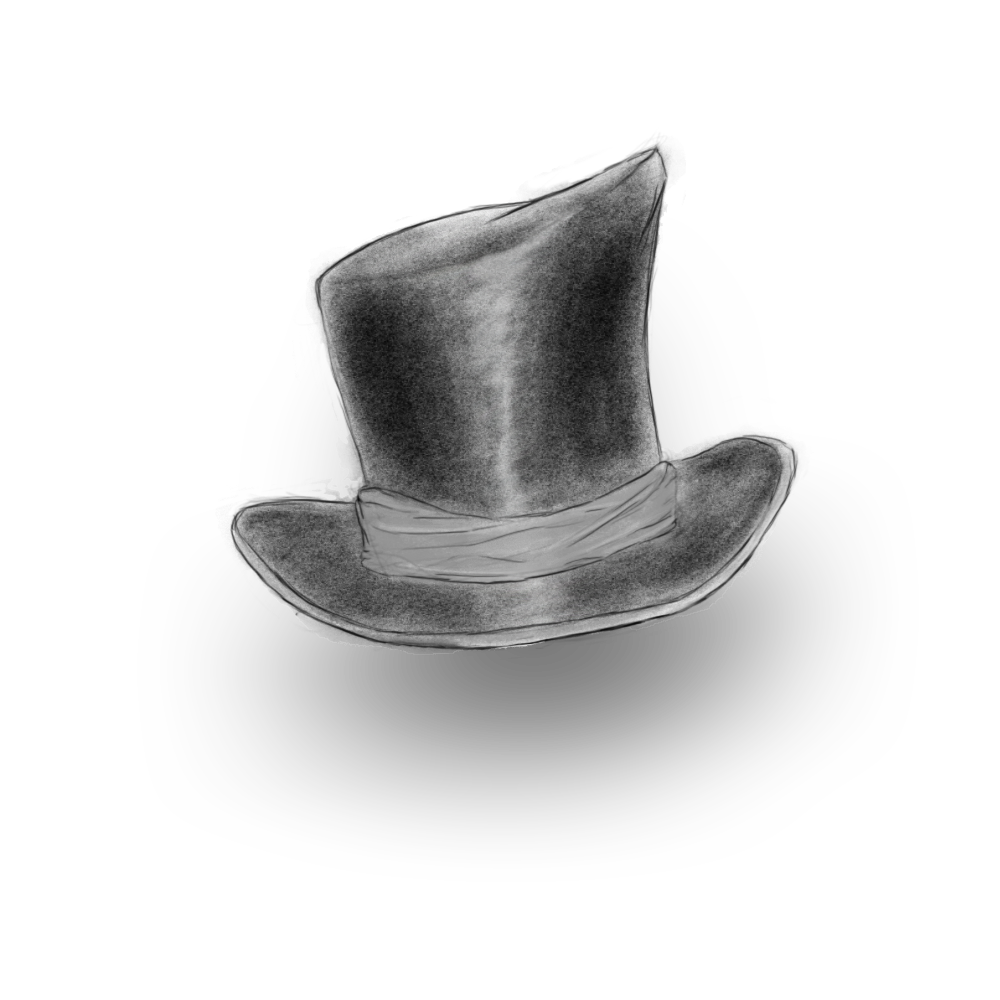
He goes to that promontory of the hat cemetery that curls through Brentwood to the edge of the Lethal Magnet School and he climbs up and he throws down his hat as an offering, stomps it thrice, and lopes up to sit on a high peak of dead, abandoned hats and sulk.
Much to his surprise, he is not alone.
“Oh,” says Tom.
He looks Edmund up and down. He tilts his head to one side.
“Why do dwarves have to tie up everything good and marvelous in chains that hurt them?” Edmund says.
“It is a mystery,” agrees Tom.
He looks up at the sky. His eyes glint with dream-light. One day some child on a distant world will look back down at their sky; will catch a glimpse of Thomas’ dream-wroth; and its alien heart will move.
That is countless millennia from now.
That is not today.
“I’d say,” says Tom, “that when we encounter an alien purpose, a thing that moves but not in the way that we expect it to move, that has a dream that is its dream and not our dream, that it is natural to want to tame it to our own ideas. To simplify it, to bind it down into that which aligns with ourselves, and that which is our enemy, so that there is no expression of its being that is not in those terms that are our own.”
“That isn’t an answer,” says Edmund.
“Hm,” says Tom.
He takes down his hat. He holds it in his hands. He plays with the rim of it. “Sometimes I think I am my own worst enemy,” he says.
“Yeah,” says Edmund. He looks at his hands. Sometimes he wants to bite his fingers off, gently, chew them, swallow them, feel the warmth of Edmund in his gut. Sometimes he wants to bite off his own head. He gets so hungry.
Then he does a double-take, because the hat’s come off.
“Tom?”
“Huh?” says Tom. He waves a hand vaguely. “Yes. That is my name. Thomas the First, if you like, or Tom Friedman. I am the head boy of the House of Dreams —”
“Dude,” says Edmund.
“And if you are torn,” says Tom. “If you are at war within yourself, or unfocused; if you are given to two destinies, or to no destiny at all —”
It percolates, like svart-drink flowing through the ill-named and ill-omened coffee-makers of the House of Dreams. He realizes.
“Edmund?”
He is crying. Why is he crying? He can’t imagine it. He’s Thomas I, of the House of Dreams. He is basically a god. Also, a science adventurer. But he can’t help it. He is laughing and he is crying.
“Linus is here too, man,” says Edmund. “Oh, God. This is so awesome.”
“Linus?” says Tom. “Linus? I looked, man. I thought the Devil’d taken him.”
“He was being shuffled through a series of increasingly baroque and terrifying foster homes, as is traditional in our beloved, post-cisorian twenty-first century England, Tom! But now, he’s here!”
“How is he?”
“He’s great,” says Edmund. “He’s great. He is sneaking into a nunnery even as we speak.”
Tom squints at him.
“Fine,” says Edmund, “it’s a school trip to Leominster. But it totally counts.”
Tom laughs.
After a while, he wipes his eyes. He blows his nose. He smiles.
“Wow,” he says.
He flops down on the hill. He leans back. He looks up at the stars.
“Wow,” Edmund agrees. “You’d think there’d be some kind of spiritual radiation that’d keep him out, but apparently that’s only if he forgets to bring his chicken blood.”
“Ah,” sighs Tom, reminiscing.
After a while he says, “I was going to offer you my hat. Why was I going to offer you my hat?”
“I — don’t know?” says Edmund.
“There were dwarves,” says Tom.
“What?”
“You were saying something about dwarves and rot. Only, I wasn’t paying the least bit of attention.”
“We were conversing!”
Tom smiles apologetically. “That’s my marvelous auto-conversation ability,” he says. “I was totally thinking about dead mice.”
“Ha,” says Edmund.
He leans back too. He sketches in the sky with a finger. It doesn’t take, although maybe — after all his lessons — there’s a little tiny bit of violet light that follows it. Maybe. It’s ambiguous.
“Do you always give your hat to people when you start thinking about mice?” he says.
“Only you, Ed. Only you. Seriously, what’s up?”
“There’s a girl,” Edmund says.
“O ho,” says Tom. “You sly dog.”
“What? No!”
Tom giggles.
“Sorry,” he says. “I have just always wanted to call you a sly dog.”
Edmund cracks up. Then he tells Tom, “That is by no means funny, you know.”
“I know.”
“I have a wolf bound through me and in me,” says Edmund. “I want to eat you. I mean, right now. I mean, the kind of eating that leaves you dead.”
“Sup dog,” Tom offers.
Edmund winces.
“Tom,” he says. “Seriously.”
Tom sticks his tongue out. “You cannot eat me, Edmund. I am a science adventurer. I would just subdue you — with science! Besides, your girl is unlikely to approve. She would look at you and the slaver and the bits of Tom you have on your mouth and say, ‘Eek! You cannibal! This relationship is over!’ I trust you to avoid such eventualities as that.”
“Bah,” says Edmund. “I’ll just tell her I was saving the world from ophidian planet-inheritors.”
Tom’s smile flickers. It goes out. Then it comes back on a bit.
“Perhaps,” he says.
“She isn’t really a girlfriend, anyway,” says Edmund. “She isn’t into that kind of thing. She’s more of a —”
He waves his hand around.
“Candidate Doom Team member, if you know what I mean.”
“Oh.”
“I do want to free them,” says Edmund. “I want to let them go.”
He’s sitting up now. He’s grinding his fingers in the hats. He’s trying to find something, some way, to let his emotions out, but there’s nothing, he can’t, there isn’t, all he can do is vigorously massage dead hats.
“They’re so hurt,” Edmund says.
“If you want,” says Tom, “I can give you something —”
“Yeah?”
Tom has stopped. He is silent for a while. “Pardon. I am just wondering if my marvelous auto-conversation ability has led me out onto a conversational branch which, now that I am paying attention to it, I should retreat from. This is a transparently bad idea. But —”
“But?”
Tom smiles. “But it is through exhaustive implementation of our bad ideas that we discover at last the good ones. If you want to let ‘them’ go. If you want to become something that can let them go. Wolves that eat the world. Whatever? I can help you.”
“Really,” says Edmund flatly.
“I can’t predict what’ll happen,” says Tom. “Maybe that’s not even really who you are, you know? Maybe deep down you’re not a wolf-boy but a proper science adventurer. Or even some kind of holy saint! But —”
He shakes his head, vigorously.
“No matter. I can give you purpose, Ed. And I can make you more.”
“You can help me,” says Edmund. He licks his lips. He looks at Tom and his eyes catch the light of the drifting moon. “You can help me free Fenris?”
“Aren’t you supposed to do that anyway?”
Edmund’s voice has gone to begging: “Can you help me?”
In his head is the memory of the nithrid breathing, and the blood dripping from her mouth, and his conception of the spikes; and Fenris’ horrid wounds —
“Yeah,” says Tom.
Tom tosses him the hat.
Edmund looks it over. He turns it upside down and right-side up. Then, with a shrug, he puts it on.
He flails backwards.
Edmund seizes there magnificently upon that hill of hats; he flutters like a kite in a gale-wind. He tries to tear the hat from his head; he screams; his eyes roll back and his hands twitch and his fingernails sharpen and grow long.
It is pounding through him. He cannot think.
His mind keeps glancing off of the walls of the hat’s structure in him like a dazed man staggering into walls of polished marble, granite, slate. They are slick, the eyes of his mind are confounded, he cannot focus on the things that obstruct his thoughts because no sooner does he see them than his attention chases its own reflection in great slick streams into his hidden thoughts. His mind bruises itself from within; flails; he tastes bird’s spit, four simian arms, and what he can only imagine to be the torment of the willing, the clanking footfalls of some cat, the bearing witness to the wrongness, and the perseverance of hope.
Hope tastes, in case you’ve ever wondered, like a hat.
Lacerations spread around Edmund’s four limbs. He is cut, he is scarred, he is ripped and mended in a moment. Chalk-white flecks, pale veining, and bits of silver spread from the whites of his eyes into the iris and the black.
The white wolf-gold that is wound through him and around him is pulled shockingly straight and tight against his soul; it is snapped out from both directions like a cord pulled suddenly into a knot; his own soul frays. The hunger in him explodes; it alloys with him, within him, and through him, until there is no part of him that is not whole and sound and rife with the hunger’s rancid touch.
He is made starved in a world of chains.
The kether-hat floats from his head and he scrambles in the graveyard until he finds a hat of pale white to match his soul.
He rests there, for a moment, on his hands and knees in the hat cemetery. His head hangs low with its white cap on.
Tom picks up his hat. He stares at Edmund thoughtfully.
“I’d hoped you’d be in Dreams,” he says. “But Dreams wears a night-hat. What are you? What name is given to your House?”
An intuition moves in him.
“Hunger?”
“Tom,” says Edmund. His voice is weak.
“Yeah?”
“Can you do me a favor, Tom? Please?”
“Anything,” Tom says.
He tries to take in a sharp breath of pain and stops. Edmund’s hand is in Tom’s lungs. It’s pulling out a handful of . . . stuff. Edmund’s shoving Tom down onto the hats. Tom’s heart beats rapidly. He can’t think. He can’t breathe. He is drowning in the stench of hats.
His body is heavy.
“Can I kill and eat you, Tom?” Edmund clarifies, just in case Tom will live long enough to confirm or retract his broadly stated answer. Edmund slurps the bite from his hand, drops onto Tom, and prepares to rip out Tom’s neck with a snap of his jaws.
A dream-wroth falls onto Tom instead.
Tom ducks aside. He rolls. He staggers.
He shudders out a mental command to his robot bees. They swarm out from their hiding places in Tom’s backpack and the little nest in his hat. As Tom holds the crowning hat to his head and rolls away, the bees pour over Edmund and distract him from his prey.
Black blindness threatens to drown Tom’s vision.
He digs an ampule out of his pants pocket. Edmund is snarling, screaming. Tom jams the ampule into his own arm.
He watches Edmund clawing at the bees, then runs.
Ten seconds. He guesses that he has ten seconds; and —
The bees are gone. His life is gone. He is —
Tom glances back.
Edmund’s head is moving like a squirrel or dog preparing for a jump. Tom charts things. He sees a hope. He moves, he runs, his head is down, he can’t breathe any more, his heart is stopping —
Edmund leaps. He lands a foot from Tom, intending to press his attack, but he doesn’t.
He is standing, to his surprise, on a patch of quickfelt, the most hazardous of haberbogs, an Edmund-devouring morass of hypersaturated hats.
He sinks.
“I’m dead,” whispers Tom. “I’m dead.”
He is still walking.
“I should be dead by now.”
He cannot understand how he is still walking. Science cannot explain it. This makes him weep and then go into denial.
He is alive not because of the ampule, or because of some hardiness in his body, but because of an alien vitality. It pours down into him from the sky; from the world; from the crown of his wicked hat.
– 1 –
It’s a week or two earlier.
Lucy attends an underground fighting tournament.
There are rings and rings of people fighting down below. There are at least four battles going at any given time. It’s dark and the area is tented like a circus.
She squints down.
She pokes the girl sitting beside her.
“You,” she says. She waves her underground fighting playbill. “Human girl. Tell me of Sid and Max.”
Emily glances at her.
Lucy suddenly flashes on an old Vulcan salute. She flares her nostrils. She looks away.
“Nevermind,” she says.
“Ha ha!” says Emily. She sing-songs, “Max has a fan-girl.”
The evil prophet of space kills her —
Wait, no.
That’s a pretty sweet viper palm, admittedly, but it goes through where Emily’s neck had just been and not through Emily’s actual neck. Emily is on the floor, having just kicked out the metal support from under Lucy’s chair. The evil prophet of space tumbles forward and lands awkwardly over the shoulder of Meredith, who was sitting in front of them.
“Club represent!” says Meredith, pumping a fist.
Lucy hisses and thinks about killing her, but because Meredith is in the Konami Thunder Dance club she does not. Instead she awkwardly rights herself.
“I’m Emily,” Emily says. She is holding out a flat hand. Lucy stares at it, waiting for it to writhe with some sort of aegis of evil prophecy, or possibly stupid-Vulcan-salute-girl cooties, but it doesn’t. So finally, resentfully, she shakes hands.
“Lucy,” sulks Lucy.
“Oh! The new girl.”
“I am not —”
Lucy sighs.
“I am here to watch Max’s fight.”
“Too late,” says Emily. “You just missed — just kidding sit down.”
Lucy eyes her. Then, showing off, she snaps her fingers and restores her chair to solidity with the power of the wicked god of space.

– 2 –
Edmund and Peter weave through the audience.
“It’s good,” Peter says.
He’s using his ninja skills to balance three buckets of popcorn as they scramble to their seats.
“It’s good,” Peter says. “It’ll make a man of you, this place will.”
“I ate a death ray once,” Edmund says.
Peter shrugs eloquently.
They sit.
“Also, we’re in the audience.”
Peter ducks forward as a throwing axe smashes into his seat. He smashes it through the back of his seat into the person behind him with his head.
Edmund waves off a snake someone has thrown in his direction.
“It’s an audience participation thing,” Peter says. He hands Edmund a bucket of popcorn.
There are rings and rings of people fighting down below. There are at least four battles going at any given time. It’s dark and the area is tented like a circus.
“Oh, man,” Peter says. He points vaguely. “There’s Sid.”
“Sid?”
Sid is squaring off against Max. They’re in the summoners’ circle. That’s where the summoners fight.
“Know your wimps!” says Peter. He spits to the side. “He’s the worst-ranked kid in your class. Cosmic whipping boy, that one is, but no, he’s gotta think of himself as a winner.”
“He looks like he’s got potential,” Edmund says.
“That’s just his summon,” Peter dismisses.
Sid’s scraped out a summoning circle in the dirt of the summoners’ circle. This always sounds redundant when he’s talking about it to people but it doesn’t feel redundant at all when he is fighting for his life.
Light glitters upwards from his circle.
He cries out, INTIMATION!
That’s the best summon he can manage right now. It’s an intimation that he might one day summon something better.
The ninjutsu fight from a different ring storms out through the audience. Two of Peter’s classmates are a stuttering, tumbling blur of weaponry, clashing, vanishing into ninja-space for a step or two and reappearing in a spinning bundle out over the audience’s chairs. Emily starts up from her seat, then settles back into it; she’s too far away to do anything —
There’s a scream as one of the prophesy students takes a nunchaku to the eye.
Meanwhile, Max stomps the ground with his summoning stick. It’s like a regular stick, but at the bottom it has the reversed imprint of a summoning circle on it. It saves time.
“HAND PUPPETS!” Max shouts, and tosses aside the stick.
He summons two hand puppets. They resemble sea monsters. They fit neatly over his hands.
Sid launches himself at Max, wreathed in the intimation that one day he might summon something that will totally show Max what for. Max stops him with one sea-monstered hand held firmly against his head.
“Oh, that’s a good show,” says Peter.
He snatches a napkin — well, a headband — from the tumbling ninjas as they go past and he wipes his mouth. “See, you lose points if you touch your enemy directly, but Max’s summon lets him put his hand on Sid’s forehead fair and square.”
Sid continues to flail.
“You’re sure it’s not potential?” Edmund says.
“It’s INTIMATION,” Peter says. “Geez, you’d be a sucker for CERTAIN DOOM.”
The mouth of the sea monster puppet in Max’s other hand begins to gleam. It is building charge for a puppet beam.
The light brightens.
Sid ducks under Max’s hand. He pounds the earth. He free-summons DIRT SPEAR. This fails because free-summoning is an extremely advanced topic and only three people in the world have ever managed it. Instead there is only the sudden, furious intimation of a spear striking up from the Earth through Max’s bowels.
“Ha ha!” says Max. “I’ll be regular tonight!”
His sea monster hand puppet’s maw opens. He blasts Sid.
Sid falls.
“Ooh yeah,” cries Max. “Who’s the champion?”
That is when Eugenie, whose summon is a gigantic four-armed ape, steps into the circle.
“Oh,” says Max, embarrassed. “Right. That would be you.”

– 3 –
“I can’t believe this,” says Lucy.
She walks back towards the dormitory. The underground fighting tournament of the Lethal Magnet School for Wayward Youth, where secondary school students do their level best to be badass, has not impressed her.
“Hand puppets,” she says. “Hand puppets. Prophets who can’t even see their own blindness. Four-armed apes. And you.”
She glares at Emily.
“Why are we even walking together?” she says. “You are a stupid human.”
Emily shrugs.
“I like to dance,” she says.
“You are a terrible dancer,” says Lucy.
“You’ve never seen me,” says Emily.
“It is transparently obvious,” Lucy says. She waves a hand dismissively. “Git. Go. I am going to the Konami Thunder Dance club to work off tension. I do not want it polluted with your human cooties.”
“That would probably be why we’re walking together,” says Emily. “I’m not interested in Max, you know.”
“Neither am I!”
“I just thought I’d say,” Emily says. “After.”
“I am the evil prophet of space.”
“Oh?”
“Space does not like you,” says Lucy. “You people. You look outwards towards space. You make puppy-dog faces. You project onto space with your purposes and expectations. Space is confused and nauseated by this! Space is not your frontier. It is a cold bleak void! You need to stop hoping and dreaming towards it. So I am here to kill everyone in hopes that this will make you stop!”
“I see,” says Emily.
“What?”
“Well,” says Emily, “you’re going to have some trouble with that, on account of I bet I can take you.”
“Bah,” says Lucy. “I was not fighting seriously.”
Emily squints at her.
Then she giggles.
“I’m not into girls, either,” Emily says.
Lucy gives her a horrid look.
“Fine,” she says. “I like Max. Stop squinting and giggling at me like that. He will be the last to die. Or possibly the first to die. I cannot decide what order humanity should be killed in. You are all too irrelevant. But seriously, hand puppets? He is a disappointment.”
“He’d like you more if you didn’t kill humanity,” teases Emily.
“You seem markedly more equable about this than I expected,” Lucy admits.
Emily grins at her.
“Here,” she says. She pushes open the door to the Konami Thunder Dance club. “Let me show you what a svart-elf’s god-daughter can do.”
“You’re not a god,” says Lucy, uncertainly; only —
In those days, gods walked among us, courtesy of the Konami Corporation; and Emily, it turns out, over the course of their dueling, is very good indeed.
Lucy has tried to dance an expression of it —
Lucy has tried to dance before Emily the purity of it; the awfulness of it: the full dread hopelessness and pointlessness of humanity in the face of the wicked god of space. But woven through Emily’s music — flowing through her Symbols, through her dancing, in it and within it —
There are magical jaguars falling, endlessly, around the Earth.
Lucy can’t even figure out how that could apply, how that could be an answer; but it pierces through the wall of despair she tries to build for the other girl anyway. It shatters it, it circles around it; and in the end, Lucy’s thunder dance stands at 95% completion, and Emily’s gets a perfect score.

– 4 –
It is a few weeks later.
Andrea is in her room. She is dancing, thoughtfully, with herself; but after the style that she might dance with Peter.
Edmund is staring at her from the open door.
She turns. She looks at him.
“Do you think —” she starts to say.
He holds his finger to his lips.
He walks in. He closes the door. He says, softly, “Andrea, would you like your freedom?”
She tilts her head to one side. “Of cour—”
He rips her chains.
Her mouth opens. She discharges the lightning. It fills the room; it bursts it; it arcs out, loop by endless loop of it, shatters the window, fries the screen, and pours into the sky.
He rips open the ribcage of her human body. He crushes flat the spikes. He shatters the eyebones and still the lightning pours from her.
Now and again it touches him; it burns him; it sears him; but if it touches him too long he bites at it, swallows the forked and bladed edges of it, and it howls and slips away.
He spears his fingers through the eyes of the ghost-duck. He wrings its neck, counterclockwise, and unwhisks it. The spirit dissipates. It’s . . .
That’s good, I guess?
It’s . . . I mean, logically, it would be good, wouldn’t it? To un-whisk a duck? I know it’s good when you unplug a cow or make dull a goat with primary education and heavy lager.
I don’t actually know how to describe this scene from a moral vantage except that he does it, and he is Edmund, and she is the nithrid.
I would be more inclined to approve if it weren’t for the fact that he’s eating spurs of her ribs now. I’d be all, “well, sometimes you have to be visceral to be kind,” except, oh, God, Edmund, that thing you are doing with her eyeball is just gross.
It is a brutal room.
It is a bloody scene.
It makes you remember that wolves are wild creatures, wolves and gold, and you must not trust an aristocrat who has been raised by an acid-drooling wolf not to go berserk and start ripping people open if you are ever in a situation where self-control of that sort will be demanded.
Meanwhile Peter has new boots.
He stomps in them.
He has almost entirely recovered from being irritated at the presence of the antichrist at his school. He has almost entirely forgiven Edmund for being such a jerk as to be friends with said antichrist. It is not really Edmund’s fault. The boy has just had bad influences.
He stomps, and he imagines scissors.
He imagines them spindling. He imagines them crumpling. He is the rock against which their scissorsy ambitions shall crumble, denature, and fall.
He sighs happily.
There is something in a boot that loves to stomp. There is something in a boot’s nature that calls for it. It exerts a subtle, cumulative pressure upon the wearer; and to release that stress by stomping is a supernal pleasure. If boots could wear boots, and those boots could wear the original boots —
If you’re a little confused by how that would work topologically, please imagine that there is an explanatory diagram and that I am pointing you helpfully in its direction —
Then they would fulfill one another in an endless stomping frenzy of orgiastic glee.
They would roll across the world, they would know great fury, and nothing stompable would be safe. Grapes would turn to grape juice, and eventually to wine. Paper towers would be stomped flat. Paris seems kind of fragile. It would probably just get bum-plain paved over when the stomping boots rolled by.
The Pope looks up! He screams!
Why did he even go to Paris? The Pope should be in Rome! Rome, Pope! Rome!
The Pope screams anyway. Perhaps it is a premonition.
Thus lies the story of the boot.
It’s not all imaginary boots strapping each other on and pulling themselves up into a storm like feet, though. There’s real stomping involved, too. Listen.
The end of Fenris, prophecy says, is the boot. That wolf’s going to get stomped. Boot to the head? Shoe to the tongue? Even the hunger of the wolf can fail against the brutal leather of a really gigantic shoe.
The end of the Lethal Magnet School for Wayward Youth, too.
Nostradamus had said it. He’d prognosticated it.
If there should be a Lethal Magnet School for Wayward Youth in England, in a certain year, the boot shall come.
Lest all this talk of stomping seem overly focused on the future, we must remember Pompeii, stomped by the fiery boot of Heaven; or Atlantis; or that adorable little rabbit, you know, the one that got stomped.
I don’t even want to think about it!
That poor bunny!
It was going to be a world-destroying bunny, I guess. I mean, I think Hans had his reasons. But even still.
Sometimes I like to dig it out of the cavernous depths of the earth, hold it against my chest, rock it gently, and tell it that when the Rapture comes surely an innocent bunny like itself will be given new divine flesh and spirit, even if it’s at the expense of one of the 144,000 fundamentalist Christians otherwise destined to know Heaven.
This is a logical, reasonable activity!
Magical jaguars in a decaying orbit around the Earth have probably already eaten those Christians’ tickets into Heaven anyway.
Peter stomps.
Peter stomps in accordance with the fundamental rules for boots.
Then he throws open Andrea’s door. He cries, “Andrea! Look! I have new boots! I’m stomping in them!”
Andrea is, unusually, being eaten.
– 5 –
He throws open Andrea’s door. He cries, “Andrea! Look! I have new boots! I’m stomping in them!”
Andrea . . . is being eaten.
“They’re like the boot that will stomp this School,” Peter says. “Only, smaller.”
His voice is becoming uncertain.
He is becoming a little confused now. He is staring into the room. He is having trouble processing it, what with all the red. Edmund’s white hat is like a tooth amidst the gums, if the gums were the bloody remains of Andrea’s human flesh and all our teeth were little hats.
The smell hits him.
“Bloody,” says Peter. “Bloody. Bloody heck.”
He isn’t thinking about stomping. There was this whole cognitive shelf in his brain that was reserved just for thinking about stomping, only, it’s like there’s been an earthquake in his mind, and all the jewels of thoughts are falling off his shelves and shattering against the floor.
“Oh,” says the Edmund-beast. It turns around. It smiles. Its teeth are white. “Peter. Come in.”
Peter shakes his head.
Why did he sleep through all the lectures on cannibal-fighting? Why? Why? Why? He had been so certain that he’d never actually need that in real life —
The Edmund-beast edges forward a little.
“It’s all right, Peter,” the Edmund-beast says. “You know me. I’m just Edmund, remember? I found — I found —”
The Edmund-beast hesitates. It tilts its head to one side.
“Is it all right,” it asks Peter, “to lie, if the end result is freedom?”
“No,” Peter says.
“Are you sure? That seems a self-serving answer.”
“Well,” says Peter, “yes, but — why am I talking to you?”
“I’m your friend,” Edmund says. “I’m your friend and I don’t want to eat you. That is why we are talking. Language is what lets us communicate with one another.”
Edmund swallows. He blinks at Peter innocently. His eyes are luminous and white. His head is tilted to one side. It is a very canine expression. It is basically the same way your dog would look at you when attempting to reassure you that it doesn’t actually want to kill you and eat you.
Except that he’s slavering. Just a little.
That doesn’t help him sell it. That and —
“You’ve still got bits of Andrea on your mouth!”
And that.
If your dog looks at you and it slavering a little and still has bits of Andrea on its mouth, then even the most otherwise innocent expression can perturb. That is why your dog is always so very careful to wipe the blood and slaver away before you see!
I mean, they would be. If they did that kind of thing. They don’t! They’re a good dog!
As for Peter, his eyes have shrunk to points. He is flailing for his ninja competence but he cannot find it. His stomach is too busy turning. His heart is too busy racing. The Edmund-beast is wiping at its mouth unsavorily and all Peter can think is: Oh, God. Oh, God.
“Oh, God,” the Edmund-beast echoes. “That’s so embarrassing. But seriously. I don’t want to kill and eat you.”
His stomach roils and grumbles.
“Little white lie,” admits Edmund. His teeth are white. “But honestly, I’m totally in control of the flesh-hunger. You . . . don’t need me to kill you, do you? To let you out of that body or anything? I can imagine that you’re trapped in there. It must be so lonely, Peter, all alone in that great big body of yours. No wolf. No Edmund. No Vaenwode and no Jordis. I could help you. If you like.”
Peter fumbles in his pockets.
“I mean, look at you,” says Edmund Gulley. “You’re trapped in your mortality. You’ll just grow old and die, and the whole time you’ll be caught in this world of suffering. Surely I can help you with that. Surely you’d like me to —”
He hits the side of his head. He gets gore on it.
“No, no, no, Edmund. Bad wolf-boy. No. There is no killing and eating people simply so they do not grow old and die. Sorry. I’m so hungry. It is making it hard to engage in moral reasoning.”
He gives Peter a strained grin.
Peter continues fumbling in his pockets. He is looking for inspiration. Inspiration and/or a weapon. He has neither. He finds gum!
Gum is extremely similar to a gun when spoken or in print, but it’s harder to shoot people with it! So much harder! In order to shoot someone with a gum —
You can’t shoot somebody with a gum! Peter discovers this right in the middle of the relevant exposition.
It is not possible.
A piece of Lethal gum slips from the pack he is attempting to shoot Edmund with and falls, pathetically, to the floor.
“I have a razor!” Peter declares.
It is a sudden, bloody victory, this razor in his pocket. His fingers run red with his power and his joy. He brandishes it.
It is small. It is made from blue plastic. Its twin blades could cut Edmund open, leave him bloody and dead and Peter to be the one who walks away, if someone removed them from their housing. Small imprinted letters on its handle read, Lethal.
Edmund smells Peter’s blood.
His stomach rumbles. He groans. He moves towards Peter as if his body could stretch.
He whispers cruelly, unfairly, “Oh, you’re using scissors now?”
Peter gapes at him. Just because the razor has two blades —
Peter works his jaw. Peter is horrified. Then Peter convulsively throws the razor at Edmund. There’s a flash of metal and light. The razor’s patented surface scrub technology slivers a hair off of Edmund’s arm!
Edmund loses control. He snarls. He leaps. He bowls Peter over.
They melee-roll.
Peter scrambles up and away. He flails through the door into Andrea’s room. He tries to slam it. Its handle and latching apparatus is broken! It just hits the frame and bounces back.
Peter continues scrambling! He is over by Andrea’s remains now.
He scans her for a weapon. He slams her eyelid closed with a palm and scribbles a cross in the air in front of her forehead. Behind him, Edmund is stalking in after him. Edmund is shaking his head, repeatedly, as if trying to throw off being sleepy.
“I’d like it noted,” Edmund says softly, “that you initiated hostilities.”
Edmund closes the door. Adding insult to injury it closes seamlessly behind him with a click.
“I have boots!” Peter remembers.
He flails a boot at Edmund. Edmund recoils. Edmund’s mind becomes a confusion and he staggers against a wall.
This is infinitely better than Peter had expected this to work.
“Aha!” says Peter. “Got your weakness! You can’t handle boots, can you? Because you’re a cannibal!”
That must be what was covered in the anti-cannibalism lectures!
Peter’s eyes glint with Peter-wroth. He hops vindictively towards Edmund on alternate feet. “Boot!” he says. “Boot! Boot!”
Edmund snarls. He cowers. He can’t even figure out why. He has nightmare visions of —
He clutches at his empty chest. His mind seethes with whiteness.
“BOOT!” says Peter.
He tries to show Edmund both boots at once. He slips on Andrea’s vitals. He staggers. He falls sideways. He unexpectedly autodefenestrates.
He attempts a ninja disappearance. He is distracted as three bolts of lightning attempt to grab him out of the air.

– 6 –
The yard is green and blue. The grass is damp. There is a fountain in the middle of it, white in the darkness, with a cherub perched in its marble center. It is a Lethal cherub; there are letters marking it as such scrawled across its base.
The sidewalk is clean but poorly maintained and there are startled ladybugs in the air.
Above it all there is a window that is missing, its glass shattered and turned to dust, its wooden frame burnt, its screen melted away. This is a safety hazard; for instance, somebody trying to scare off the Edmund-beast by hopping at them while brandishing brand-new boots might slip on the blood and viscera of Andrea’s mortal body and fall sideways out the window. The remnant window wouldn’t be an obstacle to this at all!
Above that, the sky boils with nithrid.
It is an unchained storm. It darts whithersoever it pleases. It burns the sky and it burns the ground: lightning lashes from it to set the flagpole merrily on fire, to burst the gardens of Principal Goethe, to chase two errant students who had waywardly been necking into the cover of a nearby Hall.
It was Andrea but now it is a seething sky-fire. Now it will bring an end to the civilizations of the earth.
Cheryl and Tom are arguing.
Tom is of the opinion that he can bloody well keep going even though he’s barely patched up, and Cheryl should stop worrying about him. Cheryl, conversely, is of the opinion that they should abandon the hunt for Edmund and instead harness the energy of the sudden living lightning storm all around them to conquer space.
She makes a particularly stern argument. She snaps her arm out, flat-handed, as if to assert an emphatic conclusion to the same.
Peter thuds smoldering into the ground.
“Cheryl!” chides Tom. “That’s not how one emphasizes one’s points in the House of Dreams.”
“The matter is coincidental,” avers Cheryl.
“Loose lips throw people from windows,” Tom sighs, and shakes his head.
Cheryl is at Peter’s side. She checks him for signs of consciousness. She looks up at the window he’s fallen through.
Edmund stares out at them with hunger-whitened eyes.
“Oh, right!” she says, suddenly remembering. “We’re hunting cannibals. Tom, you should be resting.”
Tom squints up at Edmund. He tries to remember which argument he’s having. “There are souls toiling in Hell,” he says. “Realistically, we should be using lightning to wake up the dead and let them go. That’s what Frankenstein would have done.”
Edmund glares down at them with a vague, possessive anger.
He vanishes into the building at a run.
“Dr. Frankenstein is fictional,” Cheryl says.
“I don’t like this,” frets Tom, ignoring her.
“You’re barely conscious.”
“No,” says Tom. “I mean, the part where we’re all about to get eaten.”
“Priorities, man!” she says. She waves upwards at the lightning. It flashes, almost simultaneously with the roll of thunder.
Tom stares at Peter.
Then he shakes his head. “He’s still a good role model for proper scientific behavior,” Tom says. “Knew what was what, Victor did.”
Cheryl’s shoulders sink.
“But, but — space.”
Tom picks up Peter’s arm. He makes Tom-wroth gestures with his head until Cheryl picks up the other one. They drag Peter off.
Behind them they can hear the Edmund-beast howl.
“We’ll conquer space one day,” Tom reassures her, but Cheryl is too busy dragging half of Peter to really pay attention to his words.
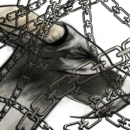
– 7 –
Lucy faces off against a goat.
“I knew,” she says, “when I came to this world, that there were two players. Just two, at my level. Two obstacles to remove, before I could kill this stupid world. I could feel it. One of them slumbers. He is of no account. He will not play rock-paper-scissors against me until it is too late. But then —”
She counts. She throws. One, two, three, paper.
The goat has inexplicably failed to participate in the game. It dies, as a goat will die that plays against the evil prophet of space unwisely; or too well; or not at all.
“Then,” she says, “also there was a goat.”
She frowns.
Her evil monologue has gone unremarked-upon. Her enemy has failed to show the competence that she expected.
She pokes over its corpse.
She scowls hatefully.
“Why,” she says. “Why can’t I ever find happiness? Why must the world keep it from me?”
She casts the runes but she already knows.
Of course it wouldn’t help anything to kill it.
This is not that goat.
It might not even —
Judging by the patternlessness in its spilled-out entrails —
Be an actual goat at all.
– 8 –
“He’s still after us,” pants Cheryl.
She isn’t panting because pants are the opposite of hats, for clarity. She’s panting because she’s been exercising very hard.
Also, boots are the opposite of hats.
“I don’t want to die,” she says. “I haven’t even finished my one-use matter transmission system or my origami bombs.”
“We won’t die,” says Tom. “It’s just an adventure.”
“Um,” says Cheryl.
“There is no way,” says Tom, “that I’m going to let Edmund kill and eat me. That’s against everything I stand for!”
They’ve retreated back into the hat cemetery. They’ve crawled under the plastic ropes that fence it off with a still semi-conscious Peter held between them. They’ve tried to lose themselves in the natural geography of the hat cemetery, with the help of Tom’s extensive experience with dead hats and Cheryl’s folding ability, but even a blind wolf could follow the scent trail left by Tom’s cologne.
(Unless its nose was also blind, and possibly even then.)
“Tom,” whispers an echoing voice, through the hat cemetery. “Come help me, Tom. I can’t control it, Tom.”
It doesn’t sound desperate. It sounds mocking, and rich with hunger. But maybe that’s just how someone sounds when suddenly they’re driven to kill and eat you. It’s not a normal experience, you know, on either side.
“I need to eat, Tom. I need to be stronger so I can break my chains. Right now I’m hardly any stronger than a boy. But if I eat you, I’ll have your strength and not just mine. Won’t that be nice? Yours, and Peter’s, and — is that girl worth eating? You must be honest with me, Tom.”
“She’s sharp as a tack that’s stuck in another tack!” shouts Tom, and doesn’t understand at all why Cheryl hits his arm.
“I was praising you,” he says.
“Don’t —”
She flails. Then she says, unhappily, “Fine. I apologize for hitting you. You may praise me as freely as you like.”
“And she’s courteous!” Tom shouts.
There is a silence for a bit.
“Don’t humanize her, Tom,” comes Edmund’s voice.
“She is human —”
Tom looks at Cheryl. “Wait, are we still human?”
Cheryl shrugs.
“I think she is human,” Tom calls.
“I’ll let the others go if you’ll come to me,” says Edmund. “You’re the tastiest. I’ll eat them later, but I won’t eat them today. You’d be the best. We could have forever. You’d be so sweet.”
Tom is shaking with fury and exhaustion.
“Sweet like your mother,” shouts Tom, in what probably qualifies as the worst attempt at insulting somebody ever. “I’m a science adventurer!”
One reason that this is an extremely bad attempt at insulting someone is that one is not supposed to compare oneself to the mother in question when using a ‘your mother’ style insult. Another is that ‘your mother’ style insults are part and parcel of a pervasively patriarchal society that science adventurers are normally inclined to deny their actual participation in. And one hardly needs point out the tackiness and problematic sexual connotations of the use of ‘sweet’ in this particular insult.
Most importantly, it is a bad insult because it leaves Edmund completely confused.
“Helissent was a science adventurer?” he says.
“No!” shouts Tom.
Then he staggers a few steps onwards, trying to look as if he’s somehow won or proved something. Lightning sets small fires on the hills.
“The cheek,” he says, to Cheryl. He glares at her, not for any particularly good reason. He doesn’t specify which of Edmund’s cheeks he means, or if he means one of Edmund’s cheeks at all.
Possibly there is a hat, nearby, that has a cheek.
Why would anybody do that to a hat?
Peter mumbles something again. He flails an arm. He knocks over a hat. It tumbles down a steep hat-slope into the night.
That was probably the one!
Tom opens his mouth. He’s going to yell something.
“He’s probably trying to provoke you,” says Cheryl. “You know. Into revealing our location.”
“Oh,” says Tom, a bit embarrassed.
“By shouting,” Cheryl explains.
“Oh,” says Tom again.
He hesitates.
Then an idea strikes him. “Can you fold the sounds of my yelling so that they seem to come from somewhere else?”
She looks at him. “Not without a sound-folding device.”
“Oh.”
“Seriously, Tom.”
“Sorry!”
They stagger on. Tom falls down. He tries to get up again. He can’t. Not while pulling Peter along.
“Peter,” singsongs Edmund. “Peter. Are you still with them, Peter? You mustn’t trust them, Peter. He’s just tenderizing you for my supper, Tom is.”
Tom’s voice is nauseated. “There is nothing for it. We will have to do it. I do not want to do it. Not like this.”
Cheryl blinks. “You’re going to tenderize him?”
“No!”
Peter is drooling a little.
“No. Well, maybe a little? I don’t know! I just wish he were conscious for this. He deserves self-determination in his hatting or not being hatted, but —”
Sheets of sudden rain tear across them. Lightning flashes in the sky overhead. It limns and silhouettes a beast that stares down at them from atop a hill of hats.
Tom closes his eyes in pain.
“Oh,” Cheryl says.
“Tom,” cries Edmund. “I can smell you. I’m almost on you. Wash your neck, Tom.”
Tom opens his eyes.
They are gone full black: the color of the House of Dreams.
“Forgive me,” he says, to Peter. “I am a prisoner of my circumstances.”
He holds his hat high. He brings it down on Peter’s head. It goes right over his face, just like Peter wants to stay asleep a little longer.
The boy’s boots twitch. His body shudders. He who was a boy of many directions is made over into a boy of one.
“Ptuh,” says Peter. It’s a spitting noise. He isn’t spitting into the hat. It’s just kind of what the noise he’s making sounds like.
The Edmund-beast is skidding down a hat-hill towards them. It is alternating sliding and loping. The beast can be seen to slaver when the lightning flashes behind it.
Peter sits up.
He shakes off the hat.
He is on his feet in one boneless maneuver. He takes in the world. His eyes burn red. He blurs into the sky like Vaenwode’s spear; he strikes true. He tackles Edmund: flings back the beast; pins him against a great shelf of hats.
Lightning strikes and thunder growls where Edmund had almost been. It hits a vaporous node. It ignites it, and behind the tumbling pair there is an explosion that fills the eyes of Tom and Cheryl with red-white glare.
Peter rolls off of Edmund.
Peter scrambles for a fez. He pulls it on. He glares at it. He hunts, desperately, in the pile, for any non-fez red hats.
Edmund stumbles to his feet.
“Not now,” snaps Peter. He waves Edmund away. “I have to find a non-ridiculous red hat!”
Edmund squints at him. Then he shrugs. He reaches into the pile of hats. He’s spotted a bit of red yarn. He tosses Peter a dead knit cap.
“Thanks,” says Peter.
Peter sinks back to the ground with relief.
“That was a bit of a thing,” he says.
Tom and Cheryl are staring at them. Tom is squinting and swaying. Cheryl is trying to finish a prototype origami bomb.
Edmund tilts his head.
“Peter,” he says.
“I know, I know,” Peter says. “You’re going to eat me. Can we talk first?”
Edmund moves. He attempts to rip Peter’s throat out. Peter isn’t there. There’s just a wreath of red around his hand. Peter has vanished into ninja-space.
He spirals back into being a little further up the hill.
“Apparently we can,” Edmund says.
He laughs.
“Oh, whatever. Sure. Fine. Talk to me.”
He waves Tom and Cheryl off.
“Get out of here!” Edmund calls. “This guy’s given his life for you. I think. I don’t know. Go!”
“That’s really gracious!” Tom yells back.
“Tom,” says Cheryl.
“He’s practically my brother,” Tom says.
“Oh.”
Cheryl attempts to imagine the family Tom grew up with.
“That’s not what I imagined,” she says.
“There was also a Taoist deity and the antichrist,” Tom says. “But they’re off in nunneries and rot. We had such good times.”
They drag one another off through the hills and valleys of the hats.
“So,” says Edmund.
“What’s it like for you?” Peter asks.
Edmund blinks at him. “It is very difficult, Peter. I am very hungry, and suddenly all of the people I care about appear to be made out of meat.”
“I don’t think I am,” Peter says.
Edmund sniffs the air.
“Keep telling yourself that,” Edmund says.
“I woke up,” says Peter, “and suddenly everything that was in me, everything that had been skew was straightened. Everything that had struggled in me was smoothed out. I looked up and I saw you, and I saw the tickling premonition of the storm, and I thought: Edmund is going to die. So I jumped. And it was beautiful. It was totally clean.”
“Oh, yeah,” says Edmund. “You’re really fresh. I’m looking forward to it.”
“It’s not for you,” says Peter.
“What isn’t?”
“My —” Peter flushes. “Look, I don’t want to talk about myself as edible.”
“Aw,” says Edmund. “Mr. Perfected is embarrassed about his nutritional information. What’s your secret shame, Peter? Is it the trans-fats? The lack of vitamins? Ooh, do you contain more than the recommended daily allowance of sodium? Because you have to understand, Peter, that the nitty-gritty of nutritional concerns ought to be secondary to living a generally healthy and fulfilling life.”
“I have trim nails,” Peter says. “Perfectly neat. Look at those. How does that even happen? How does a hat do that?”
“He bound you,” shrugs Edmund. “I think. He trapped you in his hat-chains. His milliner’s gaol.”
“Am I bound?”
“Yeah,” Edmund says, softly.
“Huh,” says Peter. “Are you?”
Edmund makes a whimpering laugh.
“I have never felt this good,” Peter says. “Not in my entire life. You know. I don’t feel chained.”
“You’re not making this easy, Peter,” says Edmund.
“It’s not supposed to be easy,” Peter says.
“It is,” says Edmund. “Come on. Please. It’s one thing to talk to you. I can still talk to you. But I haven’t eaten anybody.”
“Andrea.”
“I haven’t eaten hardly anybody,” clarifies Edmund. “Hardly anybody. This isn’t right, Peter. You’re just standing there and I can hear your stomach, you’ve got food in your stomach, don’t you?”
Edmund tilts his head to one side. Then he looks ill.
“No,” he says. “You don’t, do you. That’s manna. You’ve gone all holy. Oh, Peter.”
“Holy?” Peter says.
He thinks about that.
He walks a bit away along the edge of the hill of hats.
“I think I finally understand why I told the Devil no,” he says. He turns. He smiles at Edmund. “I think I finally get it. It’s not because scissors ought to be beaten up. It because most of the people they fall on probably shouldn’t ought to die.”
“Damn it, Peter,” whispers Edmund.
Peter grins at him. The lightning shines behind him like a mandorla. “You think I ought to make this easy, scrub? You think you can just put on a white hat and suddenly it’s OK to come in and kill and eat me? Choke on this, Edmund: no.”
“That’s just the hat talking,” Edmund says.
“Bad. Dog.”
“If you could see,” Edmund tries. “If you could see what it’s done to you. You’d beg to die. You’re begging me now. I can see it. It’s hidden but I can see it. You’re screaming. He’s sainted you, Peter. You. Of all people, you. You can’t possibly want to live that way.”
“It’s a bad puppy that kills and eats people,” Peter says. “This is a thing that should not be done.”
(He’s right, incidentally.)
Edmund licks his lips. He swallows.
“You’re a bloody frosh,” Peter adds. “You’re lucky I don’t tan your hide.”
“You’re a saint!”
Peter tilts his head to one side. “Well, yes,” he says. “Thank you.”
Edmund grinds his teeth. He’s going to do it. He resolves to do it. Later, when he has time to think about it, he’ll be angry at himself; he’ll writhe, unhappily, because it is a bad puppy, wolf, well, Edmund, really, a bad and human boy that would kill and eat people when they haven’t even given permission; but he’s going to do it. He can see the movements in his head. They’re all planned out. He slings low his lower jaw.
“One day,” Peter interrupts him, “you know, when there’s scissors in the head of your wolf —”
Edmund’s intentions stumble.
“— and scissors in its paws, and you’re laying there broken on the ground trying to remember how to breathe, and staring up with those dead white eyes, you’ll think, well, at least, Peter’s up there fighting for us. Up there in the sky with the scissors. So maybe somehow things’ll be all right.”
Edmund clicks his mouth closed.
There is a long silence.
“And will they?” he asks quietly. “Will they, Peter?”
“No,” Peter says. “No. Not really.”
He turns away.
“Nothing’ll be OK,” he says, “I think, until the jaguars fall.”
Edmund stares at him. Peter shrugs. Peter makes faces. Peter walks away. Edmund lunges after him, hungry, wild, but he trips on a slippery hat. Why do they even make slippery hats? But I guess the question answers itself.
Edmund falls.
Thank Heaven for slippery hats!
And he tries to get up. He tries to tackle Peter from behind. But it’s too hard. It’s too evil. It’s too complicated. He’s too hungry. He can’t do it. He can’t even do it. He isn’t even a good bad dog. “What,” he says, struggling, “what if I, I mean, maybe, maybe would you like me to not, not eat you, Peter?”
But however clever this trick might be, the red-hatted boy is gone.
“Spudgeflidgeon,” swears the cannibal. “Spudgeflidgeon. Fuck. Glip.”
I don’t know where he even got language like that. It is probably the corrosive influence of youth culture.
“Geffle-twonk,” swears he.
And he eats the corpses of the hats: tens of them, hundreds of them, he swells into a ball that rolls about the hills and vales of the hats until his wolf-gut digests it and unswells him, but this is extremely bad cannibalism, he would get an F in it twere it a subject, and it only makes him hungrier, in the end.
Sponsors
Today's
STRANGE ENCOUNTER ...

Icon_Andrea_NoBG
