– 14 –
Edmund and Andrea dance.
They dance — that time, and others; they dance until Edmund is utterly exhausted, after the patterns of a nithrid’s ways.
“What are you?” he asks.
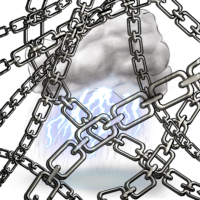
The quad goes dark when they are at practice. The clouds roll in and deepest night occupies even what would have been the brightest day. In that thick darkness are veins of darting color, purple, yellow, and white, as the eye tracks the lightning that is the nithrid’s dance.
Edmund tries.
He really does.
It is already the fourth session, now, and he is still half-choking with exhaustion, his own saliva, and chunks of heavy air by the fifteenth minute of the dance. He can’t even hold out long enough to get a good cardiovascular workout out of the experience. He’s too lost. Too staggering. Too inept.
He spins to a halt, tripping over an old stone fountain that he’d forgotten was there, and the nithrid slams into him. She isn’t sure why. Some combination of “to remind him that there is nithrid also moving on this track,” “humor,” and “because she does not decide not to slam into him before the fait is accompli.”
“Gah,” he says.
He sprawls there in the fading dark, bloody, with a nithrid on his back. She doesn’t bother getting all the way back up. She just sits.
“This is like wrestling with the wolf,” he says, and laughs.
She stands. She walks away a little bit. “The problem you are having,” she says, “is that you are not hacking the fundamental laws of the universe with your footsteps.”
“I’m not very good at that,” Edmund admits.
He rolls over and sits up.
“I could try eating the light or something,” he says, “but I didn’t want to get all cute in the first month.”
“Eating the light.”
She stares at him, then shrugs.
“No,” she says. “Don’t do that.”
She floats a few feet to the right. Her foot comes down. Where it touches the earth smokes; dark gathers; a numinous pall clouds the air. She sights a metal pole; she arcs to it: she leaves a trail of violet behind.
She catches her breath around a spear of pain all through her chest, swallows it down long enough to say: “Like thus.” before she must rest instead of speaking.
“Please remember,” he says, “that I am not actually a nithrid.”
“I know,” she says. “But —”
She ponders.
“You look at yourself,” explains the nithrid. “And you see yourself. You see the magic in yourself. And it wasn’t magic before, of course. It was only a thing before. Before you looked at it, it was only that which had happened: marvelous and physical but not magical or intrinsically affecting at all. Only, then you look. You look, and your own sight of it weaves it into magic. You become able to do what before you only inspired to do. Thus: nithrid. Does that make sense?”
She twists, a single writhing, convoluted motion that takes her four feet into the air; makes her form appear to dissolve into caryatids intertwining, bowing towards the center, incandescent, before the frog eggs and the whisked duck and the rainbow glimmers that enchain her snap her back.
“Like so,” she says.
“I cannot see myself doing that,” Edmund admits.
He squints at her.
“Nobody sees me doing that,” he says. “You don’t even see me doing that.”
“Is that so?” she wonders, distractedly. “Hm. That may be a thing.”
She arcs to the water of the fountain. She sits beside him. She is beginning to bleed from the edges of her mouth and eyes.
“It hadn’t occurred to me,” she says, “but I suppose I don’t see you people as storms. That’s so. I’d thought that that might just be because I’m outside you? But you are rough, gross and physical by nature, and all bound up to wolf and gold.”
“I am that,” Edmund agrees.
“It would be easier,” she says, “if you were naturally electric. If you were the Easter bunny, or something like.”
“Energizer,” says Edmund, with surprising insight.
“The energizer bunny,” she corrects herself. “But — you are not hopeless. It is not that bad. There is a potential in you to be a breaker of chains. A killer. A devourer. A wielder of the lightning. It is a dim and distant potential. It is drowning in your gross mortal fleshiness and the constriction of your pet wolf’s fetters but in you I see something golden, conductive. It is buried but it is there. So see it yourself, Edmund Junior. See it harder. Empower it with your eyes.”
“I can’t see it,” he says softly. “It’s your perception.”
She hesitates.
Then she waves a hand dismissively. “Just look harder,” she says. “It’s there.”
“Maybe,” says Edmund, “I wasn’t meant to — I mean, maybe I’m supposed to look at the magic that’s actually in me, and not . . . like, your nithrid-style stuff.”
She looks at him blankly.
“I mean,” he says. “Maybe I’m not supposed to be hacking the world with my feet. Wolves are supposed to pad quietly and not with great crescendos of thunder. We’re not like, you know, cats or —”
Edmund remembers that most cats do not clank.
“I mean, like kettles, or the like.”
“I am not your father,” she says, “or your faculty advisor. Please feel free to try this, if you like.”
“Right, then,” he says.
He concentrates. People walking by think about bothering him, but don’t. He looks inwards. He faces himself, as in a mirror. He tries to recognize the magic in him: the wolf; the storm. After a while he shrugs.
“I have nothing.”
“It is all right,” she says. “Two human eyes are clouded.”
“No. I mean, inside me,” says Edmund. He holds out his hand. He closes it on air, twists it, snaps it open and closed a few times as if grasping at something that he cannot feel. “Inside me, there is a yawning white nothing. I think it is the wolf. I think it is the thing that calls the wolf, the thing that frees the wolf, the white hunger that is in the wolf. It is a devour-some emptiness. It eats the eyes of the mind I use to look at it with.”
“Huh,” she says.
“You’re bleeding,” he says. He tilts his head. He looks at her.
“Please,” she says, waving it off, “finish your discussion. I have now become interested in this nothing.”
“But you’re bleeding.”
“I pushed too hard,” she says.
He squints.
“The cage of my bones is lined with knives,” she says. She touches her cheekbones. She touches her breastbone, then runs her hand down in front of her chest to indicate the ribs. “If I am too vast, too fierce, too quick, then they will cut me when I breathe.”
His face twitches.
“It is of no account,” she says. “I am a nithrid, that has been caught by Hans. I would rather focus my attention on whether you have actually seen something worth seeing, and therefore worth stirring into a storm with your inner eyes.”
He isn’t listening.
She waves a hand in front of his face. He isn’t looking.
She says something. He does not hear it. She says other things. He does not hear them. She shakes his shoulder. She pushes him. She becomes angry. She pushes harder but he does not feel it. He does not react.
He pours it all down, down, down, into the box around his heart instead, until the world is humming, empty, barely present around him; and even still he must fight back the pain.
It’s not about her. He wishes it were just about her. He doesn’t even really like her.
It’s not about her.
What is hurting him now is the same gnawing emptiness he’d mentioned, only seen from the other side. It is the same knowledge that gripped Linus Evans, once, when he felt Hans’ death and knew the cleaning man would rise; the same that gripped poor Betty’s mother when she saw the turtle-people come.
He is hurting because he has acquired a fuzzy, awful awareness of the sea of hurt and wrongness that is suffusing the mortal world.
Finally he lets himself hear her.
He says, “I’m sorry. I can’t help you. I can’t help anybody.”
“. . . I was not asking for your assistance,” she tells him. “I was teaching you. . . .”
She stares at him blankly.
He is distant. He is mahogany, balsa wood, and teak. He will accept it.
“Of course you didn’t,” he says.
He gets up.
He can feel it, behind him. She is breathing. With each breath she is cut. He can feel it, inside him. The wolf is hurting. The fetter cuts into it. And somewhere in the world Linus Evans, who was his friend, is still alone, and suffering, and the antichrist; and Tom, he thinks, must be off in some hospital somewhere recovering from being ophidian; and Jane and Mouser doubtless wandering the streets eating out of the trash bins; and everything is wrong, wrong, wrong, and awful, and there is no brightness in it; it is rising like a storm of pain and horror in him, and he bumps into someone, barely even manages to make himself look up and apologize, o how wayward I have become —
“Linus?” he says.
“Bro!” says Linus.
“Oh my G— my— my— oh my sweet, euphemistical goodness,” says Edmund, dropping the rage and pain from him like a backpack that he’s just shrugged off. “Linus?”
He hugs Linus. He pounds his back. “How the hell have you been?”
<< – 13 –
– 15 – >>
Sponsors
Today's
STRANGE ENCOUNTER ...

Hat_3a_nobg
