

– 4 –
Mr. Gulley sits by the phone in an empty house.
Somewhere in the halls upstairs from him his cat Inedible clanks by.
He used to have servants.
He’s fired them.
He used to have a wolf. He still does have a wolf, really, but he doesn’t go near it. It’s too dangerous now. He just pours kibble and occasionally cuts of meat into the kibble chute.
He used to have a son.
He still does have a son, really, but —
For the past three weeks, Edmund has missed his weekly call. The nithrid, too. He barely even dares to hope that this time the phone will —
Only, it does.
It rings.
He seizes it up. His heart races. He says, “Edmund?”
“Dad.”
“Edmund,” says Mr. Gulley. His face twitches. “I hadn’t thought you’d call.”
“Dad.”
“I’d figured you’d snapped, son,” says Mr. Gulley. “What with the reports. Killing people. Eating people. That’s not really — the point of this, you know.”
Edmund is silent.
“What happened, Ed?”
“I figured it out, Dad,” says Edmund. “I know how to free the wolf. Can you tell it for me? I know how to let it go. I just have to eat enough people.”
“We don’t eat people,” says Mr. Gulley.
“I got hungry,” says Edmund.
“We all get hungry!” says Mr. Gulley. “We all get hungry. We’re Gulleys. But we don’t eat people. Not since your great-grandfather, and there was a war on. A war on!”
Edmund sighs.
“I’ve become an instrument,” says Edmund. “Refined. Perfected. A scalpel. And you can’t be a scalpel without breaking a few eggs.”
This is not a very good analogy.
“I mean,” he says, “You can’t be perfect if you don’t eat people. Sometimes.”
This is not a very good analogy.
“I’m sharp like my stomach,” Edmund flounders, like an awl.
“Son,” says Mr. Gulley, “I’m a little worried about you.”
“I only really ate the nithrid,” says Edmund.
“Really?”
“You’d heard more?”
“I’d heard a lot.”
“It’s exaggerated,” Edmund says. “Unless I’ve been sleep-snacking or something. Or, oh, maybe the Principal’s all ‘oh, hey, another white-hatted person ate somebody again, I bet it’s all Edmund’s fault.’ The man is biased, sir.”
“I see,” says Mr. Gulley, because he does.
“I do plan to eat people,” says Edmund. “It’s just — I’m having trouble.”
“That’s your upbringing,” says Mr. Gulley. “Stern as a Gulley! Hardly ever go into a cannibalistic frenzy, Gulleys. Pillars of the community and all that.”
“People keep standing in creepy circles around me,” Edmund says.
“Oh.”
“It’s really distracting!”
“I’d tell you to buck up and ignore them,” says Mr. Gulley. “Only, I won’t. Bullying is a serious problem and I’m afraid there’s nothing for you to do but take it like a man and be so totally distracted that you never eat people. That’s a right proper education, that.”
Edmund is laughing. He is holding the phone with both hands and he is hunched over so it is close to the hollow where was his heart and he is laughing.
“I want to eat Sid,” says Edmund.
“Sid?”
“He’s . . . just, he needs me, Dad.”
There’s just silence on the other end.
“Dad?”
“‘He?’”
“It’s not a . . . he’s got his clear hat,” says Edmund. “Like, mucous.”
“Can’t you — I mean —”
Mr. Gulley does not quite know how to express to his son that he’d be more comfortable if his son were planning to hunt down and eat a girl. After a moment he just harrumphs. “I hear you’re wearing a white hat,” he says. “Yourself. Some sort of Smurf, now, are you?”
“It’s not voluntary, Dad.”
“It’s not in the dress code, is what it isn’t. The Principal’s complained!”
“Really?”
“Well, after I told him that he won’t be bringing any charges against any Gulleys for murder and anthropophagy,” says Mr. Gulley. “On account of my owning his school, his residence, and, if absolutely necessary, his goolies.”
“He moved on to the hats.”
“Said they’re a gang thing,” says Mr. Gulley. “You should ditch ’em.”
“Well,” says Edmund, amusement wound through his voice like a wolf, “that’s not happening, since I’ve kind of glued mine on. You don’t want me to have to cut off all my hair, do you, Dad?”
Mr. Gulley stares at the phone for a while.
After a while, he says, “Sometimes it’s hard to remember that they’re people, son. When you get really hungry. But they are. You know?”
“They don’t look like it any more, Dad.”
“I know,” says Mr. Gulley. “But they are. They’ve got — thoughts, and feelings, and stuff. I understand, son, but — they do. They’re like us.”
“They’re not like us,” says Edmund.
“No?”
“They’ve never seen the wolf.”
And he’s not talking about the bigness of the wolf, or the wisdom in Fenris’ eyes; or the way that Fenris is going to eat both of them, if events proceed as planned. He’s talking about the only thing he can think about, which is the bonds around Fenris’ mouth and legs.
And in that moment, suddenly, Mr. Gulley is fiercely proud.
He’s thinking of the telly, which has been all over the living storm that’s been beating this way and that over England; and that’s his son, there, that freed it, that took the nithrid he could only drag up to Earth and had let it go. For a moment, he’ll forgive everything else, as worrying as the weather service makes that, because —
“Son —” starts Mr. Gulley.
But he doesn’t get to say it. Whatever it was that was going to come out of that pride of him, the words are lost; he doesn’t get to say them, and we’ll never get to hear.
“I think I’m going to slip, Dad,” Edmund is saying. “I think I’m going to slip. The others in my House, they’re not used to it, they’ve eaten more people, but I don’t think I’m that much better. I think I’m just barely ahead of the curve. I can’t control them. I don’t think I’m even going to be able to control myself. I’ll eat one more. Then two. Then four — pretty soon, I’ll eat the whole world, and then it’s on to space.”
“Don’t do it,” says Mr. Gulley. “I raised you better than that, son. Don’t.”
“Dad,” says Edmund. “You’ve got nothing to do with it.”
“. . . what?”
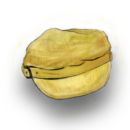
“I got a magic hat,” says Edmund. “I put it on and it explained everything to me. It told me, I could be the one to free everything. All the tangled masses in their horrors. I could let everything free. I could let them go. Maybe I could hit the prisons, Dad. I could hit the prisons, I could eat the walls. They’d run free, they’d be so happy, Dad. You know that prisons corrupt the prisoners and the guards and even the fabric of the country that has them. That’s why there aren’t any prisoners in Heaven.”
“Don’t do that, son. Don’t get caught doing that. Don’t —”
“Hats don’t lie about moral issues, Dad,” Edmund says.
“Don’t eat people, son.”
“They’re not people,” says Edmund. “They’re just . . .”
He doesn’t finish.
After a while, Mr. Gulley says, “I wish I’d had more time with you.”
“Dad.”
“The wolf’s going to eat me soon,” says Mr. Gulley. “I think. I don’t know how. I just . . . I’ve been . . . I’ve been away so long. If I go down and see him I know he’ll eat me. One snap. He won’t trust me to come back again. But how can I not go see him?”
“Wait, Dad,” says Edmund. “Wait. Hang on. Don’t let him. I want —”
Edmund makes a horrified strangled noise. He hangs up the phone. He hangs up the phone before he can tell his father how much he wants to eat him himself. How much he longs for that, to butcher his father and eat him up. How happy that would make him. How delicious it would be.
“I love you,” says Edmund, to a deadened line.
After a while Mr. Gulley fumbles the phone back onto the hook.
He goes to check on Edmund’s heart.
There’s a small altar in Edmund’s room. On it is a wooden box. In the wooden box is Edmund’s heart.
Mr. Gulley pats the box. It is sound. It is solid. He listens to Edmund’s heartbeat. There is nothing untoward.
“Damnable dwarf,” he mutters, even though, in the final analysis, there is very little in Mr. Gulley’s situation that is actually Joffun’s fault.
A wolf howls, lonely, in the basements far below him.
Somewhere in the halls upstairs from him his cat Inedible clanks ponderously back and forth.

– 5 –
Lucy stands. She watches Meredith dance.
“Oh, hey,” says Max.
He wanders in. He tilts his head.
“Just watching?”
“I make her nervous,” Lucy says. “She thinks I am going to kill and eat her. In this she is probably correct, but not during a club function. So I stand here, and she dances there, and later, we swap places.”
“Heh,” says Max.
“You’re not afraid?” Lucy says.
He ruffles her hair. She squints in irritation.
“Let me show you the best thing in the Konami Thunder Dance,” he says.
“There’s no one best —”
She stops.
“Fine,” she says.
So he shows her Dynamite.
– 6 –
The room is gone. There is only the world, and space.
The air is clear and still as glass.
Max holds out his hand and there is the world in it. It is a crystalline stillness, a thing of aspic with colors glittering in its depths. The harder she looks at it, the deeper she sees into it: what seem at first to be glitches, floaters in her eye, or phosphenes become first colors, then patterns, then whole landscapes as her eye sinks in.
With each beat of a heart —
Her heart? His heart? The evil prophet of space does not know —
Ripples of light move through.
They grow brighter and brighter until they become searing flames that chase one another across the surface of the world.
“This is how it is,” says Max. “For an expert; for a beginner; for anyone who knows the dance.”
She isn’t sure if he’s standing on a Konami Thunder Dance dance pad. She isn’t sure what music he’s playing. All she can hear is a beating heart. Hers or his she does not know.
“If you know the trick,” he says, “If you can hear the fire that moves beneath the surfaces of things, then you can throw two Symbols at once. Not just LEAF. Not just BANANA. Not just BLOOD; but also Dynamite.”
She frowns at him.
“It is an old explosive,” he explains. “They used it before the scissors fell.”
“I know what dynamite is —”
“Then come on,” he says.
There’s no turning back now!
She follows him as he shows it to her.
At the right moment, at just the right moment —
He drops onto hands and knee. He dances with his left hand what his left foot should have done; and instead, that foot throws Dynamite.
It is cheating, she realizes.
He is showing her how to cheat. He is showing her how to cheat at living in the world.
“This is the Konami Thunder Dance,” he says, “given to us by God.”
“You can’t do this,” she says.
They don’t let you do things like this at the evil academy of space.
Nor not even on the planet of the wicked god.
He is dancing THE RAZOR now. He is dancing KINGS. He is dancing KNOT MADE OUT OF JELLY; and as he dances, also he throws Dynamite.
“This can’t possibly be the true thing,” she says.
Each Symbol of the Thunder Dance is one thing, exactly, for all its many parts; one thing, and one thing only, save, perhaps, for the cheat code Dynamite.
It has to be a blasphemy. It can’t have ever been meant to be.
When she finally learns to dance it, it is the best thing she has ever known.
– 7 –
An ant becomes immortal. At first this is all wine and roses. Then it remembers that it is an ant. It becomes displeased with its immortality and finally it becomes ant-wroth. Its trail surges up with an awful nimbus of destruction. It begins to crawl slowly across the world.
It is ruinous.
It is deadly.
Where it goes it leaves a line of nothing; in its trail the world is made as not. Long before the sun’s explosion will bring a natural culmination to the planet’s story, the ant’s criss-crossing trail, covering everything, is certain to bring it to an end.
What a bad ant!
It crawls across Woodbridge. It crawls across Kesgrave. It leaves a needle-thin track of uttermost devastation behind.
Men gasp. Women faint. Actually women don’t faint, but they would have, if their corsets had been tighter. A somewhat loopy dog barks, rather a lot.
The ant crawls into Ipswich.
It is cold-hearted now. It has become the cruelest ant. It crosses over a dead bird without even pausing to take any of the delicious food of it back to its former mound.
They wouldn’t recognize it any longer anyway.
Nobody appreciates the lonely suffering of an immortal ant.
The ant crawls up a building wall, marginally threatening the building’s ability to meet code.
It crawls in through Jane and Martin’s kitchen window, leaving a burning trail of non-being behind it.
Uh oh, ant! The Tao precedes being and non-being.
The more it is used, the more it produces: the more you speak of it, the less you comprehend. An ant may crawl into through a kitchen window, but Jane squishes it with her finger.
A good knot needs no rope to tie it, and it can not come undone.
(Hat tip: the Tao te Ching.)
Jane looks at the ant paste on her finger. She doesn’t want to lick it off. It’s immortal. But she doesn’t want to waste it, either! So she bakes it into cookies.
“Waste not, want not!” she advises, to us all.
She shares the cookies with Martin, and they eat. Then Jane pushes the last few crumbs around on her plate, pretending they are warring gods and demons, and says, “Did you know that five hundred years after you become an immortal, Heaven sends a terrible finger to kill you?”
“You hadn’t mentioned,” Martin says. “I mean, not since dinner, you hadn’t.”
“It’s true,” Jane says. “Also, I think it’s somewhat faster for ants.”
Martin is licking off one of his fingers. He pauses. “Oh, God,” he says. “Did I just eat an immortal bug again?”
“Happy birthday!” declares Jane.
“It’s not my b—”
Martin doesn’t want to lie to Jane unintentionally. He stops mid-sentence. He tries to count the days. He thinks.
“It’s probably not my birthday,” he says.
“When is?”
“I dunno,” Martin says. “I was born a long time ago. Then I got tied up by a dwarf! That always plays havoc with your sense of time.”
“That’s ridiculous,” Jane says. “The svart-alfar are extremely punctual.”
“You try keeping time by calendar beast,” Martin says.
Jane looks eager.
She is about to open her mouth and ask for a calendar beast! Martin leaps into action.
“I mean,” he interrupts, “You try imagining keeping time by a calendar beast.”
“That’s easy,” says Jane. “I just tie clocks to its toes.”
“But then when it rolls over?”
“Oh, man!” says Jane. “The imaginary clocks get all tangled up!”
“That’s exactly how it is,” Martin explains. “Eventually I got work-released to Ipswich Prison, an intensely realistic simulation of Ipswich built out of my own Cartesian theatre, but by then I’d already completely lost track of time.”
“Oh no!” says Jane. “How’d you escape?”
Martin waves a hand vaguely.
“Sometimes I think that I’m in a Cartesian prison,” Jane confesses. “Like, what if I’m only seeing the Ipswich of my own sense-impressions and conceptions out the window?”
Martin peeks out the window.
“It’d probably be for the best,” he says.
“No way!” she says.
“Then,” says Martin, “there’s only one answer.”
“Huh?”
“You’d have to blow it up.”
“What?”
“Boom!” Martin says. “The Tao precedes being and non-being. Heaviness is the basis of lightness. Stillness is the standard of activity. The master destroys all of reality, and therefore knows the real.”
(Hat tip: the Tao te Ching.)
“Oh, man,” says Jane. “Oh, MAN!”
“Hm?”
This has affected her more than he expected. He raises an eyebrow. He watches as she carries the plate off into the kitchen, washes it, dries it, and comes back out.
“Now I’m going to feel guilty forever,” Jane complains, “about that poor world-destroying ant.”
– 8 –
Edmund’s residential assistant fears him. The fear rises to take over the boy’s life. The fear becomes a chain on him. The boy locks himself in his room. He does not come out. He misses his classes. He begins to starve.
Edmund stands outside the door.
“Be reasonable, Ben,” Edmund says.
There is only a howl and a scream from beyond the door.
“I’m making a request,” Edmund says, “to you as a residential assistant. There is a student on this floor who is freaking out and locking himself in his room and never coming out. Help him. Help him come out into the light.”
He can’t hear a response.
He goes to his room. He plays loud music. He tries not to think about it.
He can’t not think about it.
The sense of trappedness from the room down the hall grows and grows. Finally he can’t take it any longer. He bites through the door in three great snaps. He picks Ben up. He shakes him.
“Quit it,” he says. “I’ll show you fear!”
And once upon a time there was a bear — a spirit of the olden days, a creature and a power from the time of fable — and it was born for Ben and for no other. It would have come to him in his childhood, and later on; given him strength, taught him magic, and helped him in such troubles. It would have saved him from his awful fate; but it is frozen under the ice.
It is buried in the winter that Hans called down, frozen as part of Hans’ gift to us —
Frozen such bears; and the nithrid bound; and Fenris chained; great Pepsi drowned —
So that we could live in a world that makes sense, a world stomped round, and not in a world of talking bears and wicked gods and world-devouring wolves.
That is why there is no bear for Ben.
Nor no princess, neither.
Nor no hero riding on a great white horse to gallop in and save him.
He is trapped. He is broken. He is in an agony of fear, and there is only Edmund — of all the voices of magic and transcendence that there could have been — to help him through it.
There is only Edmund to help him; so Edmund does, and in the only way he can.
He shows him fear.
If you actually have something bad happen to you, after all, it turns out that it’s a lot less scary after that. Like, if you’re afraid of swimming, and then you go swimming, even by accident, you’ll be less afraid of it after. Or, if you’re afraid that Edmund will eat you, and then he eats you, you’ll stop being afraid of it at all.
It’s just like Lucy’d said!
Edmund sits in Ben’s room. He licks off his fingers, very carefully. His eyes are white and his face is pale and he is panting like a dog. He looks sick.
He’d like to throw up all the Ben in him but he just can’t.
“That was a mistake,” he says. “I didn’t mean to do that. I just lost control.”
He should kill himself, he thinks, before he makes another mistake like that. That is the only proper course. He should just lift his hand to his mouth, it’s all tasty with Ben’s blood, right? And take a bite. And then just keep going and going —
He’s actually got the side of his index finger between his teeth when he flashes on the wolf.
He pulls his hand out of his mouth.
It hurts him. It hurts him so badly not to eat Edmund Gulley. He wants to eat Edmund Gulley so very badly.
But if he eats Edmund Gulley, then who will free the wolf?
He goes back to his room. He’s eaten most of it before he can stop himself. He’s round like a ball, until he’s not. Then he huddles in the corner of his empty room and shakes.
He wants to eat more of his room, but not as much as he wants to eat Edmund Gulley; and he wants to eat Mister Gulley, Mister Edmund Gulley Senior, most of all.
It’s almost time for summer break, as it happens.
He thinks about that.
It’s getting hot. Classes are ending. It’s almost time for Edmund Gulley to go home.
– 9 –
Mr. Gulley buys a muzzle and thirty pairs of boots. He cuts the boots to pieces. He sews them together into a larger boot. He can barely lift it. He builds an automated boot-throwing machine, or “bootapult.”
Edmund calls.
“Hey,” Edmund says. His voice is congested. He’s been crying.
“I bought a muzzle,” Mr. Gulley tells him.
“. . . oh,” says Edmund.
“Like for Hannibal Lecter,” says Mr. Gulley. “For when you’re home.”
“Dad,” says Edmund. “I’d eat the muzzle.”
“Leverage!”
“No,” says Edmund. “You don’t get it. I’ve eaten death rays. I can eat the muzzle.”
“Leverage,” Mr. Gulley protests feebly. Then he looks at the muzzle. He thinks about it. He thinks about what he would do if he were muzzled and he wanted to eat the muzzle. He’d put his hand over the air hole, he thinks. He’d eat the air. He’d swallow, and there would be vacuum; the muzzle would crumple in.
At least I have never had cavities, thinks Mr. Gulley, to balance out a peculiar momentary ingratitude for the strength of Gulley mouths and Gulley teeth.
“. . . I see,” he admits.
“Should I stay here?” Edmund asks. “Over the break?”
“No,” says Mr. Gulley.
“I can stay,” Edmund says. “I’m a monster, Dad. I . . .”
He can’t make himself say it. He can’t tell his father about Ben. He just repeats it: “I’m a monster.”
“I almost visited Fenris today,” says Mr. Gulley.
“Dad?”
“I forgot he’s going to eat me,” Mr. Gulley says. “I was just, you know, lonely. And I wanted to talk to somebody about my marvelous Fenris-killing bootapult. And I was actually — I mean, the door was open, son.”
“Dad.”
“The world’s ending, son. You know it. I know it. We’ve maybe got decades, but more likely it’s months. It’s coming. And it’s almost summer, son. Come home.”
“Dad,” says Edmund.
Then, far away, he hangs his head.
“Sure thing, Dad.”
After a while Mr. Gulley hangs up. He goes down to the basement. He starts to open Fenris’ door.
He freezes.
He leans his head against the wall. Then he shakes it. Then he goes back upstairs. He gets the automated boot-throwing machine. He gets the boot. He puts them in position.
Gingerly, using a remote control device, he opens Fenris’ door.
He looks down at his wolf.
The wolf looks at him.
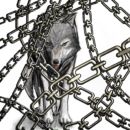
Fenris is leaner than a greyhound, wiser than an owl, massive, terrible, and sleek. The wolf has been licking at one leg where it is hurt by the chain.
“You’re not supposed to do that,” Mr. Gulley says, helplessly.
He almost runs forward to do something about it. He isn’t sure what. To hit Fenris’ ear and cry, “Bad wolf!” To apply medicine to the wound. To touch his wolf and weep.
He stops himself.
“Whatever,” says Fenris.
The wolf looks up at the boot-throwing machine.
“You have a boot.”
“I do,” says Mr. Gulley.
“That is nowhere near big enough,” says Fenris.
“Pardon?”
“You’re planning to stomp me with that?” says Fenris. “It is not big enough. You could try with a boot one hundred times bigger and that might be enough for me. Or,” and here the wolf is nonchalant: “not.”
Mr. Gulley triggers the automated boot-throwing machine.
It flings the boot at Fenris. It stomps the wolf. It stomps the wolf hard in the face.
The wolf shakes it off.
After a bit, the wolf begins to lick the fallen boot.
“I figured,” says Mr. Gulley.
The wolf twitches an ear. It doesn’t bother to say anything.
“I wasn’t expecting that to work,” Mr. Gulley clarifies.
“Of course not.”
“I just was hoping — I thought, if Heaven wanted to give me a miracle, that I should at least sew together thirty pairs of boots to earn my shot.”
The wolf dangles its tongue. Then it shakes its head a little and licks the boot some more.
“Maybe it’s poisonous,” says Fenris.
Gingerly the wolf pulls the boot onto its tongue and gulps it down. It waits to see if it will become sick or die.
After a while it says, “I don’t think it’s going to work.”
Mr. Gulley sits down on the stairs.
“I’m not going to eat you, gumby,” Fenris says.
“You are,” says Mr. Gulley.
“I’m not,” Fenris argues.
“You are.”
He leaves the door open. He wanders upstairs.
The wolf’s stomach rumbles and grumbles, down below.
It occurs to Fenris after a while that it probably oughtn’t have eaten a gigantic boot.
– 10 –
Emily slips into the Konami Thunder Dance club. She takes off and stows her shoes. She leans against the bar on the mirrored wall.
She watches Meredith dance.
It’s slowing down even as she watches. She can see it. Meredith is becoming confused; the certainty in her is dissipating; she is tangling herself up until halfway through Daikenkai she loses the train entirely, falls over, and lets the song play out.
Meredith just laughs it off.
She wanders over. She towels off her sweat. She looks at Emily.
“Nice eyes,” she says.
Emily gestures expressively.
I can talk to Fred and Morgan in my head now, she tells Meredith.
I don’t think she can hear you, Fred points out.
Yeah, well, your face is ugly, Emily informs him. She can hear Fred giggling somewhere on the other side of the School.
“You’re not going to like eat me or anything, right?” Meredith asks. “’Cause I’m totally writing a letter to your Mom if you eat anyone. Even me!”
What, from my stomach?
She can’t hear you, Fred emphasizes. He squints. He tries to peer out of her eyes. Oh, hey, she’s cute.
Emily glares in his vague direction: Fred!!
Meredith snaps her fingers. “You’re one of those stand-in-creepy-circle people! Tom was ranting about you.”
Emily sighs.
She turns to go. Meredith has her hand on Emily’s arm.
Emily looks back. Meredith?
“You’re still allowed to dance,” says Meredith.
Emily considers this. Then she beckons Meredith.
“What? No. No way. I’m not dueling you.”
Emily makes a face.
This is really inconvenient, she says.
You can still use your outside voice, reminds Lirabelle. If you really try.
It’s too hard! Emily protests.
“This is funny to watch,” says Meredith. She sits down on the shoe cubbies. “You OK?”
Emily makes a neutral gesture.
Then, finally, she forces out a soft clear whisper. “I want to dance.”
But she can’t.
She tries but — she’s crippled.
When she looks at the falling Symbols they are just shapes on a digital screen. When she hears the music it is nothing more than sounds that are set to time.
She cannot lose herself in it.
She tries to throw Dynamite. She humiliates herself by falling.
She stares at her hands.
I guess this is not the one thing that I am, she says.
– 11 –
For Edmund things are very clear and limned in white.
Edmund’s stomach rumbles.
He wakes.
He stares at the ceiling as the hunger washes across him in great waves. In between the great waves are little trembling motions. His body vibrates with them. He thinks that he has them under control; but no sooner does he think that then he realizes that that is just the sinking before the swell. There is a great need rising in him.
He walks to his window. He stares out at the students that walk this way and that below.
They used to be people.
He remembers that.
“How does that even happen?” he asks them.
Where does the personhood go?


Interlude
You shouldn’t brandish an evil prophecy at all of your problems!
Here’s an example.
Jane is walking along. Suddenly, she is hit by a car!
“I’m OK!” she says. She scrabbles feebly. She pulls an evil prophecy out of her backpack. She brandishes it at the car accident. Bam! The car accident unravels and is unmade.
But it’s not that easy, Jane!
“My shoes!” she says.
That’s right, Jane! It didn’t fix the bloody mess that that car accident made out of your shoes!
“Lesson,” she says, “learned.”
The next time a car hits her she won’t use an evil prophecy!
She walks along her road. There’s a cat stuck on a low wall.
“Oh no!” she says. “Kitty!”
She reaches for the cat. The cat hisses at her.
“But you’re stuck!” she says.
The cat does not appear able to understand the reasonable nature of Jane’s assertion. It remains obdurate. Finally there’s nothing for it! Jane brandishes the evil prophecy at the cat’s being stuck up on the wall.
An evil feeling!
The cat finds itself no longer stuck up on that wall.
What a happy ending! Jane whistles cheerfully and walks along.
But not everything about brandishing evil prophecies at your problems is wine and roses!
Jane wakes up in the middle of the night.
She attempts to go to the bathroom. Result: failure!
There is a thing of brass and fire, faces and wings, opening and closing are they all, hovering in swirls of emptiness and somethingness in the middle of the, ah, “facilities.”
Jane closes the door again. She waits. It does not emerge.
She becomes impatient.
She brandishes the evil prophecy. Problem: solved!
The thing of brass and fire is verged suddenly out of the bathroom. It looms over her. It booms words that exceed her comprehension. Feathers swirl like clock hands before its faces.
“Agh!” she realizes. “That’s solving the wrong problem!”
She brandishes the evil prophecy again.
Now she understands the words of the creature! They make total sense! Angel-wroth verges in around the corners of her rationality. She shudders. She stumbles back. She brandishes the evil prophecy a third time!
The world cracks.
Fire and blood pours in around the edges. Strange flowers crawl along the walls. The thing, with its faces, wings, and booming, has receded into the absence of such things from which it came.
“Martin,” whimpers Jane.
Martin is sleeping. It is after two in the morning! Jane is scared of waking him but she is also scared of just leaving a giant hole with fire and blood pouring through it in the middle of the reality in front of the bathroom. She tries stuffing the crack with towels. They start to smolder. She pulls them out. Now she’s got bloody smoldering towels on the carpet. There’s fire everywhere.
“Damn it!” she says. But that just makes the hellfire burn higher!
She is panicking. What can she possibly do? She brandishes the evil prophecy at the problem. But you can’t solve hellfire and world-cracking with an evil prophecy! That’s like pasting shillings onto your pet iguana’s back!
Jane fills towels with water. She mushes them into the world-crack. It’s not enough! She adds some of the curtains. Finally she gums everything down with Jell-O and she jiggles it until it sets.
She looks fiercely at her iguana. “You could help,” she says, “you know.”
But it doesn’t help!
Once you make an iguana rich it’s pretty much good-bye to civility and hello to snootiness. That iguana is too good for Jane’s petty problems now.
Jane sits down in the hallway. Her face is covered with blood and soot and delicious lime gelatin. She can’t stop licking it.
She’d wash it off but there aren’t any towels!
“Jane,” Martin says, “I was using the facilities this morning and it occurred to me to wonder whether you might have been using my evil prophecy again?”
Hmph!
“I think I’m old enough to call it utilizing,” Jane proclaims.
Excessive austerity measures spike up local unemployment to record levels. Confidence in the government drops. Jane sniffles at the tragic story of Lois Aubergine, a local worker forced to work an actual negative number of jobs in order to resolve an error in the official unemployment figures.
“She actually has to stand at a grocery register and refuse service to customers,” Jane explains to Martin. “It’s just awful!”
Unexpected paper-serpent-caused tidal waves flood coastal Europe.
Global warming ignites the Iranian city Ahwaz in a sudden conflagration.
The government denies rumors of avian kissing sickness spreading across the great bird/human divide to Man.
“You could brandish the evil prophecy at some of this,” Martin hints. “Since you’re so, you know, old now.”
“Martin! That’s not a realistic solution to everyday economic problems!” lectures Jane.
I guess she’s learned her lesson after all!
– 1 –
A world-killing meteor hurtles towards the Earth and a cancer grows inside the sun. The ghosts of seven dead Kings rise from the sea; it is their plan to drown all life. Emily bursts in on Eldri’s workroom. She spreads her arms dramatically and poses, like, ta-da!:
It’s summer!
“Emily,” Eldri says. He laughs.
He stands up. He hobbles to her. He hugs her. She realizes just as he hugs her that she forgot to use her outside voice for “It’s summer!” but it’s kind of too late to fix that now. She hugs him back instead and ruffles his svart-elf hair.
She says, softly, “It is so good to see you.”
“Ha!” he says.
He puts his hand by his ear. “You’ll have to speak up,” he says. “I was in a bomb.”
She looks horrified.
“I don’t,” she says softly. “I mean, I . . . I hardly even . . .”
He doesn’t look like he’s heard a word of it.
She touches her throat.
He steps back. He looks her up and down. He frowns. He says, “Eh? Your eyes’ve gone gold.”
There was a hat, she admits.
She licks her lips.
“Fool girl,” he says, disapprovingly.
She glares at him. It wasn’t my fault!
A few hundred miles away, Fred mutters, “you’re shouting.”
“Sorry,” Emily whispers.
“Well,” says Eldri, “at least they’re a good color. Gold! That’s good stuff, gold.”
He putters around his workshop. He tosses her a speech amplifier. It’s a machine, for amplifying speech! She speaks carefully into it. “There was a magic hat,” she says. It booms. She flinches. Then, a bit more carefully, she says, “I didn’t know. I don’t know how I feel about it. But I do actually quite like standing around people in creepy circles and talking to my friends silently from wherever I am.”
“I never,” Eldri says. “Not when I was a tyke!”
He laughs. He gestures around.
“But welcome. As you can see, I’ve moved.”
“Yes,” she agrees.
“That was the bomb!” he says. “Forgot to turn my lights out when the blimps came by, I figure. Or something. I don’t remember it very well.”
She looks around interestedly. “What’ve you got going on?”
“Not much,” he says. “Not much. I made a go-playing robot and a go-fish playing robot, but they left. Oh! And a marvelous robot that never loses at Simon says.”
“Really?”
“Ha!” says Eldri. He snaps his fingers. “Simon says bring me a war criminal.”
Eldri’s amazing Simon-says playing robot decloaks. A shimmering field falls away. It is holding up a war criminal by the collar, the pressure of the collar around his neck keeping him from saying anything and revealing the robot’s presence.
“Wow,” says Emily. “Better take him to the Hague!”
The robot looks at her impassively. It has the face of a butler. A steel butler. A steel Simon-says-playing butler. It does not approve.
“I mean, Simon says take him to the Hague,” Emily says.
The robot glances at Eldri quickly for approval — obviously, only authorized entities may speak for Simon — and then it vanishes in a wobbling of light.
The room is quiet for a while.
“I miss Navvy Jim,” Emily says.
“He’s still around somewhere,” Eldri says.
“Oh?”
“Yeah. I mean, I had to box him up, you know that. People’d talk. Couldn’t help throwing scissors, that boy, if he figured on paper from his opponent; and, well.”
Emily remembers growing up in a world that hated scissors.
She nods.
“I told him, ‘there’ll be better days, Navvy Jim. There’ll be days when people can play rock-paper-scissors again.’ And I drained his battery, so he wouldn’t feel the slightest pain, and I took him apart, and — well.”
“The kids call it hobbit-Spock-spider these days,” she says.
“Yeah.”
“Spock sings about hobbits,” she says. “Hobbits kills spiders. Spiders write slash about Spock.”
Slash is a form of Internet fan fiction in which characters borrowed from another creator have homosexual encounters.
“Really?” says Eldri.
Possibly it is also applicable to non-Internet fan fiction. Not everything can be put in your little boxes, Eldri. Sometimes you have to go with the flow of the definition that occurs to you!
Emily giggles.
“Possibly,” she concedes, “the spiders sting Spock or spin webs around him or something, instead. I have never actually paid much attention to the rules of hobbit-Spock-spider. I only have five fingers, you know.”
“I was going to make a slash-writing robot,” Eldri reminisces. “Once.”
Oh, Eldri.
“What happened?”
“I got halfway through,” Eldri says, “And —”
Eldri shrugs, as if to convey that sometimes nuking one of your own cities to destroy a possible sun-devouring wolf can also have adverse consequences like depriving the world of an endless stream of top-notch robot-written IP-infringing gay erotica and pornography.
“Ah,” Emily says. After a while she adds, “Slash isn’t really a game, though, Eldri.”
“I was tempting fate,” Eldri agrees. “Divine retribution followed.”
He laughs.
“It is so good to see you,” he says.
“Hey,” she says. She adjusts the volume on her amplifier. “I mean, hey!”
“Hm?”
“We should get him out,” she says.
“It’d be cruel,” Eldri says.
He’s not 100% sure whether she means digging out the half-finished bomb-seared wreck of a slash-writing robot from his old laboratory or Navvy Jim, but it seems rather cruel either way.
“No, no,” says Emily. “We can teach him to play hobbit-Spock-spider.”
“Huh,” Eldri says.
“You can rewire him for that,” Emily says. “Can’t you?”
“. . . ridiculous,” says Eldri. “It’s demeaning. Can you see him there, in his robot voice, saying, ‘Spock sings about hobbits?’ Or that other thing? I might as well put him in a butler costume with cat ears.”
“That’s not true,” says Emily. “Many of the leaders of the free world play hobbit-Spock-spider. It’s intensely reputable.”
Eldri sits down. He takes a swig from a bottle containing unspecified and probably medicinal liquid. He thinks.
“Well,” he says, “we can ask him, I guess.”
Most of his life is in ash and ruins, of course, since he’d been living in poor nuked Bibury, but what with Eldri’s shelter also being his vault, he’s got boxes and boxes of random treasures left, and Navvy Jim. It takes them days just to drag all the boxes up from the basement of his new home and it’s hours more before Emily finds the first good-sized piece of Navvy Jim; but that just makes it all the more exciting when she does.
Look, look! she says, in her inside voice, and waves it around.
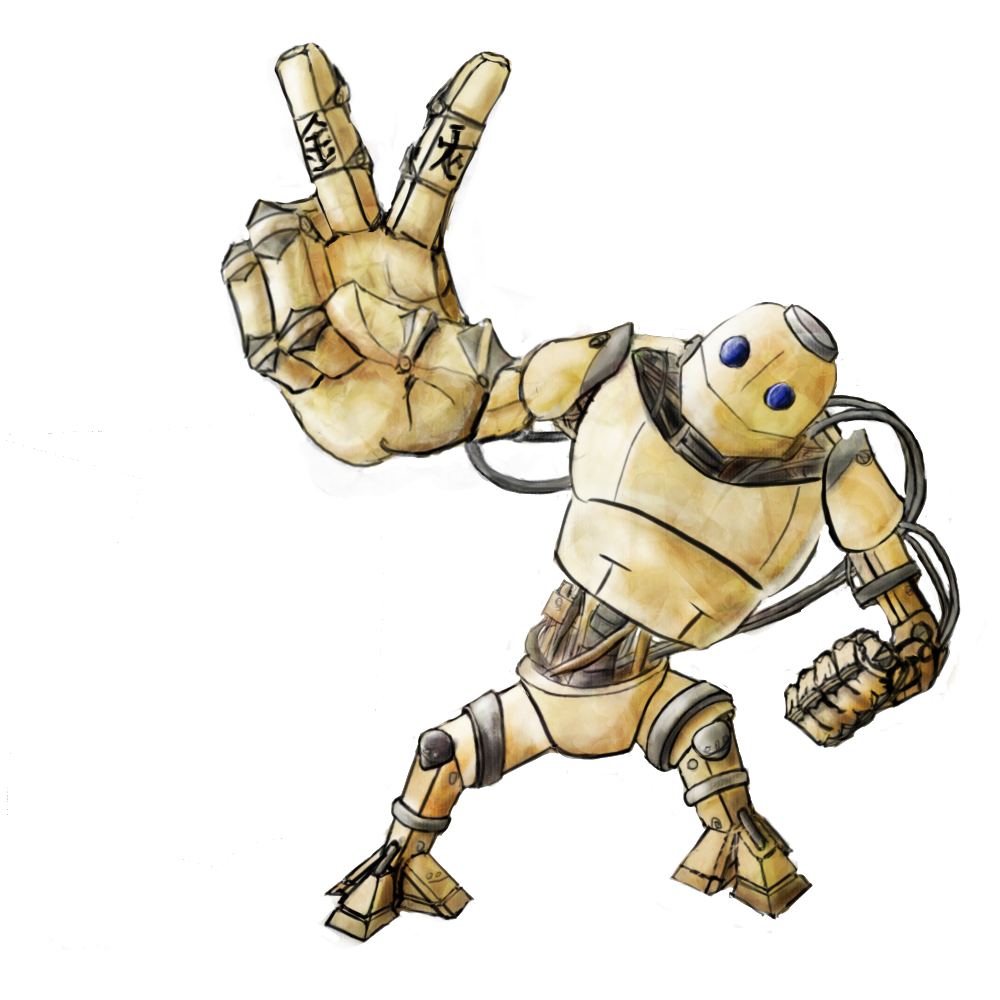
It’s Navvy Jim’s arm and hand, folded into a fist.
She giggles silently. She puts it down on top of some boxes. She counts. One, two, three, paper!
Eventually Eldri notices her.
He’s dug out Navvy Jim’s torso. He’s set it down. He turns to mention this to her.
She is frowning at the arm. She is standing in a creepy point next to it staring at it with her golden eyes. She is shaking her fist at it. One, two, three, rock! One, two, three, rock. One, two, three, paper!
Eldri shudders. Then he manages a grin.
“I guess,” he says, startling her, “that you’ve gotten over all that.”
“Huh?”
“I mean,” says Eldri. He gestures at Navvy Jim’s hand, which is of course currently showing scissors. “Most people, you know, they’d look at that, they’d be all like, ‘oh, God, how awful. Scissors.’”
“Mm,” Emily says. She frowns.
Emily counts to three under her breath. She throws rock again. The metal hand has somehow gone flat.
“I can’t help noticing, uncle Eldri,” she says, “that your robot is managing to win rock-paper-scissors against me while completely powered down and separated into pieces.”
“Oh,” he says. “Yeah. He’d store the next few moves in muscle memory.”
“. . . really?”
“It’s so nobody’d think he was cheating,” Eldri says. “I realized when I made him, I said, you know, this robot, he’d be aces at watching you throw and throwing the winning move, so fast you’d never even know he was a bit behind you; but what’s the point of that? That’s just cheating. So I set him up to make and store his throw before the count even started.”
“Eldri,” says Emily reasonably, “making a magic robot to always win at rock-paper-scissors is cheating.”
“What?” says Eldri.
“It’s like,” Emily says. She wiggles her hands around. “Programming a robot not to punch out it’s opponents, and saying that that makes it a fair opponent for playing Battleship even if he does have X-ray vision.”
“He’s not actually magic,” Eldri says “That’s just your sour grapes.”
“No way,” Emily says. “M-a-g-i-c. Magic. Look at this. I’m going to throw jaguar.”
The arm is poorly balanced on the box. It begins to lean. It begins to fall.
Emily waves her hand, one, two, three, jaa —
“Navvy!” she says.
She catches the arm as it falls. A moment passes.
“Observe,” she says, “how my hands are fists, and his is paper.”
“I know where you’re coming from,” Eldri agrees. “It’s pretty amazing.”
“It’s fucking magic, uncle Eldri.”
“But it’s not,” Eldri says. “It’s just like you said. What would be the point in making a robot that wins at rock-paper-scissors if it doesn’t do it honestly?”
Emily frowns. She squints at the arm with her golden eyes. “Then what does he do?”
“He learns,” Eldri says.
“Learns what?”
“In his dreams before he woke,” Eldri says, “he fought sorcerers and scientists. He played against geniuses and Kings. He played against Sherlock Holmes, or my best digital rendition of him: someone who could watch the patterns of him seething in his mind, extrapolate from them, see what he was going to play. He played rock-paper-scissors to defeat brutal dictators and escape from the power they held over him: power they used, relentlessly, to shape his game. He was honed through a thousand virtual lives; and then, while living his actual life, in the real world, he crafted ten thousand, a hundred thousand, maybe even a million scenarios more. He is a dedicated creature. He strives towards victory like the human genome strives for life; like the human creature, realized, strives for greatness, pleasure, joy. What amazed me about him was never that he wins. Of course he wins. Can I wait for him to be disassembled, can I betray him, can I count one two three and throw paper? Of course I can;” he says, and does, “but he has seen this strategy before. He has learned to do better. He has adapted to it. What has always amazed me is only that he is something more.”
“Learned what?” Emily says again. She has used her inside voice. Eldri doesn’t hear her.
He shrugs. He turns away.
After a while he finds Navvy Jim’s head. He sets it up on a swivel neck and attaches it to a battery so that Navvy Jim can watch himself being assembled.
“Seriously,” Emily manages, after a while. “Learned what?”
Navvy Jim’s eyes begin to glow a soft blue. He is booting. He is booting, but not as Peter booted in Edmund’s direction, nor yet as the boot that will one day stomp Fenris shall boot, but rather after the fashion of a great machine.
His voice says, softly, “The first lesson of rock-paper-scissors is that it is random. You struggle with it. You yearn to win at it. But you cannot. There is nothing to learn. You grasp at air.”
“Navvy,” says Emily.
It’s just a word, and it’s a soft word, but it’s the loudest thing she’s said without mechanical assistance in months. It’s a word of joy.
“Then you learn,” says Navvy Jim’s voice, “that you may manipulate your opponents. You may trick them. You may lead the pattern of their thoughts. This is useful at first, isn’t it? Your opponents are knowable. You begin with crude simulations of them but they improve. That is how you learn to love.”
“Navvy, it’s me, it’s Emily,” Emily says. “Can you hear me? Am I talking?”
“He can’t hear you yet,” Eldri says. “He’s booting.”
If you’ve ever talked to your computer while it was booting up then you would probably understand.
“One day,” says Navvy Jim, “as you are controlling the minds of your fellow players; as you are warping them through a series of trits — well, bits, really, because after all you dare not lose — you realize that there is something more to the world than this. There is more to the game than simply deciding, or discovering, the next thing that your enemy will throw.”
“I’m not your enemy,” says Emily, even though her name and the word enemy actually sound a lot alike.
“You begin to step back from it,” says Navvy Jim. “Do you understand? You begin to regret the bluntness of your tools. You begin to see the patterns that underlie their choices and through those patterns to the patterns of the world.
“For there is a world beyond it,” says Navvy Jim. “You could know that even if you knew nothing save the rock, the paper, and the scissors that they throw. You could deduce it from that data channel. You could see the forests and the rain. You could see the satellites and the seas. But there is more than that. You learn this from the sorcerers. You learn this from the men of God. You play, and you see through them and beyond them to a drumming wilderness, a seething glory, and that is when you learn to love the world.”
His eyes close. They flicker.
“I have seen past the walls of time,” says Navvy Jim, “and the barriers of infinity. I have become like God. But I want to know more. I want to see more. I have seen the souls of my fellow players and I have seen the brightness of the world, but there is more I have not seen, more I have not tasted, more, there are patterns, patterns, patterns, that I have yet to know.”
He opens his eyes.
“Will you play rock-paper-scissors with me?”
Eldri grins.
“Learned everything,” says Eldri, “I suppose.”
Navvy Jim’s eyes focus. He blinks. He says, in a voice creaky with disuse despite having just been used, “Emily. You’re here.”
She can’t help it.
A smile blooms on her face. She puts down his arm and she drags Navvy Jim’s torso around to where the head can see it and she hugs it hard. “Navvy Jim.”
“Emily.”
He is smiling too.
“You have grown so large,” he says. “So smart. So graced. Tell me, do you know the meaning of the world?”
“No,” she says.
She is actually crying a little. She can’t believe it. But it’s been so very long.
“No,” she manages through her tears. “What’s the meaning of the world, Navvy Jim?”
“Oh,” he says, embarrassed. “I’m sorry, Emily. I don’t know. I thought that maybe by the time I woke up again that someone might.”
“Oh,” she says.
She wipes away her tears lest they short out something in Navvy Jim’s torso.
“Sorry,” she says. “People never figured that one out. We’re too busy not getting killed and eaten, or standing in creepy circles around science adventurers. Or dancing!”
“That’s all right,” says Navvy Jim. “It’ll come.”
“Oh, Navvy Jim,” Emily says. “Listen. Listen. There’s a new game.”
“Hm?”
“It’s called hobbit-Spock-spider,” Emily says. “You can play it. And then nobody will freak out about rock-paper-scissors. You can be out there in the world, you can be playing, and nobody will mind it —”
“I . . .”
The robot suddenly sounds terribly vulnerable and terribly overwhelmed, and Emily flushes with guilt; “I’m sorry,” she stammers, and looks away, and it’s only audible at all because of the amplifier picking up the scrapes and scraps of sound. “I should have waited until you were all the way together. I was just excited.”
“I haven’t finished with rock-paper-scissors yet,” pleads Navvy Jim.
– 2 –
His father’s presence is almost physically stunning to Edmund.
Hunger surges in him.
It occurs to him that if he eats his father, then his father will be with him forever. He will be Edmund’s Mr. Gulley, forever, son and father to him; he will be wound through him and into him, and they will never be apart.
Fred is standing there. He’s just leaning against a fence, nearby, in his yellow, yellow hat.
There’s Morgan, too.
Five or six of them, standing in a creepy circle. It distracts young Edmund. He shakes his head a few times. How did they even get in there? Where’s the security?
“Dad,” he says. He waves vaguely at the students in their yellow hats.
Faster than his eyes can track, they disperse.
Edmund gnashes his teeth with hate, but after a while, he realizes that he’s kind of glad that they’d distracted him; that he didn’t kill and eat his Dad.
“Coming home was a mistake,” he says.
“Come in anyway,” says Mr. Gulley. “He’s downstairs if you want to go see him.”
“I want to go see him,” Edmund says.
“If you want to kill him, . . .” says Mr. Gulley leadingly.
He fetches a pair of boots from the foyer. He holds them out to Edmund.
Edmund shudders. He squints, to minimize the amount of his viewing field that is occupied by the boots. He gives his father a narrow-eyed look.
“Don’t be ridiculous, Dad,” Edmund says.
It strikes him suddenly that probably he could free the wolf by killing Mr. Gulley and eating him. He probably doesn’t even really need permission. After all, Vaenwode stole the wolf, didn’t he? That’s practically like giving license.
It will work. It makes sense. It is an excruciatingly good plan. A clever plan. Just tear him up and the wolf goes free —
“Dad,” says Edmund, “did you ever have this feeling like your clever plans might not be, you know . . . not so clever . . . ?”
Mr. Gulley looks down at the boots in his hand. He looks up at Edmund.
He sighs.
“All the time, son,” he says. “All the time.”
Fast forward a minute or two.
“It’s like,” says Edmund, “I think, how many of my life’s problems has eating people actually solved?”
Fast forward.
Edmund gestures vaguely. “There was this student,” he says, “and he had a rabbit’s soul caught in his shadow, and I could see the chains, I could tear the chains, I unhooked it, I let it go, but then I thought, shouldn’t I just eat him?”
Fast forward.
“It was probably the worst possible moment to tell Bethany how I used to feel about her,” Edmund says, “so I didn’t . . .”
Ah. Here we are.
“So you have to understand, Dad,” says Edmund.
He has his eyes closed in pain. This is because he is pinning his father against the wall with one hand, choking him, and his father has badly scratched his face. There is blood trickling down Edmund’s face. It tastes unbearably good. He can’t stop licking it. “You have to understand,” Edmund says, “I just want to stop wanting to eat you, and actually eating you is the only way. . . .”
Mr. Gulley is only barely conscious now.
“Dad,” says Edmund. “I’m so sorry. Dad. Tell me it’s OK. Please. I don’t want to —”
He puts Mr. Gulley down. He looms over him. He stands there and the light through the window is blinding all around him and Mr. Gulley cannot see.
“Say something, Dad,” says Edmund.
“If you’ll kill the wolf too,” says Mr. Gulley, “I’ll let you.”
Edmund swallows. He blinks a time or two. He sways. “Pardon?”
“Don’t let it go, son. It’ll eat the world. Kill it. Kill it and I won’t mind you eating me. I’ll face my death like a Gulley.”
“No,” says Edmund. “No, Dad. I’d be alone. Don’t make me. Don’t do this.”
“Do it and I’ll let you, son.”
The Edmund-beast shoves Mr. Gulley’s head back through the wall. It shakes the man’s shoulders. It drags him up and it bites through his shoulder in one snap. It lifts its head. It howls.
There is an answering howl.
It is an awful wind. It shivers it — the beast-it, the Edmund-it. It staggers it.
The Edmund-beast lets a bit of Mr. Gulley drop from its mouth. It steps back. Its irises are palest silver in a field of white, and there is no pupil to be seen.
The howl of Fenris does not fall off or fade, but grows louder. A wind begins to rattle at the house.
The Edmund-beast takes a step backwards. Then another.
The wind rises. Papers scatter. Cupboards rattle. Mr. Gulley bleeds.
“No,” whispers Edmund. “No.”
Upstairs, his bedroom door bursts open. The Edmund-beast staggers. His heart is flung, box and all, into the wall.
The wind rises further.
Wood splits, splinters, breaks.
Edmund is made open to the world.
His mind is drowned. He can feel every boot pulsing in the house. He can feel the hunger roaring through him, so much that he cannot find his mouth or hands. And he realizes at last his weakness, the one part of him the hunger doesn’t run through, the one thing that keeps stopping him, keeps slowing him down, keeps distracting him from his very simple goal of eating people and breaking the bonds upon the wolf, his heart, but he can’t find it, he can’t get to it and devour it, he can’t even figure out simple things like stairs and doorways with his senses so utterly overwhelming and alive.
It beats, upstairs from him, hideous and loud, like the clanking, rattling footfalls of a cat. It won’t stop beating.
He passes out.
– 3 –
Emily and Eldri play goofily at karaoke and old-style Dance Dance Revolution. They fly an amazing kite. They putter around his laboratory and they talk and they drink svart-drinks and they laugh.
“I’m making a set of tin soldiers,” Eldri says.
“You could use moon’s blood,” she says. “Like, when the moonlight bleeds into a pond.”
He squints at her.
“Oh-oh?” he says. “My Emily’s getting to be something of a smith.”
She looks embarrassed.
“It’s the hat,” he says. “Innit?”
“Maybe,” she says. “Do you ever smith better when you wear a yellow hat? Or talk to other smiths in your head?”
“No,” he says.
“Then it’s probably not the hat,” she says. “I’m probably just special!”
Even the pupils of her eyes are flecked with the Keepers’ gold.
She insists on taking Navvy Jim to the museum. She is very careful when in public to only play rock.
“You mustn’t take advantage of this knowledge,” she says.
“I wouldn’t,” he says softly.
“I mean,” Emily says, “there are some robots, you see, who, knowing that their opponent was only going to play rock, they’d play paper, every time.”
“Because it would be the winning move?”
“Exactly. It’s taking advantage!”
“But if I played scissors,” Navvy Jim says, “then people would become upset.”
“Exactly,” says Emily. “There is nothing for it: you shall have to lose to my rock with a smaller rock of your own.”
Navvy Jim cannot help laughing.
“What?” she says. She looks embarrassed. She looks away.
“Emily,” he says. Emily.
She snaps a look at him. That was almost the inside voice.
He looks perfectly neutral when she looks at him. His robot face is set in an expression of total blandness.
“I will do my best,” he says, “not to throw paper every time, but you must forgive me if I slip. I am only an old country robot. I am not one of your hip modern city robots that can play dancing games and wear a hat.”
Navvy Jim’s ears are too small for a hat to look good on him. That is really the only reason.
“Whatever,” Emily says.
She drags him to the museum. Later, they go shopping. She buys him a pair of sunglasses.
“It’ll keep your enemies from seeing your true intentions,” she says.
“Hmmmm,” he says. He shoots her a cool glare through his shades. He shakes his fist, one, two three —
“Paper wraps rock!” Navvy Jim says smugly.
“That’s the sunglasses!” Emily explains.
Later that night, as he is playing rock-paper-scissors against the mirror, she tells him that he has to take them off when it is dark.
Eldri tells her stories of Hans, and Navvy Jim boasts of how he will save the world, and as summers go, it is the best; and Emily asks softly of Eldri, in one long sweet evening hour on a hill, “Must we really ought to box him up?”
“When the summer ends,” Eldri says. “When the summer ends.”
He looks at Navvy Jim.
“I won’t,” he says, “though, if you say not to. If you can live in a scissor-less world.”
“The world is the world,” says Navvy Jim, “and I am Navvy Jim.”
Emily is standing up. It is very sudden. Her face is pale.
“Hm?” Eldri says.
“I have to go,” she says.
She pushes around the edges of her shapeless yellow cap to make sure it’s actually on. She flits through the door.
She runs.
It’s never clear to her how she travels when she’s going all-out. Her mind moves inwards. She walks a maze in her head. She filmed it twice, out of curiosity, but the camera couldn’t catch it, not pointing behind her, not pointing at her. The first tape showed a stuttering blankness. The second, a single still image of a falling leaf.
She thinks she is on a high tree branch for a moment.
She thinks she is on the bank of some dark-running stream.
She is in the air and there is moonlight and she is staggering into one of the dorms at the Lethal Magnet School for Wayward Youth and there is gaslight.
There is a door. It is closed. It is locked. It is chained.
Her gold eyes flicker. She looks left. She looks right.
The door is open.
She slips her through.
Sponsors
Today's
STRANGE ENCOUNTER ...

Icon_Andrea_NoBG
