. . .
Vaenwode reaches a terrible chimney — miles deep, it is, cut all the way from the surface to the farm, and sharp and twisting and slippery every man’s-height of its path — and he looks up and he whistles, sharply, echoing, three long notes.
. . .
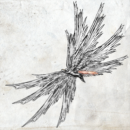
Vaenwode seizes the rope.
He laughs, helplessly, in the face of Hans and his storm-steed. He clings to the rope with hands already growing slick with ice.
He can’t help it. He frees one hand to salute.
Then the rope jerks sharply. It hisses. It is like a living thing; somewhere high above him, Gunfrid has bound it to the water-wheel, and it lashes and it draws him up.
. . .
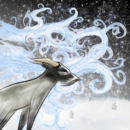
Hans slows his horse. He stares up into the distance. He sighs.
“Priorities,” he reminds himself, and he attempts —
Albeit in failure —
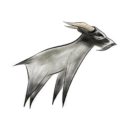
To recapture his ravening goat.
– 6 –
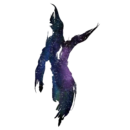
Space’s wicked god unlatches the last of its clever bindings. It seethes out. It boils upwards.
It seeks its natural home — in space.
It occupies the sky; it crawls beyond it; it dwells there, for a moment, in the sphere around the Earth, before becoming disturbed by the dreams, the hungers, and the impulses of the people that live below.
They look up to the stars and they imagine.
This disgusts the wicked god of space.
. . .
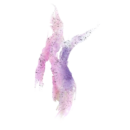
The wicked god eddies there, in space. It streaks itself with purple, black, and blue. It becomes a soap-film of awfulness between the world and nothingness; but the message, such as there is of it, is too subtle for humanity to grasp.
It flails out.
It flutters away from the world, away from everyone who is expecting things from space. It retreats like a wounded nightmare, clawing at the fabric of existence and dragging itself bloodily agone. It flees from people and their purposes. It is in loathing of the burden of their hopes.
. . .
It travels away from us, and yet it is bound to us.
At nearly relativistic velocities it squirms away from us; it travels seven hundred years as light would travel, which are great long and awful months to it. It runs but it cannot escape from us; we are entangled with it, we are embedded in it, we cling to it with our sticky fingers, with our sticky hopes and dreams and hungers; it is not simply space, not simply the god of space in general, but a creature of the space of Earth.
– 7 –
And as for Vaenwode, he has become rich and powerful and he basks in the love of his family and his wife. He has four children with Gunfrid and three survive.
He leads men in battle.
He becomes legendary for his wealth and strength and cunning, albeit with provisos hinting at a weakness in his wisdom.
He is happy, his life is good, except —
. . .
One morning Vaenwode wakes up, and he plays with the hair of his sleeping wife, and then a horror grows from a sudden cavernous emptiness and coldness inside him. It sweeps across him, makes him shudder and curl, as if he were a soap bubble trying to hold itself from popping, as if he were the caryatids, floor, and ceiling of some circled vault.
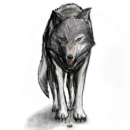
He loses his senses for a time, simply sweats there, and he comes to know the presence of the wolf.
. . .
The wolf is in him and within him. It is wound through him. It is with him, he who has stolen Hans’ gold.
Vaenwode staggers to the basin and he tries to throw it up. He chews savage herbs and makes his stomach heave but something suppresses it, he digests them, and when he looks up at the mirror he sees the wolf behind him in the glass.
He spins.
He is staring at shadows. He is gasping great awful breaths.
. . .
Raiders strike Vaenwode’s home; he goes into a blood-rage in the fight, he ravens out among them, he wakes and finds he has eaten part of one of them. He can’t get the taste out of his mouth, or its subtle sweetness. He can’t regurgitate at all.
He prays, wild-eyed with fear, into the night.
He sends his wife and children away from him. He lives alone. He is afraid that one day the wolf will come out of him; or take him over; and that will be their end.
He dreams it is a god-wolf, or a god-killing wolf, at least.
He dreams of it growing larger than the world; and hungry enough to gulp it like a snack.
. . .
So when a pair of svart-smiths come, man and woman they, dressed in their panoply of red and black and armed for war, Vaenwode is eager to see them; he comes out, he plans to press his treasure back upon them, to say, “Here! I have your gold, take it, here is the wealth that I have bought with it, only leave me my self, my wife, my children, and whatever is not portable in my home —”
Their faces are bleak as they regard him. Hope dies before it speaks itself from his lips.
“We have come,” says the elder of the smiths, “to bind the wolf.”
. . .
“Pardon,” says Vaenwode, “but surely you have come to claim back the stolen gold. See, I have had a change of heart; I am repentant —”
The smith holds up his hand. “I am Eldri,” he says, “and this is Brygmir. You are a fool; this need not be repeated. You have chosen, on your own account and of your own accord, to take responsibility for a burden that is Hans’; there shall be no repentance, no repayment, and no regret.”
Sponsors
Today's
STRANGE ENCOUNTER ...

Icon_Wolf_v2b_noBG
