. . .
“You know,” says Bertram, later, as he drinks tea with Amelia and watches the two of them play, “I bet they’d love little Edmund.”
“I don’t know,” says Amelia. “It’s got to be hard for an ordinary kid to understand.”
“That’s why!” says Bertram.
“Hm?”
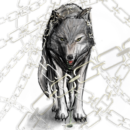
“Edmund’s got the wolf-gold wound through him,” says Bertram. “The little scamp! He’s going to let Fenris Wolf out one day and then they’ll eat the world.”
“Wow,” says Amelia. “Seriously?”
“Cross my heart,” Bertram Gulley says.
. . .
“That is crazy talk,” says Amelia. “You’re Gulleys. You’re not like me and Tom.”
“Rich people have world-ending scions just like —” Bertram narrows his eyes at Amelia. “Besides,” he says, “you can make gold.”
“That is practically the definition of new money,” Amelia points out.
. . .
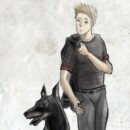
They watch as Tom and the antichrist duel one another with plastic lightsabers.
“Edmund needs some renegade in his life, anyway,” Bertram says, after a while. “Never met a more standoffish boy.”
“You should have seen Linus,” giggles Amelia. “He was all ‘sulk this’ and ‘antichrist that’ and ‘nobody can understand the endless emptiness that is my soul’ when I got him.”
“Hard to imagine,” says Bertram Gulley, and he shakes his head.
The black dog catches Tom’s lightsaber in its teeth, growls, and wrestles with the boy; and Linus flails at him with his own saber and he laughs.
– 6 –
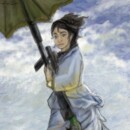
Bertram Gulley withdraws money from the bank. He walks out. He walks straight into the point of an umbrella.
“Um,” he says.
“I am the space princess assassin Maria Souvante,” the umbrella’s holder says. “And certain of your colleagues have judged you — unnecessary.”
“That’s probably on account of my vast debts to unsavory interests,” admits Bertram. “But I’ll pay them! Honestly! I don’t need to be assassinated!”
. . .
She pushes lightly on the umbrella. He backs into the bank. She follows.
“Fear not, Mr. Bertram Gulley,” says the space princess assassin. “I am not without mercy. I am sworn to always give my victims one . . . slim . . . chance at survival.”
He gets a step ahead of the umbrella. Two steps. This apparently conforms to her plan and not his own as a gun muzzle flicks out a step and a half from her umbrella’s tip.
“Let us play a game,” says Maria. “Mr. Bertram Gulley, and if you win — well . . .”
“Tag,” says Bertram, frantically. “I’m it!”
Maria leaps back and out of the way as he moves forward. He flees the bank without tagging her. She blinks.
“I didn’t mean to say just any game,” she protests.
She hesitates.
“God, Maria!” she says. She beats her head on the wall of the bank. “You are the worst space princess assassin ever!”
. . .
Bertram pants. He gasps for air. He flees to his car, tears squealing out of the lot, flees across the city to Amelia. He hears the building crumble behind him; and after that, he never again feels safe.
“Amelia!” he cries, bursting in on her. She is staring grimly at a blender full of alchemical substances. Then, almost three seconds later, she startles violently.
“Bertram!”
“I’m being hunted by a space princess assassin!” he says.
“I’ve adopted a girl!” she says. “I don’t know what to do with girls!”
He looks confused.
“You’re a girl,” he says.
“I know!” she says. “But I had a toad!”
“Wait,” he says. “Why have you adopted a girl?”
“She is supposed to destroy the world,” Amelia says. “Well, the portents are ambiguous.”
“There’s no room left for anybody else to destroy the world,” says Bertram, frustrated.
“That’s not her fault,” Amelia says.
“Point,” Bertram concedes.
“They were going to kill her. But I said, ‘no! No killing! Instead I will adopt her!’ Then they gave me that look that people make.”
Bertram eyes her.
“Yes! That one! The one that says, ‘you are quite the renegade, Amelia, but for some reason or other we will accept your unreasonable notions.’”
“About that,” says Bertram.
“Yes?”
“Well,” says Bertram. “I mean, um. It is, I have debts, you see. So, thus, I mean. I mean, the space princess. I mean, she was going to kill me, Amelia.”
“Death is very frightening,” Amelia agrees. “Do little girls like trucks or is that only boys?”
“Dead!” says Bertram. “Bang!”
“Well, buy her off with your money,” Amelia tells him.
“I’m not — I —”
“Or your archaeology!”
Bertram sags.
“I’m such a loser,” he says.
Amelia stares at him with stress-filled eyes. “What if she makes a baby? What if she makes a baby out of trucks?”
That is when the blender’s top explodes, showering the room with alchemy.
. . .
Things might have gone very differently for Bertram and Amelia from there.
If the blender had showered the room with chemistry, for instance, or magic, instead of alchemy, then they might have kissed. They might have found love. He might have honored her memory, when she was gone.
But it wasn’t chemistry. It wasn’t magic. They didn’t kiss. They didn’t become lovers. He just got half of a golden face.
. . .
“I don’t know why I even bother talking to you,” he says, metallically. He’s lost half of his ability to express love, right then and there. He’s turned all two-faced, golden-tongued, and metallic. He clicks his gold teeth together, and his white ones, and he walks away.
– 7 –
A few weeks earlier.
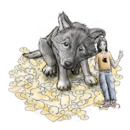
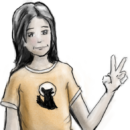
Martin goes off to school. He leaves Jane alone with a giant sun-eating wolf.
“I don’t know,” he says, in response to the obvious questions. “Feed it, or something?”
. . .
Jane, having been left alone with a giant sun-eating wolf, sulks.
She punches the wolf. Then she feels guilty and she pats the wolf. Then she pushes it into the closet and tries to ignore it.
“I wouldn’t feed you the sun even if I had it,” she says, missing Martin.
The wolf, whose name is Skoll, whines.
Eventually she catches bits of sunlight in water and brings it in to the wolf. Also candles. The wolf eats the candles, but only if she lights them. She gripes about this too.
“I’m not supposed to play with fire,” Jane says.
She lights the candles. She juggles them. She throws them into the wolf’s mouth. He snaps them out of the air, one, two, three!
Children should not do this. Not ever. Not even if they have a wolf.
. . .
Jane vacuums the floor in dismal dolor. She makes herself breakfasts. She eats more sugary cereal than Martin would ever let her eat but after a while it palls and melts into a mass of sugary color in the milk. She droops, and her face falls, and she gets milk and cereal all over it.
“You are not a substitute,” she says to Skoll, who eats two glowflies and an accidental moth.
Now and then Skoll sneaks out of the house. He sniffs the air. He is looking for Fenris, who used to be part of the same eolith. However his sense of smell is way too attuned to smelling sunlight and he cannot track his way to Edmund Gulley and his wolf.
That is why Skoll stays and raises Jane, or, possibly, the other way around.
“You have to study geometry with me,” declares Jane. This thing they do, but they do not do it well.
The sun-eating wolf perverts her notions.
Afterwards, if anything, Jane is even less confident of her Euclidian geometry than before.
“Honestly,” she says, “You’d think you were a hound of Tindalos.”
Skoll yips, shrugs in a wolfish fashion, and wanders off to lick himself in a fashion we will not otherwise discuss.
Agency spies watch this from afar. They use spyglasses. They become concerned.
“Isn’t that . . . ?” one agent asks another.
“It is!”
That is a wolf that is going to eat the sun!
Sponsors
Today's
STRANGE ENCOUNTER ...

Toad_Dotted_NoBG