

About the Author
Jenna Katerin Moran has naturally curly hair. She’s written some other books, including the RPG Nobilis. She has a compsci doctorate.
She thinks you’re cool.
About Hitherby Dragons
If you look out at the world, there’s a lot that you know. There’s a lot that you understand. But at the edge of your map, there’s emptiness.
There’s questions that are hard to answer.
There’s things that are hard to explain.
There’s choices that don’t make sense and there’s a sea of chaos and there’s emptiness.
So a while back, Jane went out to the edge of the world, where Santa Ynez touches on the chaos. She walked across the bridge to the abandoned tower of the gibbelins. Finding that its machinery was in recoverable order, she assembled a theater company of gods and humans to answer suffering.
Also they put on shows.
Hitherby Dragons represents a collated, transcribed, and occasionally somewhat edited or adapted collection of transmissions from the theater company at Gibbelins’ Tower. Enemies Endure: the Storm that Saw Itselfis the third novel-length work from this collection.
Stay tuned for book 3:
Enemies Endure: Vidar’s Boot
. . . starting its serialization on books.hitherby.com in June 2014!
Antarctic Procrastination
It should be understood that the prophecy is inevitable. It will happen because it must happen. It cannot be avoided save by some sort of wholesale damage to the timeline, some transtemporal process wiping the prophecy slate clean. Even that would raise issues, such as:
Where, then, did the prophecy come from?
Or what, then, does the prophecy mean?
So it is inevitable despite all the conscientious, willful awareness of the Known Existential Threats team that one day its esteemed Professor of Antarctic Procrastination will travel north (or is it south? It’s best not to check.) to the Antarctic and awaken the end of the world.
It is as certain as the snow. As definite as the real.
wakes up.
He runs the forecast. It’s actually pretty cold in Antarctica right now, and for the next few weeks. It’s not pleasant.
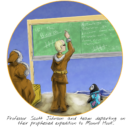
“Hm,” Professor Johnson says.
The expedition’s pretty much all packed. Everybody has their gear and stuff. You can only put that off for so long before it feels like you’re just faking it. Eventually they’ll have to go to the airport, Professor Johnson and students, and go hunt their forthcoming doom down.
It’s really cold there.
The expedition, decides Professor Scott Johnson, will not head out for the Antarctic today.
Disalienation
“I can’t fight scissors,” explains the werewolf. “But if I don’t fight scissors, what am I?”
It’s best not to answer questions like that.
Insteadjust says, “You’re sure?”
“I can’t be sure,” the werewolf says. “I am a werewolf because I never let go. Did they tell you that? That is how you become a werewolf. You start as human. But one day you get an idea in your head. A thing. A thing that you can’t let go of. And so you never let go. And then you are a monster. Then you are a bloody-toothed horror. You heal when you’re injured. You have these animalistic passions. You are connected to the moon. And if you try to meditate and destroy scissors with the pure power of your meditation, and if you are a werewolf, then that does not work.”
“Mm.”
“It means you’re not a person any longer,” says the girl. The werewolf. Rhea. “It means you’re no longer real. And I can’t have that. But if I let go of that, if I let go of things as a werewolf, then am I anything any longer at all?”
It’s another question that it’s best not to answer.
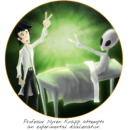
Professor Knapp adds three drops of humanity to the girl’s coffee and passes it over.
“Interestingly,” the Professor notes, “this isn’t extracted from humans. It’s extracted from extradimensional cosmic horrors.”
The girl looks at the coffee.
“The humanity drops,” the Professor clarifies. “Not the coffee.”
“I’ll drink it.”
She does.
After a while she bites her lip with her little fangs. She brushes at her unibrow. She looks at the pentagrams in her palms. She makes a face.
“I’m sorry,” says Professor Knapp.
“Hell of a way,” the girl says. “Hell of a way to find out you’re still human.”
“It happens,” says the Professor. “Some people are.”

Title Page
Enemies Endure: Book III
Vidar’s Boot
by
Jenna Katerin Moran
Copyright © 2010-2015 by Jenna K. Moran
All rights reserved.

Disclaimers
All characters in this story are fictitious or heavily fictionalized. Readers are advised against drawing conclusions about or regarding persons living or dead based on this material.
Portions of this material have appeared previously as part of theweb serial.
Dedications
Dedicated to:
Karl Friedrich Borgstrom
for teaching me the joy of sailing
And with special thanks to
Cync Brantley
Rand Brittain
Hsin Chen
Cheryl Couvillion
Anthony Damiani
John Eure
Jim Henley
Jim Hermann
Miranda Harrell
Elane Imgoven
Paul M. Johnson
R’ykandar Korra’ti
Angela Korra’ti
AJ Luxton
Kevin Maginn
Robin Michael Alexander Maginn
Killian James Sebastian Maginn
Gregory Rapawy
Gretchen Shanrock-Solberg
Alexis Siemon
Amy Sutedja
Chrysoula Tzavelas
and
Raymond Wood?

Prologue
Sid is in class. Sid is studying summoning. Sid’s teacher teaches him about HALF-THING.
“You can summon it,” enthuses the Lethal Magnet Professor of Summoning. He holds up his summoning magnet. “It’s half a thing!”
Max raises his hand. He’s a boy summoner.
“What about a whole thing?” Max asks.
. . . he doesn’t summon boys. For clarity. He’s a teenaged boy, who summons things. But not whole things! Right now, he is learning to summon half a thing.
“That’s ridiculous,” dismisses the Lethal Magnet Professor of Summoning. He waves a hand as if to brush the notion from the air, but since it’s the hand holding a magnet, it’s possible he only draws it closer. “Nobody’s ever gotten strong enough to summon a whole thing.”
He hesitates.
“Well, whole things,” he says. “I mean, um, people have summoned things. There are things that people summon wholes of. Or even two of, like HAND PUPPETS! But the thing is, you see, they’re not this thing. This is the thing you only summon half of. The other half is something else.”
Max ponders this.
“I’d rather learn a more useful magic,” he says.
“Bah,” says the Professor. “You can use a half-thing to do all kinds of things!”
Not, you know, in a —
“Not,” clarifies the Professor, given the titters from the back of the class, “in a juvenile sense. Rather, you can use a half-thing to clean wounds. Or to pull spiders off of someone’s hair. Or to help them to the infirmary!”
“Why wouldn’t SCRUBBING BUBBLE be better?” Max asks him.
“We’re learning,” says the Professor firmly, “about HALF-THING, today. . . . Sid. Sid. Sid!”
Sid startles and looks up. He was scraping away at the bottom side of his wrist with a dull blade. It’s not sharp enough to cut down to the artery, at least not the way he’s using it, but the tantalizing thought that he might makes the pain just a little bit more acute.
“Yes, Professor?”
“Sid, you’re not paying attention to this highly important information on the summoning techniques for HALF-THING.”
“I know!” enthuses Sid. “That’s why I’m punishing myself for not paying attention. But the punishment keeps distracting me.”
“Boy’s practically a half-thing himself,” mutters the Professor. Then, louder, “Go to the Principal, then.”
“Isn’t that double jeopardy?” asks Max.
“What’s half of double?” wonders one of the students, who isn’t quite keeping up. She’s runic track, and they don’t have fractions in their language. I mean, their magic language. Obviously she’s speaking English. Unless you’re reading one of the many masterful translations of this story into other languages that its unprecedented popularity has brought about. But even then!
“I can’t,” says Sid. He makes a face.
“Why not?”
“Well, he’s dead.”
“Pardon?” says the Lethal Magnet Professor.
“He’s dead, sir,” says Sid, assuming that was the desired clarification.
“What? Some kind of ghost? Zombie?”
“That’s deeply insensitive, sir,” says Sid. He rubs at his nose, accidentally cutting it. “Ow,” he adds.
“I don’t —”
“It was at the assembly,” Sid says. “Apparently someone whom the investigator dared not name ate most of him, frowned frustratedly, and said, ‘Wrong goat.’”
“That’s appalling,” says the Lethal Magnet Professor of Summoning. “I pray that justice is done. Do the police have any leads?”
Sid stares at him.
“Are you asking me, sir?”
The Professor shakes his head, embarrassedly. “Anyway. Go to your room, then.”
“It’s full of spiders,” protests Sid, but under the Professor’s glare he gets to his feet and he shuffles out.

– 1 –
There is a terrible flaw in the marvelous immortality elixir of Amelia Friedman. Drink of it and you can live forever — but five hundred years later, Heaven will send a terrible finger to destroy you. And even if you survive the finger, Heaven will send a wind and fire to destroy you five hundred years after that!
“That’s no good,” says Amelia Friedman.
She tosses the diagrams into the corner. She bundles the ingredients back into the secret compartment in her desk. She stares aimlessly at the publicity portrait of Drake Steverns, man of legend, that she keeps on the wall above her.
Then she straightens.
“Right, then!” she says.
She packs a bag.
She goes out to her car. She enchants it to drive on water. She leaves a note pinned to the refrigerator for her children, because she is a responsible parent. Then she tears out to sea to find a better path.
An even more marvelous alchemical elixir!
Immortality, without a flaw!
She explains this to a seal that is lolling about uselessly near a truck stop. There aren’t many truck stops out in the middle of the sea so possibly this is actually a tiny island.
“I can’t let a finger squish me,” explains Amelia Friedman. “I have children to think of!”
The seal barks at her.
She inflicts it with the curse of language. It grumbles at her. It can talk now, but it doesn’t have anything to say!
“That’s ridiculous, seal,” sighs Amelia.
She fuels up using an alchemical extraction of the nearby island. She stomps on the gas and races out over the sea. For a moment she thinks she sees cop car lights behind her but after a while realizes it’s just the distant red glow of a seal, discovering fire.
“That’s never going to cause trouble for anybody,” she explains.
In the northern wastes in her parka she revels with the polar bears. They attempt to eat her. This does not succeed!
“I’m not that easy,” she says.
She holds them off with her marvelous wrist-mounted anti-bear device.
“It’s not even my device!” she laughs. “It was made by my son Tom!”
She delves into dark and buried cities. She goes where an Amelia Friedman ought not go.
Eventually she settles in against the back of a large, tamed polar bear. She argues with it about immortality.
“I think five hundred years,” says the polar bear, “is quite enough.”
“That’s nonsense,” says Amelia.
It stretches its claws. It rakes the ice. It yawns. “If I could live for five hundred years,” says the polar bear, “I could grow large enough and strong enough to eat the continental shelf.”
“That isn’t necessary,” says Amelia.
“No?”
“I too have known the dream of eating all the layers of the earth’s crust and mantle,” says Amelia, “but it turns out to be less glamorous than you would expect. The rocks are differentiated but they are not actually good at being their various flavors, and it’s all really annoyingly hard upon the teeth.”
“Oh,” says the polar bear. It glares out at the arctic. “You have shattered my dreams, Amelia.”
“That’s my bad judgment,” the alchemist agrees.
“If you’re not going to eat everything,” says the bear, “what do you plan to live for so many years for?”
“I don’t really need to,” Amelia says. She shivers. She pulls her parka in closer.
“Then —”
“I just wanted to make something perfect,” the alchemist explains.
But she doesn’t.
That’s not what happens.
Instead she goes to America. She adds reverted cinnabar and a living mandrake root to an unattended Slurpee machine. She creates a swirly Heaven-defying sludge.
“I am the Eternal Earthly Glory!” cries the sludge. “The Blue-Green Slurpee Sage! I shall topple Heaven and the legally appointed authorities of the United States of America! And all shall love me and despair!”
“Oh, dear,” says Amelia Friedman.
That isn’t perfection.
That isn’t perfection at all!
– 2 –
Let’s go back a little further.
Jeremiah Sandiford is homesteading. It’s after the scissors-fall. He is sweeping the scissors away. He is cleaning a neighborhood in Respite, Kansas, in the hopes of legally claiming it after the scissors are gone.
He isn’t planning to become the god of a new millennium.
He isn’t planning to do anything strange.
He’s trying not to let all this shake him. He’s trying not to be afraid of the dead scissors — I mean, I guess all scissors are dead scissors, in a sense, but still — in their piles and drifts.
He’s trying not to freak out entirely, like most of humanity is trying not to freak out entirely.
He’d lived in a world of reason; calm; and of sanity, but that reason is starting to fray.
It’s not just the scissors, either. It’s not just sextillions of scissors suddenly falling from space. He cleans and he stares at them and every now and then he fills a barrel with the swept-up metal — it’ll be melted down. But it’s not just the scissors. There’s the Konami Thunder Dance, too. That’s not normal. Nor all the summoning. And there’s rumors of great snakes in the sea and of vast wolves.
It’s everything.
He feels like he’s floating. He feels like he’s drifting.
He doesn’t want this to happen.
He doesn’t think things this . . . uncleanly . . . ought to happen.
He doesn’t think that the world ought to be this way.
It’s the day Hans dies. There’s a vacancy.
And sunlight pierces through Jeremiah Sandiford like a spear.
It is shining in on him from all directions. It reflects in on him from the scissors and from the sky.
It pours in on him suddenly, all golden and all fierce.
Gold light congeals within him as a thought — not a thought of words, but a thought of intention. It wakes in him a lion of purpose, a lion of sacredness, a shining, burning magic that roars through him and is not touched anywhere by the shadow of despair.
It illuminates him.
It fills him with a thunder like the falling of a hammer; like the shattering of the gates of Hell.
He is shining, then, in that moment.
Sacredness pushes out the weakness of him. It falls from him like a shadow from his lip. Divinity tramps out the impurity of him like it is some vintner pressing grapes. He is thrilling to it, it is resounding through him, it is tuning him to its self.
He weeps whole, pure tears.
He sinks down onto his knees. He takes up a handful of broken scissors in his hands. He holds them before his heart, like they in their awfulness are sacred, and then he lifts them to his lips and he kisses them full-on, he is gentle but he is firm, and his lips are bleeding from it.
He says to them: “Bless you, who are my enemy, for you have given me my grace.”
Then he blows on them and they denature; they turn to dust; they fly away.
He is no longer Jeremiah Sandiford.
He rises, among the scattered scissors then, as Jeremiah Clean.
He rises and he stretches, he stands there like Atlas unleashed; unburdened, like a titan who has just now realized that there is no dome, there is no burden, there is only the great clean openness of the sky.
— and with that realization made it truth.
Jeremiah roars.
The world echoes with it; it shudders; everywhere there are those who hear that roar. Emily hears it. Eldri hears it. Linus Evans, a child in Sussex, hears it; he loses his innocence; he realizes in that moment that there is nothing good in all of life.
Then, like the settling hackles of a dog as it relaxes, the sacredness recedes from the cleaning man.
To be God — to make himself as God — that would be uncleanly. To make himself God, or King in America — that would in itself be a breach of reason. That would in and of itself represent a kind of scissors’ victory.
So he lives, does Jeremiah Clean, among us, as a man.
Just a man.
Just an ordinary man — save, his heart is pure.
– 3 –
The sun sinks down to the horizon. It touches against the mountains and the sea. It would totally set them on fire and make the world into a shining bonfire of sunlight except that the world is actually extremely far away.
It’d like to set them on fire, maybe.
Not to be mean. Not because it would hurt anybody. Just because it would shine so brilliantly, burn so gloriously, you would look at that light and it would lift you, it would inspire you, it would burn through your soul and set you free.
That gleaming light — that burning in the earth, the sky, and the sea —
You’d look at it and it would make you happy, your heart would be laughing, and then it would ignite you in a firestorm, instantly flash-fry you, and leave you dead in one great charcoal pouf. You’d be like a marshmallow somebody dropped into a campfire, so smoky! and so sweet!
The sun doesn’t actually do that, though.
It’s really, really far away.
The light of that sun — a few years, and eight minutes, later — catches on the laminated badge of a janitor. He’s mopping the floors in some City Hall, in some City, somewhere in Virginia.
He’s an ordinary man, just an ordinary man, but his heart is pure.
He looks up.
He squints.
Amelia Friedman has verged suddenly onto the scene. She is rushing past him. She’s running to get a hunting license so she can legally kill a swirly, Heaven-defying sludge. She’s not paying any attention to the janitor. She doesn’t know who he is. Not until he stops her mid-step with an awful glower.
It’s like a toad’s!
She stumbles. She staggers. That glower practically knocks her over — that and running, while in heels, on a (clearly-labeled) wet floor.
She skids. She spins. She lands.
“Oh, dear,” she says.
She turns her head.
Jeremiah Clean glowers at her.
“It’s just,” Amelia explains, instantly reverting to the defeated attitude of a zero to twenty-two year old girl being glowered at by a toad — this having been her origin story — “that I wanted to make a delicious Slurpee of eternal life.”
Jeremiah Clean blinks once. His glower relaxes. He shakes his head a little, once.
“Start earlier,” he says.
“Oh,” she says. “Sorry.”
She gets to her feet. She smiles at him. “Hi.”
“It would be cleaner,” he says, “to say ‘hello.’”
“Hello,” she says. “I’m Amelia Friedman. I’m a renegade alchemist. Now I’m on the run to the law! Or at least the licensing board. To get a hunting license. To kill a swirly Heaven-defying sludge!”
Jeremiah Clean looks down at the floor. He looks up at the ceiling. Finally, he goes back to his mopping. He mops until he can stare at his own clean reflection in the floor.
“Start in the middle,” he says.
“And then,” says Amelia Friedman, roughly subdividing her life by inaccurately estimated page count, “the doctor said, ‘parasitic snake DNA,’ and . . .”
“The Slurpee,” says Jeremiah Clean.
“Oh.”
Amelia gives him a repentant grin. “Well,” she says. “I put reverted cinnabar and a living mandrake root in an unattended Slurpee machine. I hope that’s OK.”
“Those — those are dangerous contaminants, Ms. Friedman,” says Jeremiah Clean.
“Well, there wasn’t a toad,” Amelia says. “So it’s OK. It’s OK to do things if there aren’t any toads glaring at you about them.”
“That was not good judgment.”
“That’s why I’m a renegade,” Amelia says. “My judgment’s never any good. But my genius! It defies all boundaries!”
She snaps her fingers. She points at him. “Name a boundary,” she says.
“Cleanliness,” he says. “Uncleanliness.”
“Spilled soap,” she says.
Jeremiah Clean shudders all over. He gives her a horrified look.
“See?” Amelia spins about. Then she stops because there’s just a bit too much glowering in his look. Then she continues despite deciding to stop because the floor is still quite wet. In fact she almost spins out. She recovers her balance using secrets of renegade alchemy. “Anyway,” she says. “It was quite terrifying. I did not get a delicious Slurpee of eternal life at all. I got a swirly Heaven-defying sludge. And that is everything. That is the complete story. There is no more.”
“I see.”
“I left the handle down,” Amelia confesses. He has pressed her too hard. He has broken her with his insidious interrogation! “I did not mean to. I didn’t mean not to. I had no intentions on the subject. It simply happened, like water slipping through a sieve. And down it dripped, drop by drop, bit by blue-green bit. I turned to look at it. I gaped in horror. I said, ‘No! Bad sludge!’
“But it only reared up, and took three squelchy steps, and cried, ‘I am the Eternal Earthly Glory, the Blue-Green Slurpee Sage! I shall topple Heaven and the legally appointed authorities of the United States of America! And all shall love me and despair!”
Tears trickle down Amelia’s cheeks. Jeremiah catches them with his mop before they hit the floor.
“That is an astonishing story, Ms. Friedman,” says Jeremiah Clean.
“I am astonishing,” Amelia agrees sadly. “Please stop glowering at me. You are not a toad but it brings back the most awful memories. I do intend to hunt it down and destroy it, though. Bang! Right in the . . . vitality! It may escape into the sewer the first time or two and cultivate a different color of life, but ultimately I will emerge triumphant and it shall be the Eternal Earthly Glory, the Blue-Green Slurpee Sage, that splurt down from the handle of life into the uttermost abyss of death.”
“No, Ms. Friedman,” says Jeremiah Clean. “I don’t think that will be necessary.”
“Really?” she says. She brightens.
“Your heart has led you to me,” he says.
“That,” she clarifies, “was my feet.”
“I will resolve the matter,” says Jeremiah Clean.
And so he does.
There is nothing that can stop him, not even the Eternal Earthly Glory, because his heart is pure.

Sponsors
Today's
STRANGE ENCOUNTER ...

Boot
