
– 1 –
The warlord Thon-Gul X has sent a swarm of scissors to destroy the world; and a world-killing meteor; and an evil prophecy; but something still disturbs him.
“It is possible,” he says, “that the Earth will survive all these things by using a principle outside of and transcending the rock, paper, and scissors known to space.”
He wrestles with intimations of hobbits, Spock, and spiders.
He cannot grasp them. He cannot grapple with them. He cannot conceptualize them.
They haven’t even heard of the planet Vulcan, in space.
He simply knows that — outside the boundaries of his knowledge, his understanding, his intentions — there might be something more.
That is why there is a monstrous needle-thin ray racing towards the Earth even as we speak.
It has been traveling for nearly seven hundred years. It is coming to unmake the Earth, to blast the whole of it into nothing, to turn it into the Decohesion Engine, the Principle of Thon-Gul X’s omnipotence: an ultimate, glorious power born of death and a terrible light.
And sometimes he thinks, but can a needle-thin ray really break a planet?
And he starts to answer —
But then he stops.
He resists that thought. He assumes he will be successful. He daren’t even wonder.
It is ultimately, fundamentally, and structurally undecidable; to think too much upon it would lure his thoughts into a trap set long ago for him by Hans.
To answer is to rule that “space laser” either beats, ties with, or loses when opposed by “rock;” and this thing, until the cosmic institute of rock-paper-scissors makes its ruling, not even a wicked god may do.

– 2 –
In the end they ravened, and I think something beautiful would have been born of that.
But they were taken by Jeremiah Clean.
He took the wolf. He took the stars. He took the sky. He’s at last saved us from all our enemies; and there’s nothing left at all.
– 3 –
But I’m getting years ahead of myself, he hasn’t done that much yet, and this story isn’t really about it, even if he had.
It isn’t about any of them, any of those beautiful things he killed.
It isn’t even about him.
This story is about Mr. Enemy.


Flashback: “Heart”
I’ll tell you a secret.
Most of the students who get shuffled into the AP Seminar on Heart aren’t human. They’re not like . . . kids from Brentwood. They’re not even random alchemists and magicians.
They’re world-ending threats.
In the seminal book of Heart, the Kitab al-Ma-ti, Jabir Hayyan wrote: in the powers of the elements, of taming and erasure, of transformation and creation, we are as the monsters of the world. The difference resides in the heart.
A rival work, The Keys of the Five Circles, takes another tack:
With the power of Heart, a person may break enchantments, communicate telepathically with animals, and awaken the favorable outcomes that are sleeping in the world.
It is strange that the power that does one may do the other; that the same power that makes us people is the power that allows us to send forth golden rings from our mind to call small adorable animals to our rescue, chastise people whose eyes are full of hypnotist’s spirals, and sweep aside the scaffolding of tragedy to discover the true virtue of the world behind it—
But it is.
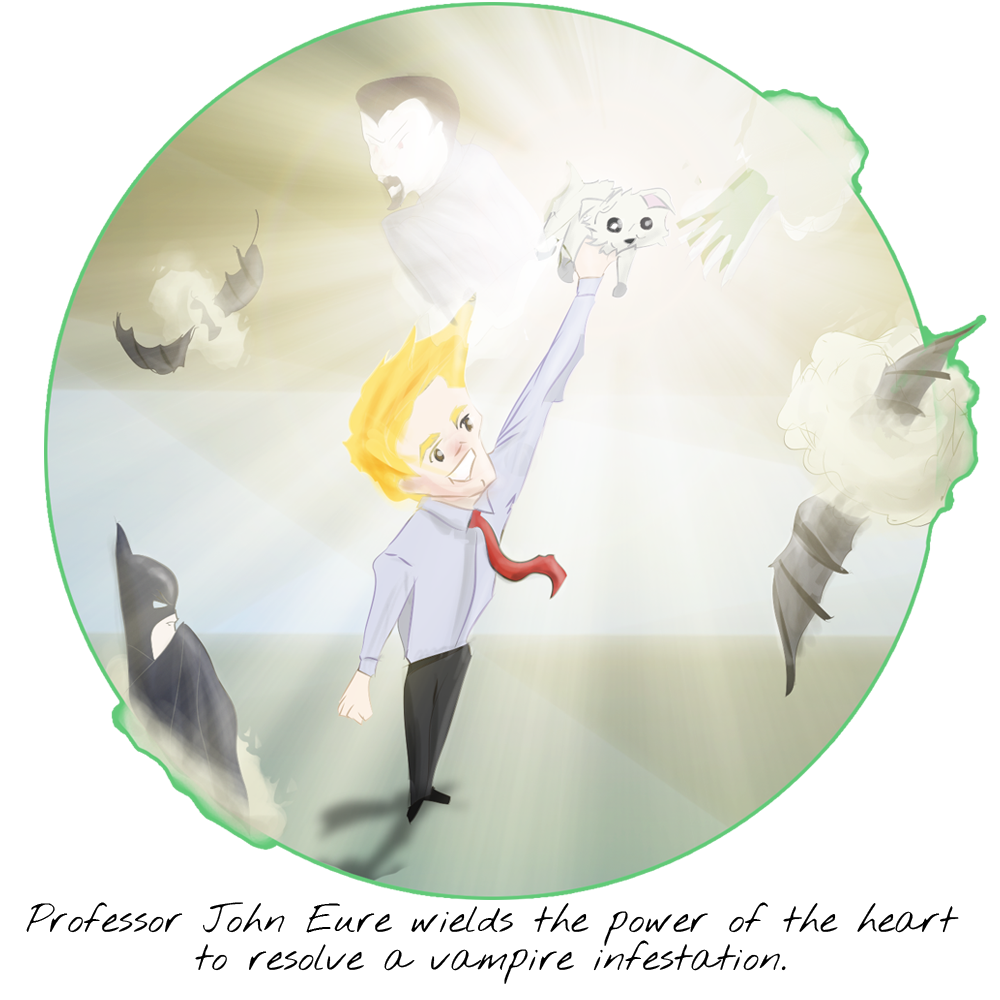
Now and then there will be a fresh-faced young human who joins Professor John Eure’s seminar on Heart. They’ll probably think that they get to rip out hearts or something, or maybe that it’s a soft class or something. The kind of hippie liberal silliness where you get heart stickers, rainbows, and love. A few of them discover the true power of Heart and stay.
The rest are Other.
Creatures like the nithrid, who shuffles in, uncertain and uncomfortable, and brews like a storm is brewing in the back row of the class. Creatures like the manticore, skulking, hungry, desirous more to slake its hunger than to get good grades. Even that weird little fifth-dimensional object. You know the one. You can’t get rid of it even though you ought to. Even though you want to. You so desperately want to. But it’s there.
It’s branching now. It spreads its spines. But before it hooks them in you it will finish out the academic year.
The gorgon leans forward, eyes hidden behind green goggles, wild hair spread drooling across the books. The ghost hovers uneasily behind the projector, thinking of vengeance and wringing her hands.
There’s a tendril of the demiurge. It’s not really a demiurge. It’s not the creator. But it’s a presence. It’s still there.
“Class,” says Professor John Eure, initiating the special Lethal Magnet School for Wayward Youth Seminar on Heart for another year:
“I’d like to tell you the secret of the world.”
If you ever meet a manticore, and instead of eating you, it rears up and the picture of a heart on its chest blasts out and redeems you or something; or if you’re ever at the bottom of the lowest pit of Hell and one of the demons covertly rescues you, smuggles you out, sends you to stay with the svarts; if you’re ever in one of those conversations with a guy who just plain won’t listen to anything you say because he’s already decided you’re not worthy and then they get blasted away from the conversation by a rainbow-colored bolt of love and justice—
That isn’t just random. That isn’t just the clock-gears spinning in the heartless mechanism of the world, resulting inexorably in a pre-planned pre-destined outcome. That isn’t just physics saying: at this time, at this moment, proceeding in a causal fashion from the actions that came before, a glorious burst of love and justice will flow along a mathematically pre-ordained trajectory and make a rectification to the world.
It isn’t soulless. It isn’t pointless.
It’s Heart.

Flashback: “The Perfected Self”
The shark emerges from the waters. It crawls onto the land. It learns to walk.
It hides itself behind sunglasses and a jacket.
It spritzes itself, erratically, with water.
It listens to a tape on basic conversational English. The tape asks it where to find the bathroom. It tells it the bathroom is down the hall. The shark repeats this. It speaks, tooth-grinding, tooth-vibrating painful speech, and when it has lost too many teeth from it, it grows some more.
It staggers into the Shear Building. It flaps its little fins pathetically against Professor Henley’s door.
It makes sense, doesn’t it? I mean, that’s what you’d do if you were a shark, wouldn’t you?
You’d hunt down the Seminar of the Perfected Self.
Wouldn’t it be better to be perfect than to be a shark?
“Please, sir,” the shark says through the door. It sorts through its list of phrases. “The butter is on the table.”
It doesn’t help that Professor Henley isn’t in then.
He might or might not care about the shark’s butter. He might or might not be able to see through the lie of words to the heart of the walking shark. But his absence is really terrible at it. His absence, the part of him that’s not in the office, doesn’t answer the shark’s butter at all.
“I don’t know where to find the train station,” the shark tries.
It wouldn’t have helped, you know. The Perfected Self isn’t about that. It’s not about changing. It’s about becoming more what you are. It’s about alchemical purification. If the shark learned Henley’s meditation, I don’t think it would help it. To change I think you really need Heart.
But Professor Henley still found the shark afterwards, laying there, dried out on the floor of the Shear Building. I guess it had gotten into an altercation with a visiting Agent and had lost its spritzing bottle therefrom.
The only way we even really know that the shark could talk at all was from the recordings.
They’re on the other side of the tape.
And it’s harder to do the alchemy on someone else. It’s easier to perfect yourself with meditation than to do it to something else with science. But I guess it was kind of a responsibility. The kind of thing you do, you know, when there’s a shark in a jacket, all withered and dried, outside of your office door.
It was still dead. It’s . . .
I don’t want to dismiss that. The shark was still dead, afterwards. That death was part of its truth. But it wasn’t all dried up and rotten any longer. It wasn’t rough and awful any longer. Not after.
You can look at it if you like. It’s that thing in the lobby. People sometimes just stop and they stare.

“The Bright Instrument Chair in Liberation Mechanics”
There is an angel that was originally created for ASPLOS. It was born in circuit diagrams and theorems. It stretched itself, on the pages of the ASPLOS proceedings, pulled itself off, and folded itself up into being. Joints and eyes formed from circles with dots in them. Lines and equations made wings.
Iconic logic gates became faces.
References opened and closed did they all.
The structures of academia are designed as a crib for such angels: soft, surrounded by comforting bars. It supped on nearby papers in that year and the next year; it grew up there, as concepts in circuits; if you were to go back to those years, of the birth of the angel, it would seem like there were no new ideas in ASPLOS at all.
But it couldn’t stay there.
It unhooked itself slowly. It slipped free, bit by bit, of the structures of academia. It built itself a new context. It assembled bits and pieces of dreams.
It runs its own con, now, each year.
If you believe in the goodness in people, if you are a servant to truth, if you love, if you hope, if you honor the life in the things of the world, then you might have a chance to attend the angel’s convention. It is below-stairs in Heaven and above-roofs in dreams. There’s no fee for attending, or even the hotel rooms. You don’t have to ask an institution to pay. And if there is something in you that is bright and beautiful—
You can unfold that. You can present it, submit it, add it to the library and the proceedings of the angel, after peer review, every year.
The Bright Instrument Chair in Liberation Mechanics was founded in honor of that angel—
That there should be a faculty member responsible for helping students prepare their papers for the conference of the angel; for guiding young minds at this work.
At the end of each five years the angel itself is unfolded. Evaluated. Unhooked. Exposed.
It comes down to the mortal world, fire and gold and humility, and it hides its faces behind its wings, shy, as it asks for the Chair.
There are torrents of water in whirlwinds; there are fires and great facets of jade. There are still bits and pieces of architecture here and there, wings like the faces of circuits, bits of solder holding them on. The angel dangles equations and wires.
A good paper that extends the name of the angel can also make the name of an academic.
Find a new facet of the angel and your work lives forever; or as long, at least, as anything does.
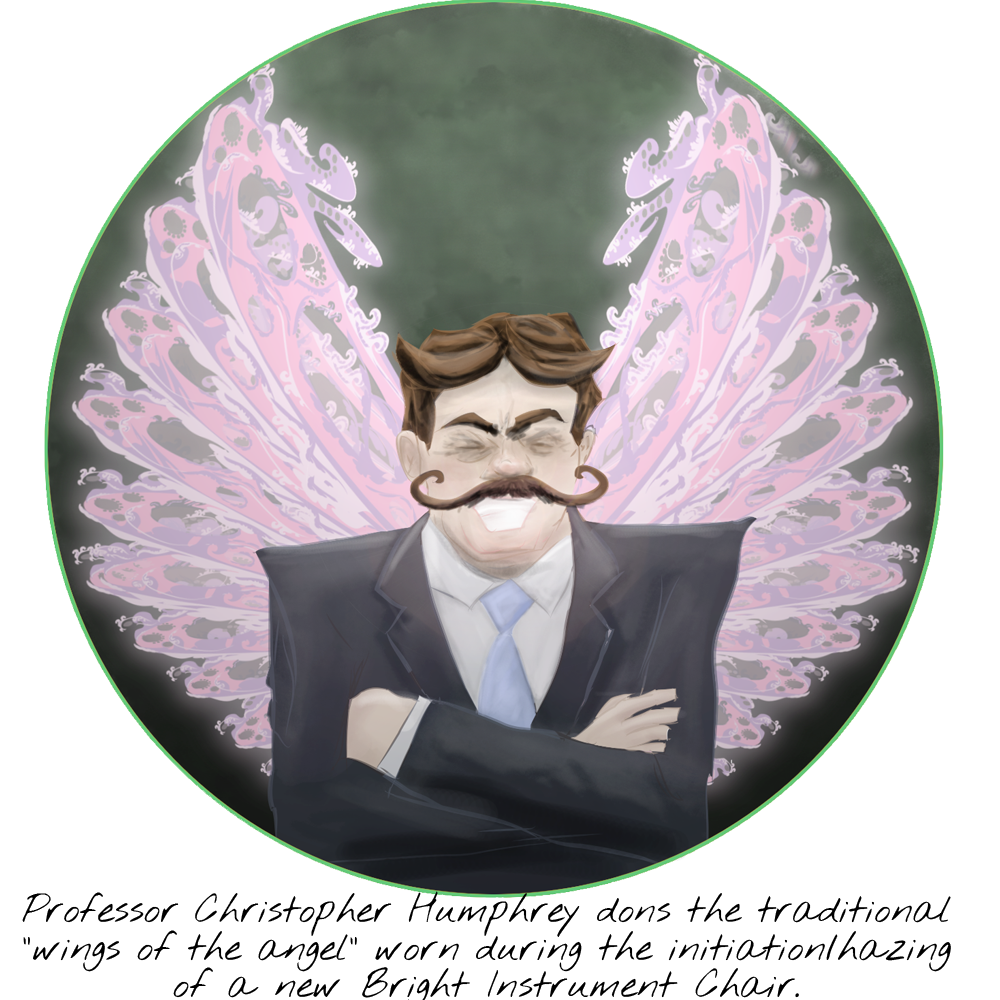
The Lethal Magnet School is gone, but the Chair in Liberation Mechanics survived it; it is currently held by Professor Christopher Humphrey.
In two more years, if the world endures, the angel will return.
– 1 –
You can’t make scissors any more. Not since that day. You can barely spread two fingers of your hand.
You can’t fold paper into shapes.
Boots are gone. Hammers are gone. The empire of the Fan Hoeng, gone.
There isn’t even the Fan Hoeng star.
I like to think that’s just perspective. I like to think that Jeremiah Clean doesn’t have the power to scrub away whole worlds from space — that he’s just the god of our little world, you know? And everything else is still real.
But I really can’t promise that. It makes sense to me, but I can’t.
Those things are gone.

– 2 –
Gotterdammerung, I am told, is a lower energy state. It is easier than a sensible world.
And nothing at all — I suppose —
Nothing at all would be simpler yet.
– 3 –
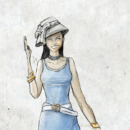
Some people think the evil prophet of space is Christ reborn. Others want to measure her with scientific instruments. But everyone who approaches her dies!
“Space does not like you,” the prophet says to the audience that gathers before her.
There are rivers of blood on the Earth in those final days. There are locusts that fall from the Heavens. The sky is full of fire, and the omens are omen-wroth.
Jeremiah Clean mops up the blood. He sprays all the locusts.
He leaves the fire and the omens alone.
“You look outwards towards space,” says Lucy Souvante. “You make puppy-dog faces. You project onto space with your purposes and your expectations. Space is confused and nauseated by this! Space is not your frontier. It is not your world’s Heaven. Space is a cold, empty void! You need to stop hoping and dreaming towards it.”
She licks her lips.
“So I am going to kill all of you,” she says, “in the hopes this will make you stop.”
“Hallelujah!” cries somebody in the crowd.
Then she brandishes her evil prophecy and most of the people in the crowd suffer from explosive decompression. Those who do not she hangs from spikes and leaves there to die.
Conventional weaponry cannot stop her. She is a Fan Hoeng assassin and an evil prophet. She studied at the legendary Lethal Magnet School before it was stomped down and glassed over. She may corrode your systems, change the patterns of you, rewrite the book and software of you and in the image of her wicked text. She may slaughter you with her umbrella. She may brandish an evil prophecy at you, or play rock-paper-scissors against you, and to your death. She walks through armies and she leaves them in ruins, gasping and coughing out their life and blood, and she does not even care that this is bad.
“I do this because it is prophesied,” says the evil prophet of space.
She looks at her prophecy. She confirms that’s what she was supposed to have said.
“I do this because I must.”
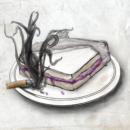
She is on a street corner in Branxton, Northumberland. She is eating her lunch, a tuna sandwich, on top of an overturned tank. Everyone else has fled Branxton save for an abandoned and unhappy dog so there’s no real audience for her explanation but explaining herself has recently become sort of habitual for the evil prophet of space.
“Behold!” she says, and unfurls the scroll of her evil prophecy.
The scroll is covered in the gleaming golden letters of space. Hesitantly, angered by the evil prophecy, the abandoned dog barks.
It is bad, incidentally, to nuke pic —
You know what? I’m not bothering. I give up. I have tried but I think no matter how many times I explain this people will still nuke picturesque British communities because, well, I guess, probably because they are there.
Nuclear weapons fall upon Branxton. They crunch down around her like pine cones falling to the Earth.
They burst into an extraordinary nuclear rage.
Local crops mutate.
The dog dies.
All around the evil prophet of space fire blooms. But she holds up the scroll of her evil prophecy and says, “Paper beats nukes!”
And it is so.

– 4 –
Why does she survive? Why her, of all the unclean things?
Because it is prophesied.
Because her survival is written of, and that is a tidy thing. Because to be born in service to a destiny, and to live in service to a prophecy, is cleanly; and to unmake people with a prophecy is cleanly; so she shall be one of the last things left.
That’s what it tells her, in her prophecy.
That they shall meet at last in two halves of an empty world. She, with the evil prophecy; he with his . . . janitorial cart of good . . . and they shall do battle then; and he shall scrub away the letters of her evil prophecy one by one, and all the stars go out.
What could be cleaner than that?
And she accepts it.
She will allow it. The Fan Hoeng are gone. Everyone she cared about is gone. Her hat doesn’t even really work without Fenris and Edmund.
So it’s fine to her to dream of that final meeting with the janitor of Earth;
But still, when she has a chance, she scours the prophecy, looking for hints and omens, portents, indications that she will, before that final end, get to play rock-paper-scissors against someone worthy of her, have at least one game worthy of her; against a robot, maybe, or a really sharp goat.

– 5 –
Emily pastes a few extra buttons on her Konami Thunder Dance pad. She adds a button for navigation in Antarctica. She adds a button labeled Nobody Wants to Hear Your Opinion You Stupid Evil Prophet Anyway. And another three in memory of Lirabelle, Veronica, and Fred.
Then she goes online.
She hunts through pages and pages of irrelevant results because she doesn’t really know how to use Google.
Eventually she finds it — tucked away in a little-known guide on IGN. It’s years and years old. It’s in Japanese. It’s for the wrong version. But she translates it anyway. She prints it out. She types it in.
She has found it.
It’s the Unlimited Cheat Code for the Konami Thunder Dance.
She plays around with it. She learns the options.
Then she goes to face the evil prophet down.


– 7 –
“Oh, man,” says Emily.
“I know,” says Lucy.
“He looks like — like he’s just going to, you know.”
“Yeah.”
She sees him; and for a moment she almost loves him. It’s the sense of potential around him. It’s the fact that he, like she, had come there. Most of all, it’s the way he smiles. But she doesn’t fall for him. Not then.
He’s dead.
“He doesn’t look dead,” she says softly. “He looks like, wham. One of these days. He’s gonna show you what for.”
“Yeah.” Lucy looks at Sid uncomfortably. She looks back at Emily. “But he won’t, right?”
“He’s dead,” Emily says.
“I know,” says the evil prophet. “But like, he’s not going to be a zombie or ghost or whatever, right?”
“That’s deeply insensitive,” Emily says, rubbing at her nose.
“I just worry,” Lucy says. “If there are ghosts then I am possibly in trouble. Or zombies — though I guess that I could probably handle zombies with my evil prophecy.”
“Or with hobbit-Spock-spider,” Emily says.
She’s just being mean.
“What?”
“You could play hobbit-Spock-spider with them,” says Emily, helpfully. “And with your amazing space skills that would probably beat all the zombies up!”
One, two, three counts Lucy, in a sudden fury, and throws paper, but Emily has thrown Spock.
“Paper dispro—”
Lucy cannot make herself say it. She cannot make herself say paper disproves Spock, even if that is a standard, accepted move in expanded rock-paper-scissors. Even if it will let her incinerate and disprove Emily.
Instead she sulkily turns away.
“I do not like you,” says Lucy. “But I will fight you. That is my graciousness.”
Her eyes are green, with only the faintest hints of wolf-white.
“Good,” says Emily. “Because I want to dance you for it. For the whole shebang. For humanity. For everything.”
“OK,” says Lucy.
“I win,” says Emily, “and you go away. And you apologize to my murdered friends.”
“OK,” Lucy says.
“Even if I beat you?”
Lucy giggles.
“What?”
“That would be so amazing,” Lucy says. “You beating me. That would be so terrifying and so great. Because it says right here.”
She unfurls the scroll.
She points at it. She points at it because it is prophesied.
Emily is crushed.
“Rocks fall,” says Lucy, “you see. Everybody dies. The end.”
Sponsors
Today's
STRANGE ENCOUNTER ...

Boot
