. . .
“I’m going to raise you,” she says. “Unless — you don’t want to? I have a son. He’s going to kill the world too. You’ll get along like cheese and crackers.”
Linus licks his lips.
“I don’t understand,” he says.
“I saw your poster.”
“I — but — I’m the antichrist,” he explains. “I wasn’t serious. I wasn’t seriously thinking that you would appear. Besides you don’t look like I imagined.”
Linus' imagination. o O
Let us pause here to sketch the woman Linus had imagined:
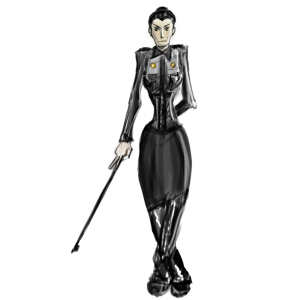
She is at least seven feet tall and has a face like a chip of stone. Her hair is tied back tightly into a bun. She frowns disapprovingly at everything she sees and corsets until not only can she not breathe but her lungs have had to be extracted, like a mummy’s lungs, through her nose. Such a woman would, naturally, listen to his Gothic poetry only out of purest social obligation, but would still thrill — on some deep level — to knowing that she was raising, and would eventually be slaughtered by, the antichrist.
Brunhilda, most likely, would have been her name.
“My name’s Amelia,” Amelia explains.
<< . . .
. . . >>
Sponsors
Today's
STRANGE ENCOUNTER ...

Toad_Dotted_NoBG