
– 8 –
It is coming. The snake is coming —
But they are ready.
The House of Dreams opens an artificial bay into Brentwood. They let in the sea.
The snake can feel her standing on a great kelp-strewn sea-wet wall.
She is standing there, proud and regal in her battlesuit.
It moves towards Cheryl. She stands there posed for a long moment. Then she clutches at the air like her hands are claws and then she rips her hands apart.
This activates the marvelous air-touch interface on her equally marvelous generic assembling and disassembling machine.
The serpent’s atoms are scattered. They are flung this way and that. They are dissolved into a mist that is spread across the world, and not the smallest portion remaining folded against itself.
It breathes and it is there again.
She stomps her foot. Ten million spikes of monofilament rear up from the waters, and three scattered spires of glass. They pierce the serpent. They raise it up like a conquered army, spiked through, torn up, impaled and held high.
It breathes and it is scattered across the world again.
It breathes and it is hanging in tatters from the spikes.
The spikes begin to bend under its weight. They begin to fold down. They are infected by the snake-wroth, the folding-wroth, the hatred-wroth that burns in it. Venom runs through the sea, pollutes it, begins to crawl as tentacles up onto the land.
“We’re getting it,” says Tom. “We’re getting it. But I want to push the button.”
“Shut up,” says Cheryl.
“You have to let me push the button,” he says. “You’re too attached to it!”
“Fine,” Cheryl says.
She sulks.
The snake breathes. It is scattered across the world.
It breathes. It reappears on the spikes.
She has timed it correctly. The snake reappears just as Bethany and the nithrid tumble by. Lightning flares through all the spikes; Bethany lands on one glass platform, slips, rises, tumbles to another, jumps, bats aside a bit of paper as she goes, and then the two are off again.
The serpent floats down, flash-fried to ashes, towards the sea.
Tom pushes the Anything-Ending Button —
And all is light.
“There,” he says smugly. “That’s science.”
She watches the waters.
“What are you — no,” he says. He denies it. “Don’t be ridiculous.”
She watches the waters.
She waits.
She can see it. She can feel it. There is something happening to the ocean. There is something happening to the air. It is subtle. It is weak. It is hurt past the point of any sensible thing’s endurance. The chaos in the air patterns and the movements of the water are corroding what little remains of it further.
But the snake-wroth is not gone.
“Please,” he says. “Come on. It’s dead. You’re wrong. It’s gone, girl.”
“No,” Cheryl says. She shakes her head.
He turns. He stares out.
“We killed it,” he says. “We have to have killed it. I used the button.”
“It’s not a thing,” she says. “It’s not an anything. It’s an ideal. And it hates me.”
The waters are still, then they are stirring. A few waves rise and fall; then they go still.
He touches her shoulder.
“It is the destiny of the House of Dreams to be hated,” he says softly. “Feared. Maligned. Scorned and spurned for our generosity. But it is all right.”
“It’s not all right.”
“It’s all right,” he says. “It doesn’t mean there’s any problem with you.”
He gives her his amazing tear-drying hand kerchief, but she just fills it with the snot that she had in her nose.

– 9 –
Joffun looks up. Cheryl is staring at him through the bars of his prison.
She says, “I nuked it. I burned it. I impaled it. I electrocuted it. I broke it. And still, no matter what I do, no matter how hard I try, it keeps folding itself back into being. It is a snake-wroth in the air and sea, now. It is a thing of fire and water, now. I dream of it, it is coming for me, it will devour me and crack the earth and live forever in the pain that you svart-elves put it in, and we who long to live shall die and it that wants to die shall live forever. Why?”
Joffun says quietly, “I don’t have to talk to you, you know. There’s gonna be a general amnesty soon. On account of Gotterdammerung is coming, and all.”
“I heard,” Cheryl says.
“Gonna get drafted,” says Joffun, “and then they’ll bring me that boy’s heart, so I can make weapons for ’em. And then, while nobody’s looking, it’s off down beneath the surfaces of things for me, and back to my wife and child.”
Cheryl blinks at him. Then she shakes it off.
“That’s fine,” she says. “You don’t have to talk to me. Talk to me anyway.”
“Oh?”
She shrugs. “Can’t live with a cracked world, you know. I guess I’ve ruined it for you. That snake’ll fold its way down where the svart-elves live and I don’t think that you can stop it where I haven’t. If nothing else, cause it came to me, so long ago, knowing that I was the one to end it.”
Joffun stares at the tic-tac-toe boards on the walls. He points at one, thoughtfully. Cheryl’s won that one. He points at another. He frowns.
“How are you doing that?” he asks.
Cheryl looks blankly at him. “Doing what?”
He laughs. He laughs rather a lot. It almost pulls him off his seat. Then he says, “Fine. Guess I must like you, even if you’re as tall as two houses and have hair like a sun-bird’s spit. Show me a bit of this snake.”
She shrugs. She folds a paper crane into a miniature giant paper serpent and tosses it to him. It hisses. It snaps at him. He catches it, holds its jaw open, and peers down its throat. After a while, he shoves its tail in its mouth to distract it, flushes it down the toilet, and leans back on his bunk in thought.
That snake never causes trouble for anybody! Flushing living wicked miniature paper snakes down the toilet must be all right.
But don’t do it to a real snake!
“It’s not a snake,” he says. “It’s an idea, right?”
“Right.”
“So you can’t stop it by folding,” he says, “or even by cutting. You could try a really sharp goat, but —”
“But?”
“Well, I wouldn’t count on it, is all. People who get involved with really sharp goats, they tend to end up cutting themselves.”
“I don’t want to do that,” concedes Cheryl. “I like myself in one piece!”
“Then,” says Joffun, sitting up again, “I think you’re gonna have to die.”
She pales.
“Look,” he says. “It’s an Ouroboros, right? Around and around and around it goes? And in its ending its beginning’s wove? Kill it and consign it to the sea and the splash another serpent weaves? That kind of thing?”
“Maybe,” she says.
“Some stuff,” he says, “you can’t put down, because you’re part of the problem. The harder you push, the rougher it goes. You’re its death but you’re its life, too, so if you’re there — I mean, I’m not saying that you cut your wrists and it’s all over, just, if you don’t die, I don’t think it’s gonna die either. It wouldn’t be proper smithing, if it’d done.”
“Oh,” she says.
She looks at her wrists. She looks at Joffun. “That’s not nice,” she says.
“Hey,” he says. “Least you get the chance to take a giant snake down with you. I’m probably going to die of cirrhosis.”
She squints at him. “Least,” she says, with black humor, “you’ll get to take the booze down with you, I expect.”
He stands up.
He holds his hand out through the bars.
“A strange game,” she says, and chokes back her fear, and she shakes his hand.
He nods.
“That’s life,” he says, and she lets him go.


– 1 –
The station rises fast, but not fast enough.
Cheryl wakes from troubled dreams and she knows it; she looks down at the Earth and she knows it; she can feel it.
The air and the sea, knitting together are they all. They are weaving themselves into one thing, folding themselves, sewing themselves; they are becoming a fabric, and from that fabric quilting themselves Ouroboros: a snake-wroth is rising in the winds and the waters of the world, and its eyes look up the bootstrap at Cheryl of the House of Dreams.
“God,” she whispers.
She rides down the bootstrap. The clouds are in turmoil; the sky stirs like great blue waters; the wind strikes at the lift as she descends, rattles it, shakes it, tries to throw her off into the sky.
When she lands there is salt everywhere in the air.
“I’m not ready,” she says. She makes her way through the school to her ground laboratory. She collects what she can. “I’m not ready,” she says again.
Tom is waiting for her on her flight platform.
“I didn’t invite you,” she says.
“I’m poorly socialized,” Tom says, cheerfully.
“I mean, get off.”
“No time,” says Tom. “I can’t hear you! That’s the time pressure. It’s clogging my ears!”
She glares at him.
Then, more softly: “I’ve made a hat,” he says.
“Pardon?”
“For if it’s beating you,” he says. “For if it starts winning. I’ve made a hat to cut you free of it.”
“That’s filthy and wrong,” she says.
He shrugs.
“Get off,” she whimpers, but he doesn’t leave.
Smoothly her flight platform lifts into the sky. It arrows towards the center of the phenomenon. She dares not wait for the serpent to completely reform; leaving aside the edge it would give the beast in their confrontation, it would probably kill everybody left on the planet.
They are in the coastal waters off Virginia when the sky and sea become serpents for them; when they are surrounded by clusters of them, striking in at them from every direction, snapping and seething in the foam.
She uses the Penguin Gun.
There are no serpents but rather great waves of penguins now, all in the air around her, snapping and seething and coiling in at her all a’wroth with their flightless, avian rage. Then they fall, with the awful teeterings of penguins trying to suspend themselves a hundred meters above the Virginian coast by sheer spite (and failing).
The sea swirls. It tears them apart. It reintegrates them. Serpents rise again from the sea below.
She is calm. She lets the passion bleed from her.
She says to Tom, “You will turn my last assignments in for me, of course.”
His jaw stiffens.
“No,” he says. “Don’t die.”
“I want a perfect record,” she says. “I am already teetering on the brink of a B+ or two what with spending all my time on a space station. An incomplete is not acceptable.”
She holds up a rod. The rod turns into a serpent. She throws it out there. The serpent wrestles with the serpents of the air and sea.
Tom bats away a pair of scissors as they fall.
“I also expect at least one major galactic world named after me,” Cheryl says.
Her origami is incomplete. Her snake cannot hold out. It reconfigures itself into a sprawling mass of dozens of tentacles and unnameable organs; it wrestles in every direction, but the venom of the snakes pulses through it and more than a few of the snake-heads are sneaking past it to die against the laser grid defense system of Cheryl’s flying machine.
“You’re too young,” he says. “I promise nothing. Don’t die.”
“Damn it, Tom, I’m your rival. I’m your biggest competition. One day I’ll probably fold you into a swan and take over the headship of our House!”
“You’re my friend,” he says. “I promise nothing. Don’t die.”
“You did promise,” she reminds him.
I will bend life and death and dreams for you, if I must, to make you a girl who can kill a giant snake made out of paper and wax —
“This isn’t paper,” he protests.
“The matter is inessential.”
“It’s not!”
But her words are right. He knows her words are right.
Finally he hangs his head.
“If I could die in your place,” he says. “If I could — but it wouldn’t help, would it?”
And he stares at the snake-severing hat he has in his hands; and maybe something would have happened then. Like, maybe he would have stuck it on her anyway. Or maybe he would have accepted it, and held that snake-severing hat out over the water and let it go; and it would have drifted downwards; and the snake would have worn it, which is just ridiculous. The only thing goofier than a snake in a hat is a giant evil snake made out of salt, air, wax, water, paper, and fire that’s in a snake-severing hat originally made to free its enemy.
That hat even has a little feather in it. That’s so ridiculous, you hat-wroth snake!
But he doesn’t.
He looks up and out at the waters and horror freezes him; stills his tongue, catches his mind, drowns his thoughts in thickened fog, instead.
He drops whatever he’s holding. His eyes are wide. His breath comes in quick gasps.
And maybe she was going to do something amazing then, some bit of smithwork and origami, to tangle up her life in the life of the snake and then fold them both through to death —
But she doesn’t.
She isn’t as bad off as he is. She is in shock but not all the way in shock. She is pounding on the keys of her weapons console. She is unleashing the viruses; the memetic lasers; the ultimate post-nuclear barrage —
But it is too late.
“No,” she says.
The sea is like glass. The air is still. The serpent slowly falls apart to nothingness around the central figure that stands within it.
“No, no, no,” Cheryl screams, and pounds on the separate desperate flailing keyboard that all devices of the House of Dreams possess.
He scrubs the last few bits of snake-wroth from his clothing; from the air and sea, and it is gone; and he smiles at them, does the cleaning man: does Jeremiah Clean.
She has a gun in her hand. She cannot decide whether she is pointing it at him or at herself. It is pointing at her ear. It is pointing at him. Repeat, half-repeat, and stop.
He rolls his janitorial cart over.
He looks in on them.
She kicks the causality stutterer. It is a minute ago. It is two minutes ago. She turns to run. She is screaming to the paper serpent, the fire serpent, the ocean serpent, that it must run. Then he smoothes out the timeline with Windex, and her escape is made as naught.
He has her chin in his hand. He is looking at her. Then he is staring off to the distant east.
“You’re trying to keep things tame,” he says. “Aren’t you? Keep them settled down. You, and that school, and that boot. And the wolf.”
“Yes, sir,” she says. “I mean, no, sir.”
That is not actually what the wolf is attempting to do.
Tom is whimpering under his breath. He keeps swallowing. He’s doing it poorly. It’s so hard to breathe.
He’s told himself over and over again how cool he’d be if he ever again met the cleaning man; he’s prepared weapons, dozens of them, weapons, plans —
He has backed into the farthest corner of the platform and is writhing his arms futilely against the metal behind him, instead.
“Well, carry on, then,” says Jeremiah. “Let me know if you need any help over there on the continent. I’m always here.”
He tips his cap.
He turns.
He goes away.
Tom gasps, a great gasp, and then he is screaming. He cannot stop screaming. He is howling, he is keening, he is screaming, he is bent over, fallen, there is bloody spittle coming from his mouth, and he has clawed at the deck until his hands and his fingernails are all over red.
It doesn’t do any good.
The thing he’s feeling is too big to express with his body. It’s like trying to give birth to worlds.
– 1 –
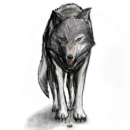
Fenris whines. Fenris struggles. The world resists.
Against the fabric of things it strains.
There is no Sid to buffer it. The world is fraying.
The world calls to the Keepers’ House but they cannot come. They cannot stand in a creepy circle around Fenris. They cannot distract the wolf with their eyes from its freedom.
There are too few of them left. They . . . would not survive.
Tom is disturbed by a sudden intuition. Sid almost bites the missing fingernails of his hands. Emily tries to pay attention in class even though the world is calling.
Edmund’s head turns with a sudden snap.
The cord frays. The cord rips.
It is Gotterdammerung.
Fenris Wolf stretches, and the wolf comes free.
– 1 –
The wolf is coming to eat the world.
There are armies marshalling. Edmund can feel them. There are missiles coming, bombs being loaded, hard men prepping their weaponry for a fight.
Edmund can feel it.
The wolf is coming to eat the world.
There are children being born. There are children playing. There are children who have grown old and grey.
The wolf is coming to eat the world.
Starlight falls on the world, from Sirius, from Barnard’s Star, from Wolf 359, and most certainly from the sun. Plants grow. The ocean surges, rises, falls. Birds sing. Animals rustle in the brush.
The wolf is coming to eat the world.
– 2 –
Mr. Gulley wakes from a nightmare. He staggers downstairs. He gets himself a cup of coffee. He toasts a delicious strawberry Pop-Tart, ignoring his distant dismal knowledge that the rain of scissors killed off strawberries along with a good portion of the biodiversity of the Earth.
What is actually in his Pop-Tart? He does not know.
He puts it on a plate.
He takes a sip of coffee. He turns around.
There is a wolf.
“Oh,” he says. “I had thought that was the nightmare.”
The wolf stares down at him.
He looks at it. He thought that he’d be frightened, but he isn’t. He’s smiling instead. He says it. “I’m smiling,” he says. “Why am I smiling, love?”
The wolf hasn’t said anything.
“I’m going to kill you,” he says, “you know.”
The wolf licks its lips. There is drool on the carpet. Mr. Gulley remembers promising Helissent that there wouldn’t be wolf drool on the carpet, but that was a long time ago.
Starlight falls on the world, from Sirius, from Barnard’s Star, from Wolf 359, and most certainly from the sun. Plants grow. The ocean surges, rises, falls.
The Agency is marshalling, he assumes.
They wouldn’t have missed the freedom of the wolf. Surely they wouldn’t have. Most likely the armies of the world are readying as well.
There are children being born. There are children playing. There are children who have grown old and grey.
He touches it. He leans against its fur. He loses himself in the softness of it.
He tries to remember what his cool, awesome parting line was going to be.
“I’m sor—” he starts.
With one great snap it eats him, and Mr. Gulley’s done.
– 3 –
The world is full of awful pain.
Fenris had considered it rather bad during the course of its binding. Freedom, in comparison, is practically unbearable.
Its every movement is stiff. It feels as if its heart is pumping, not blood, but fire.
It staggers.
It lurches. It is crawling. It thinks it has eaten — it isn’t sure. Houses. Humans. A churchyard.
I am probably not good.
It is too much.
It is impossible. Its stomach is still unhappy from the boots it ate earlier. It knows the humans will kill it if it does not eat, if it does not grow strong, but it cannot keep walking. It is too hard.
It sees everything around it as burning.
Everything is as light glinting across metal. Everything it sees is burning. Its eyes cannot handle the full light of the surface sun.
Another wave of pain builds up in its ruined limbs. It totters.
It is bad, incidentally, to nuke picturesque British communities. I am pretty sure that I have mentioned this previously, but in case you had forgotten, I wanted to remind you. It is bad. Don’t do this!
The wolf staggers and the wolf falls down.
It can feel the bullets begin to rain down onto it. It can feel the poisons seeping into it. It can feel the net of razor-wire being pulled down onto its flesh.
It gasps for breath. Its world is a maze of pain. It pants.
The last thing —
No, it realizes, I am just dreaming.
It had thought for just a moment, as the bombs came down, that it could smell its Saul.

– 4 –
Some time later.
“Oh,” says the wolf, startling awake. Its ears swivel. “I woke up. I hadn’t expected that to happen.”
It sits up. It looks around.
Everything is devastated. Everything is an awful ruin. The sun gleams off melted window-glass. It is peaceful and still and no birds sing.
It looks around a little more.
A dusty sunbeam shows Saul. He is sleeping against the tail of the wolf. His belly is very round and he is glowing, just a bit, because he has been eating nuclear explosions.
“Oh,” says the wolf. “Oh.”
Its brain sends conflicting signals. It tries very hard to stay still. It must not lick the boy. It must not jump on the boy. It must not wag —
It cannot help it.
It wags its tail. Its tail wags itself. Circumstances wag Fenris’ tail all about. Saul bounces up and down and is flailed around.
“That is ridiculous,” says the wolf. “Saul, you look like a musician.”
Saul mumbles.
The wolf struggles around to where it can see Saul. This hurts. It winces. It goes to lick its leg.
Result: failure!
“If you gnaw those bandages off,” Saul mutters, creaking open his eyes, “I am going to put a cone on you.”
Fenris considers this. Then it sighs. It stretches out.
“You left,” Fenris says. “You left, Saul.”
“Did I?”
“You reincarnated.”
“I just changed my hat,” protests Saul, who is still pretty much asleep.
“Bah,” says Fenris sulkily. It does not have proper tear ducts. It gnaws on a nearby building. “You should have come back sooner. I got adopted by a mean family that tied me up in the basement and threw boots at me.”
“Haha,” laughs Saul.
“Haha?”
“That’s over now,” says Saul. “Now we can live happily ever after.”
The wolf is coming to eat the world. The Agency’s coming to kill the wolf.
“And never,” says Saul, “ever again, to die.”
Sponsors
Today's
STRANGE ENCOUNTER ...

Boot
